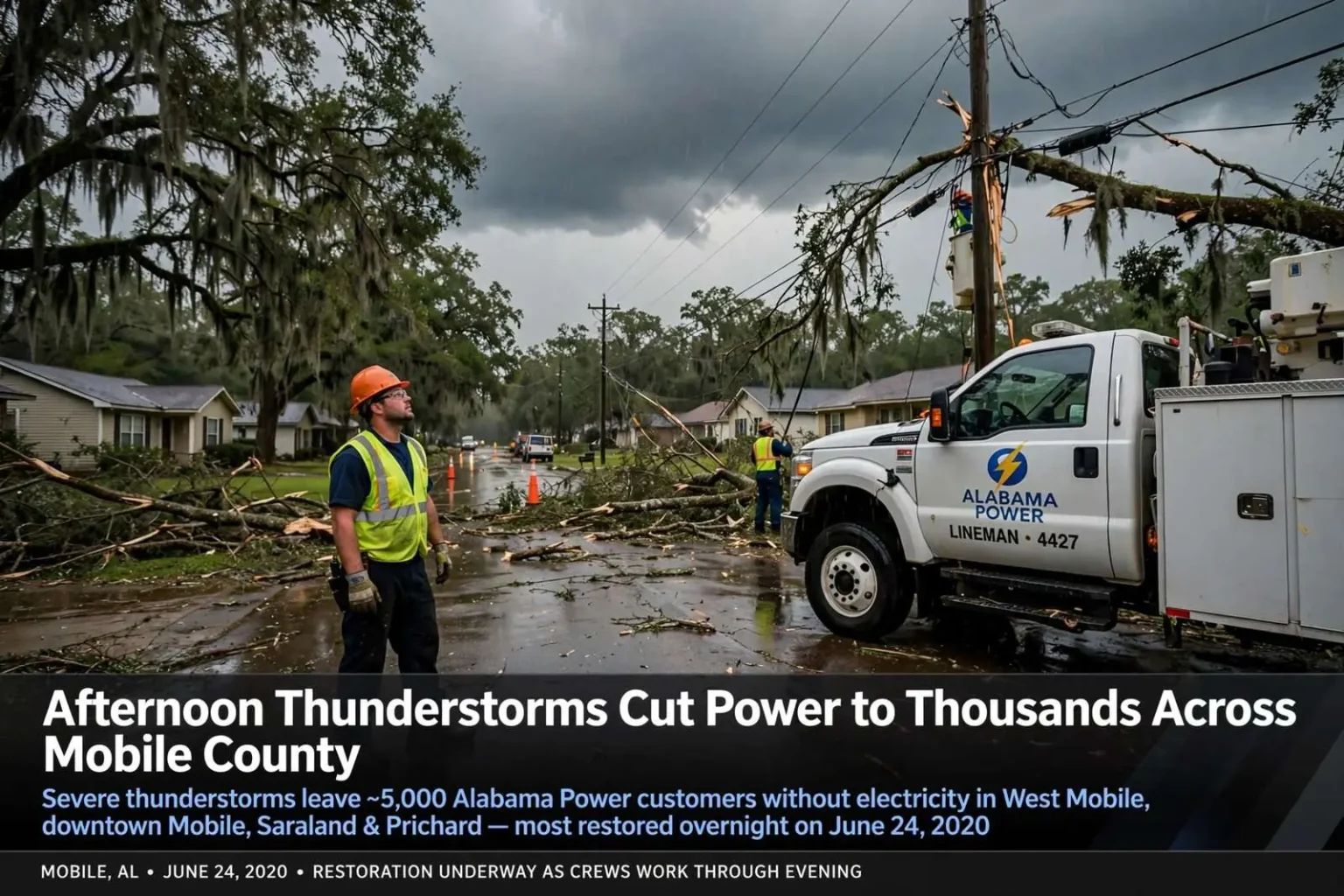
Severe thunderstorms that rolled through the Mobile area on the afternoon of June 24, 2020, left thousands of Alabama Power customers without electricity before crews brought most of the outages down overnight. The fast-moving cells crossed the county during the height of the afternoon heat, knocking out service to neighborhoods from the Mississippi line to the eastern shore of the bay.
At the height of the storms around 3 p.m., the utility reported roughly 5,000 customers in the dark, with outages clustered in West Mobile, downtown Mobile, Saraland and Prichard. The pattern was typical of summer storm damage along the Gulf Coast: scattered pockets of outages rather than a single widespread failure, each one tracing back to a downed limb, a damaged line, or a tripped feeder in a specific neighborhood.
Crews began restoration work as soon as conditions were safe. Alabama Power linemen and troublemen staged across the county, prioritizing repairs that would restore the largest number of customers first and then working outward to smaller individual outages. The outage count fell steadily through the evening — to about 2,800 by 4 p.m. and roughly 1,400 by 5 p.m., by which point Theodore had also been added to the list of affected communities as later cells crossed the southern part of the county.
By 7 p.m., Alabama Power reported just 780 customers still without service, and crews continued working through the remaining pockets overnight. The restoration curve — half the outage count gone within two hours of the peak, and more than 80 percent restored by the four-hour mark — reflected both the scattered nature of the damage and the utility’s standard practice of keeping crews on storm duty until the last customers are back online.
Why Summer Storms Hit the Grid This Way
Summer thunderstorms along the northern Gulf Coast are short-lived but intense, and they interact with the region’s utility grid in a characteristic way. Cells that build in the afternoon heat can produce 50-to-60-mile-per-hour downdrafts, frequent lightning, and bursts of heavy rain, all in a compact area that moves through in 20 to 40 minutes. Trees and limbs weakened by saturated ground or prior storms are the most common cause of outages when those gusts arrive.
Mobile County’s mix of dense residential tree canopy, overhead distribution lines in older neighborhoods, and sprawling suburban feeders means a single line of storms can produce dozens of separate outage points. West Mobile and the rural stretches south of the city, where lines run through heavy woods, tend to see the most persistent individual outages; dense urban areas like downtown Mobile often come back faster because a smaller number of customers share each feeder and damage is easier to reach.
The June 24 event produced no injuries and no major storm damage, according to reports at the time — a common outcome for these quick-hitting systems. The damage that matters is largely invisible from the street: a split limb resting on a primary line, a blown transformer fuse, a crossarm cracked by a falling branch. Each requires a crew visit, which is why restoration extends for hours after the rain stops.
How Alabama Power Restores Service
The sequence utilities follow after a storm is deliberate. Safety hazards — lines down across roads, sparking equipment, situations threatening the public — get the first response. From there, repairs generally move from the transmission and substation level to main distribution feeders, then to the secondary lines and individual service drops that connect single homes. Restoring a substation or a main feeder can bring hundreds of customers back at once, which is why the early hours of a restoration typically show the steepest declines.
During the June 24 storm, that approach showed in the numbers. The 5,000-customer peak at 3 p.m. included large blocks served by a handful of damaged feeders in West Mobile, Saraland and Prichard. As linemen cleared those primary circuits, the count dropped by more than 2,000 customers in the next hour, and the remaining outages through the evening were increasingly the smaller, more labor-intensive jobs scattered across the county.
The Communities Affected
The outage footprint traced the storm’s path across the county. West Mobile, the sprawling residential area west of I-65, saw clustered outages as cells moved through its heavily wooded neighborhoods. Downtown Mobile lost power in pockets of the central business district, where older grid infrastructure serves a mix of offices, government buildings and residences. Saraland and Prichard, the two largest cities in north Mobile County, reported outages as the storm line crossed the area in the mid-afternoon.
Theodore’s appearance on the outage list by 5 p.m. told its own story: a later wave of storm activity crossed the southern part of the county while crews were still working the northern outages. It is a common pattern in Mobile County storms, where cells often train along the same axis and a community can be hit twice in an afternoon even as the first wave’s damage is being repaired.
For residents, a summer outage of a few hours is an inconvenience more than a crisis — but it arrives with real complications. Food safety guidelines from health officials recommend keeping refrigerator and freezer doors closed, with a full freezer holding a safe temperature for roughly two days and a refrigerator for about four hours. Mobile’s June heat makes a powerless afternoon harder: without air conditioning, indoor temperatures climb quickly, and health agencies advise vulnerable residents — the elderly, infants, and people with chronic illness — to find shade or air-conditioned spaces during extended outages.
Traffic is the other immediate concern. Signal-controlled intersections across the affected communities lost power during the storm, and Alabama law treats a dark signal as a stop sign. Afternoon commuters in West Mobile and along the US-90 and Government Boulevard corridors hit the outages at close to peak volume, slowing travel through the affected areas even after the rain had passed.
A Season of Afternoon Storms
The June 24 event fit squarely into the Gulf Coast’s summer weather rhythm. From June through September, the combination of daytime heating, Gulf moisture and sea-breeze boundaries fires near-daily afternoon thunderstorms across south Alabama, and the National Weather Service’s Mobile office issues severe thunderstorm warnings for the strongest of them. Most produce damaging winds in the 40-to-60-mile-per-hour range rather than tornadoes, and most die out by early evening — exactly the arc this system followed.
Those storms are capable of downing limbs and interrupting service across wide swaths of the county in a matter of minutes. Meteorologists urge residents to treat every severe thunderstorm warning seriously: the same afternoon cell that barely rattles windows in one neighborhood can drop a tree across a feeder line in the next. Staying indoors during the storm’s passage, securing patio furniture before the wind arrives, and keeping phones charged when storms are forecast are the routine precautions that pay off on days like June 24.
Emergency managers in Mobile County also remind residents that summer storm season overlaps with hurricane season, and that days like this one double as low-stakes practice. The habits that matter in a June thunderstorm — knowing how to report an outage, having flashlights and water on hand, keeping gas tanks and device batteries topped up — are the same ones that carry a household through a tropical system in September.
What the Numbers Showed
The June 24, 2020 outage event, in summary: roughly 5,000 Alabama Power customers out at the 3 p.m. peak, concentrated in West Mobile, downtown Mobile, Saraland and Prichard; about 2,800 out at 4 p.m.; roughly 1,400 at 5 p.m. after Theodore joined the list; 780 by 7 p.m.; and the remainder restored overnight. No injuries and no major storm damage were reported.
For a fast-moving summer storm system, that is a routine day on the Gulf Coast grid — and a routine that repeats, in some form, a dozen times a season. The crews who responded kept the restoration inside a single evening, and the customers who lost power for an afternoon got it back before the next morning’s commute.
Reporting an Outage and Staying Informed
Alabama Power asks customers to report outages directly rather than assuming a neighbor already has, since reports help the utility’s system map the scope and location of damage. Customers can report by phone, through the utility’s website, or by text message, and once an outage is logged they can track its status on the company’s online outage map, which shows affected communities and restoration progress in real time during storm events.
Downed lines are the one hazard the public should never investigate. Any wire on the ground, in a tree, or hanging low across a street should be treated as energized, and residents are urged to stay away and call the utility or 911. Storm debris can conceal live lines, and pets and children should be kept clear of anything the storm brought down until crews have cleared the area.
By the following morning, the June 24 system was a memory: the last outage pockets cleared overnight, the dark signals back in service, and the county’s afternoon rhythm of heat, Gulf moisture and building clouds already lining up the next round of storms on the schedule.