AHSAA Officials Say Transfer Panic Is Overblown: ‘The Perception Is Not Reality’
AHSAA officials Kim Vickers and Heath Harmon say Alabama high school athletic transfers are steady, parents drive moves, and NIL remains on hold.
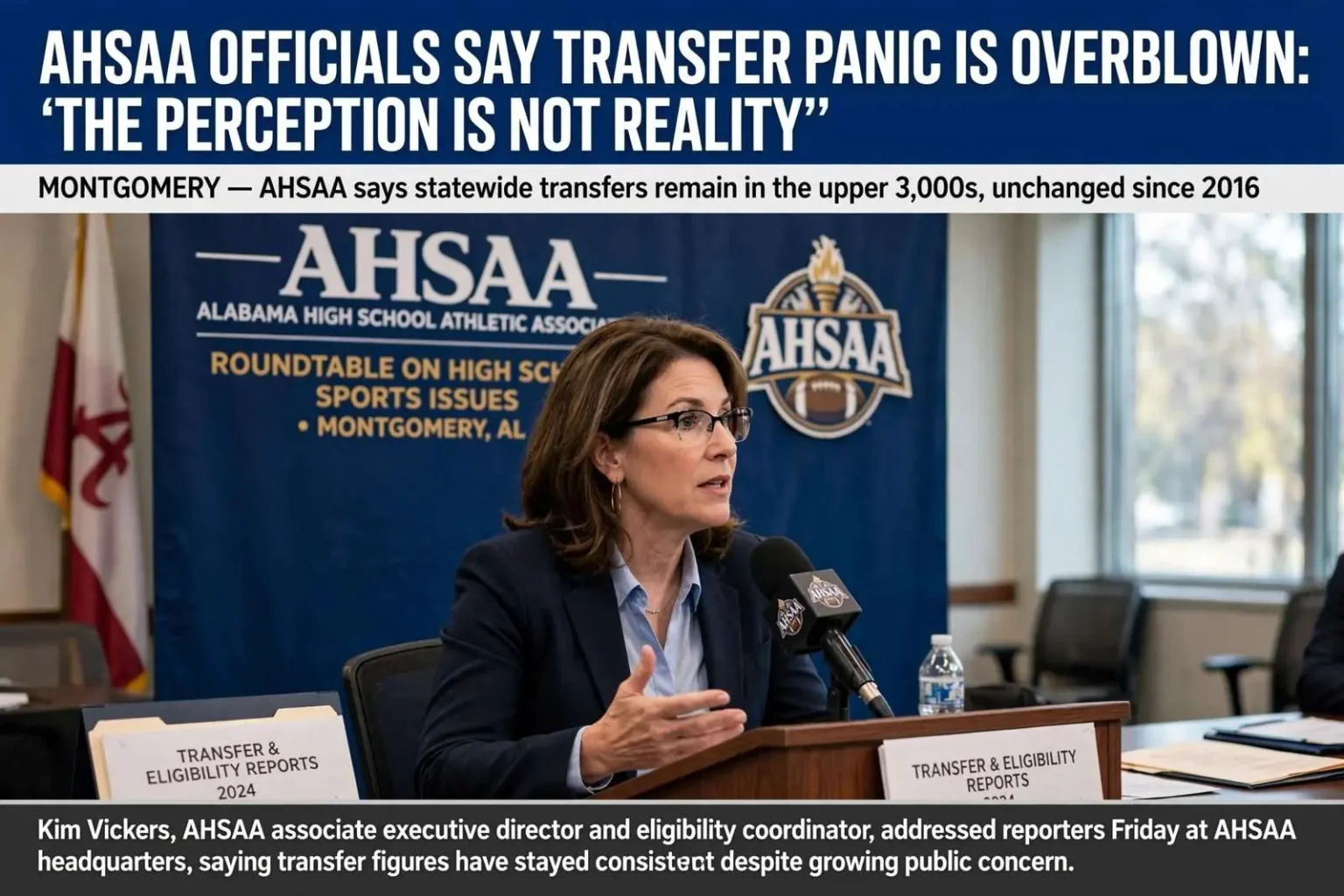
MONTGOMERY — Alarm over athlete movement between Alabama high schools is louder than ever, but the Alabama High School Athletic Association says the numbers tell a calmer story. “The perception is not reality,” said Kim Vickers, the AHSAA’s associate executive director and eligibility coordinator. “The perception is that schools are recruiting players, but the reality is that the parents are shopping them around.”
Speaking at a roundtable on high school sports issues at the AHSAA’s Montgomery headquarters, Vickers said athletic transfers statewide are expected to land in the upper 3,000s this school year — right in line with historical norms. The association counted 3,659 transfers in 2016 when it began compiling data from member schools, and the figure has stayed in roughly the same band since. “The transfer numbers have not changed dramatically since 2016,” Vickers said.
What has changed, she argued, is visibility: players now announce their moves on social media, imitating college athletes entering the transfer portal. The dramatic online announcements that have become a staple of college sports — graphics, videos, farewell posts — have filtered down to the high school level, where a single student-athlete’s move can generate thousands of views and a perception that athlete movement is exploding even when the underlying count is flat.
Parents, not poachers
Vickers said most transfer requests stem from family decisions rather than school recruitment — a player unhappy with his position, drawn to better facilities, or chasing a perceived scholarship path. In the association’s experience, the driver of a move is far more often a household’s own calculation than an outside school’s sales pitch. “If you’re good enough, you’ll get a college scholarship no matter where you are,” she said.
She also noted the association sees more transfers to public schools students aren’t zoned for than to private schools, and that families today move more easily than in decades past. That mobility — job changes, housing moves, custody arrangements — reshapes school enrollment every year, and athletics rides along with it. The long-standing assumption that private schools are draining public programs does not match the pattern in the association’s own data.
The distinction matters because the controversy around transfers in Alabama has often centered on private school success in championship competition. Public school coaches have periodically called for competitive balance measures, arguing that private schools can draw athletes from a wider area. Vickers’s message to those critics is that the movement being blamed on institutional poaching is, in the association’s records, driven overwhelmingly by family choice.
For the AHSAA, eligibility questions are a daily business. The association processes transfer paperwork from member schools across the state, applies its eligibility rules to each case, and rules on requests throughout the year. Every decision carries consequences for a teenager’s season, so the staff reviews each case against the same standards regardless of the school or sport involved.
Enforcement without subpoena power
Both Vickers and new executive director Heath Harmon acknowledged that improper enticement does occur and can be difficult to prove. The AHSAA relies on five retired investigators working as independent contractors and on referrals from member schools; it has no subpoena power to build legal cases. Investigations depend on what schools, coaches, parents and athletes are willing to share — a limitation that shapes what the association can act on even when suspicions are widespread.
Harmon, who has made rule enforcement his signature message since taking over, said the association will enforce its rules with the tools it has. The message from the leadership team is consistent: the rules exist, the investigative capacity exists, and member schools are expected to report violations rather than look the other way when a talented athlete arrives under questionable circumstances.
The enforcement challenge is structural. Unlike a state agency, the AHSAA is a voluntary association of schools, and its authority rests on the cooperation of its members. Without the power to compel records or testimony, investigators must work from tips, paperwork and interviews. Proving that someone outside a family offered an inducement — money, lodging, a promise of playing time — is among the hardest cases to close, and the association’s officials concede that some violations go undetected or unproven.
Why the transfer debate keeps boiling
The intensity of the debate is understandable in a state where high school football carries unusual cultural weight. Alabama produces some of the most heavily recruited high school talent in the country, and the stakes — scholarship offers, state championships, community pride — raise the temperature of every contested move. When a standout athlete changes schools, rivals and fans scrutinize the paperwork, the address and the timing, and social media amplifies every rumor.
The college transfer portal has changed expectations at every level of sport. When college athletes can change schools freely and announce it with produced videos, high school families see the model and expect similar flexibility. The AHSAA’s rules are stricter than college rules, but the cultural expectation around movement has shifted, and officials say that shift explains why the perception of a crisis has outpaced the numbers.
Perception also travels fast in a state with a concentrated sports media ecosystem. A handful of high-profile cases in a single offseason can dominate talk radio and message boards for weeks, even as the statewide transfer total sits within its usual range. Vickers’s point to the roundtable was essentially statistical: 3,659 transfers in 2016, a number in the upper 3,000s now, with a huge enrollment base across hundreds of member schools.
For perspective, the transfer count represents a small fraction of the students who participate in AHSAA sports each year. Member schools across all classifications field teams in dozens of sports, from football and basketball to soccer, volleyball, track, baseball and softball. The movement that draws headlines is concentrated in a handful of high-profile sports, while the annual total includes transfers in every activity the association sanctions.
What the rules ask of families
The association’s transfer and eligibility rules exist to keep movement from becoming a competitive free-for-all while still accommodating the real relocations families experience. When a student changes schools, eligibility at the new school generally must be established under the association’s rules, and the process runs through the member school and the AHSAA’s central office in Montgomery. Vickers, as eligibility coordinator, sits at the center of that workflow, reviewing cases and answering questions from athletic directors across the state.
Officials urge families to ask questions before a move, not after. A transfer made without understanding the eligibility consequences can leave an athlete sitting out a season, a result that hurts the student and the school alike. The association’s staff makes itself available to explain the rules to parents and school administrators before paperwork is filed, and officials encourage that early conversation as the surest way to avoid disputes.
The roundtable format itself reflects the association’s approach to the issue: engagement rather than defensiveness. By bringing sports reporters and commentators to Montgomery for a direct conversation about transfers, recruiting perceptions and enforcement, the AHSAA is trying to replace rumor with data. The core numbers Vickers presented — flat totals since 2016, movement driven by families, more movement to out-of-zone public schools than to private schools — are the association’s answer to a narrative it believes the evidence does not support.
What comes next
For member schools, the practical guidance is unchanged. Follow the transfer process, report suspected violations, and expect the association to investigate what it can prove. For parents, the guidance is to treat eligibility as part of any school decision and to consult the AHSAA before assuming an athlete can play immediately. And for fans, the association’s message is simple: the transfer wave everyone is shouting about is, by the numbers, the same tide Alabama has seen for nearly a decade.
Whether that message quiets the debate is another matter. In a state where every Friday night result is analyzed in depth, transfer rumors are unlikely to fade. But the officials who process the paperwork every day say the record shows continuity, not chaos — and they have the counts to back it up.
The roundtable also gave the association a chance to frame how its data is collected. The transfer figures come from the paperwork member schools are required to file, which means the totals reflect official requests that move through the system rather than estimates or anecdotes. Vickers pointed to that reporting as the reason she is confident in the trend line: the association has been counting the same way, from the same sources, since it began compiling the numbers in 2016.
Her broader point was about proportion. In any given year, thousands of student-athletes change schools for reasons that have nothing to do with athletics — parents’ jobs, housing costs, family structure — and the eligibility paperwork they file lands in the same pile as the cases that stir controversy. When those routine moves and the headline-grabbing ones are counted together, the total lands where it always has, in the same band the association has recorded year after year since it started keeping score.