AHSAA releases winter sports reclassifications for 2022-24
The AHSAA has released its two-year winter sports reclassifications for 2022-24, setting basketball, bowling, wrestling and track assignments for south.
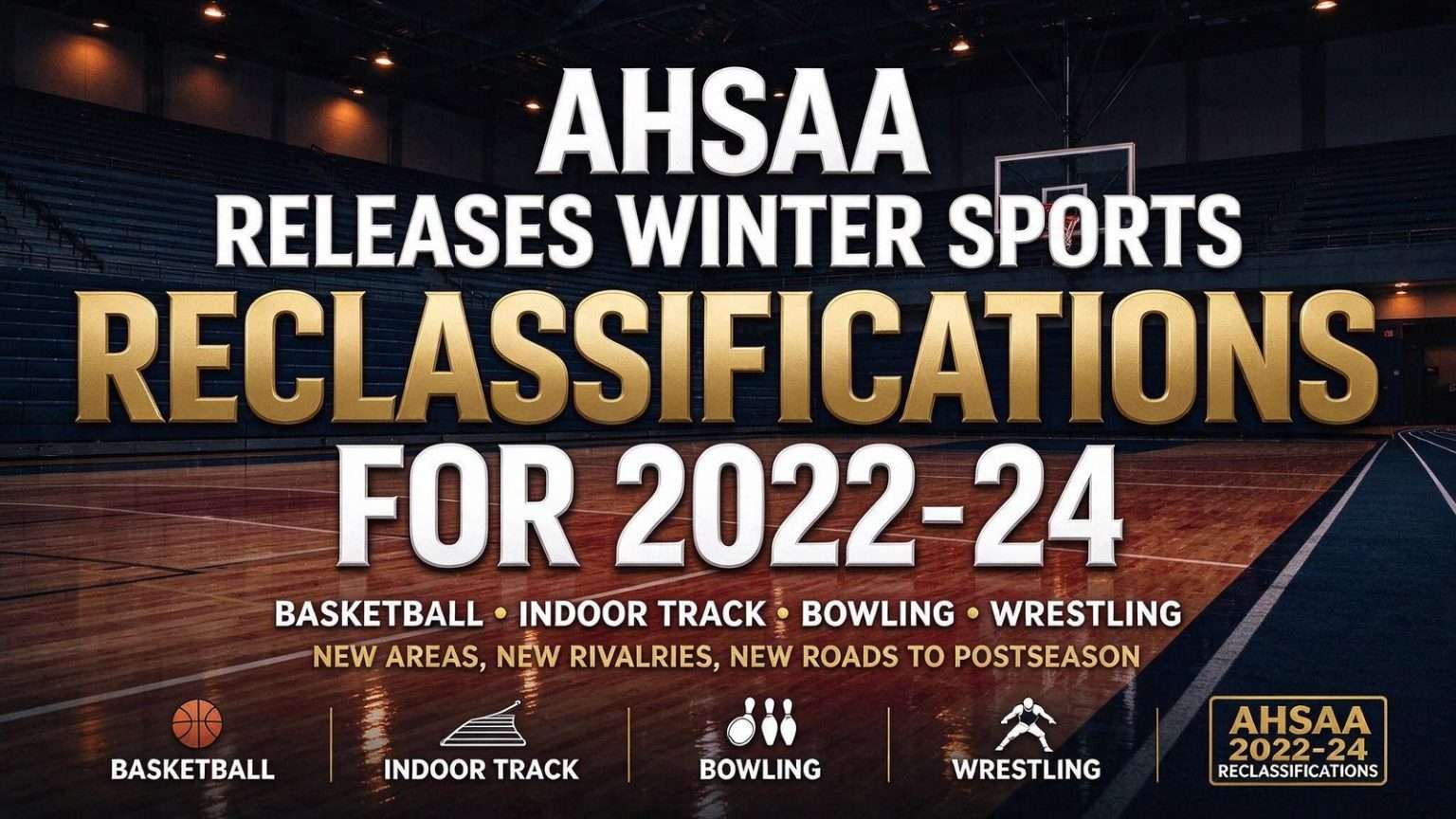
The Alabama High School Athletic Association on Tuesday released its two-year reclassifications for the 2022-23 and 2023-24 school years covering winter sports: basketball, indoor track and field, bowling and wrestling. The announcement sets the competitive map for hundreds of schools across the state, determining who plays whom during the regular season and, more importantly, who has to go through whom to reach a postseason.
The reclassifications are based on school enrollment and the competitive balance factor, with an additional adjustment applied to private schools. That combination reshuffles the league tables every two years as enrollments rise and fall, and as the AHSAA continues to refine how it accounts for the recruiting-adjacent advantages some argue private school programs can hold over their public school counterparts.
The AHSAA published the full list of area, region and section assignments for schools in the coverage area, giving coaches, athletic directors and fans their first detailed look at the roads to Birmingham over the next two winters.
Basketball: The Local Areas
In basketball, Class 7A, Area 2 includes Daphne, Fairhope and Foley — an all-Baldwin County configuration that turns one of the state’s most heated geographic rivalries into a twice-weekly area battle. Every meeting between the Eastern Shore schools now carries direct standings weight, and the area tournament that decides postseason seeding will be fought entirely between neighboring communities.
Class 7A, Area 1 spans Mobile County’s western and central schools: Alma Bryant, Baker, Davidson and Mary G. Montgomery. The grouping pairs the large western Mobile County programs with two of the city’s established basketball schools, creating long bus rides across the county and a mix of styles that area tournaments have historically produced.
Baldwin County, McGill-Toolen, Robertsdale and Spanish Fort make up Class 6A, Area 2, blending the county seat’s Tigers with the Yellow Jackets’ storied program and two growing Eastern Shore-area schools. Blount, Murphy, Saraland and Theodore form Class 6A, Area 1, an all-Mobile County area that puts the Leopards’ programs in with the city and north Mobile County schools in one of the region’s most competitive groupings.
How Reclassification Works
The AHSAA reclassifies its member schools every two years, ranking them by enrollment and cutting the state’s competitive landscape into seven classifications, with the largest schools in 7A and the smallest in 1A. The process is mechanical on its surface — the numbers decide the class — but the ripple effects are anything but: a school that moves up a class leaves behind rivals it has beaten for a decade and walks into a bracket of programs it may never have faced.
The competitive balance factor, added to the calculus in recent years, exists to address the long-running debate over private school dominance in championship play. By weighting private school enrollment upward, the factor can push private programs into higher classifications than their raw student counts would dictate, an adjustment the AHSAA applies with the stated goal of leveling the postseason playing field.
Because the assignments run for two full school years, the Tuesday release freezes the competitive landscape through the 2023-24 season. Programs can scout, schedule and build around known opponents for the next two cycles, and the rivalries that emerge from area play — the ones that fill gyms in January — now have two years to take root.
Wrestling and Bowling Assignments
For wrestling, Class 1A-4A, Section 1 includes Bayshore Christian, Orange Beach and Satsuma. The combined lower-classification section groups small-enrollment programs together for the postseason gauntlet, and for growing programs like Orange Beach’s, the assignment chart is a map of what it will take to reach state.
The section format in wrestling concentrates the stakes: wrestlers who survive their section tournament advance to the state championships, making every weight class at sectionals a do-or-die event. For the South Alabama programs in Section 1, the next two years of sectional competition will run through familiar opponents on the road to Huntsville and Birmingham.
In bowling, Class 6A, Section 1 includes Baldwin County, Saraland, Spanish Fort and Robertsdale, while Class 7A, Section 1 includes Baker, Daphne, Davidson, Fairhope, Foley and Mary G. Montgomery. The bowling assignments mirror the basketball geography closely, which simplifies scheduling for athletic departments that field teams in both sports and lets athletes who compete in each face the same opponents through the winter.
Bowling has been one of the AHSAA’s fastest-growing sports, requiring its own specialized facilities and drawing programs from across the coast’s school systems. Section assignments in the sport funnel teams toward state tournament berths, and the grouping of the coast’s larger schools ensures that qualifying runs through some of the region’s most established programs.
Indoor Track and the Postseason Map
Indoor track regions split along similar lines, with local schools placed in Regions 1 and 2. The regional structure sends athletes through qualifying meets that determine who advances to the state indoor championships, where individual titles and relay medals are decided on the board tracks that make the sport distinct from its outdoor counterpart.
Indoor track’s postseason differs from team sports in an important way: the emphasis falls on individual and relay qualifying standards as much as on head-to-head competition. Region placement still shapes which programs share a qualifying path, and for coaches building training plans across a two-year cycle, knowing the regional opponents is the first entry on the schedule.
What the Assignments Mean for Local Programs
The assignments determine postseason paths for the next two winter sports seasons across south Alabama, and each configuration carries its own storylines. Baldwin County basketball fans will note that an all-Baldwin 7A area puts three Eastern Shore schools into weekly competition with each other, while Mobile County’s 6A areas concentrate the city’s traditional powers into groups where no one gets an easy area night.
For coaches, the two-year certainty allows deliberate program building. A roster that will graduate before the 2023-24 season can be built to peak in the first year of the cycle; younger squads can be developed with the second year’s area tournaments as the target. Athletic directors, meanwhile, begin the annual puzzle of filling non-area schedules that prepare their teams for the opponents they now know they must beat.
For families and fans, reclassification changes the texture of a season. New opponents bring new gymnasiums, new traditions and new travel; old rivalries disappear from the area slate even when they survive as non-area games. The January nights that define winter sports in south Alabama — the packed gyms, the tournament brackets, the section championships — will now run on the map released Tuesday.
The Two-Year Cycle Ahead
The 2022-23 season will be the first under the new assignments, with everything from basketball area tournaments to wrestling sectionals running on the fresh alignments. The 2023-24 season follows on the same map before the AHSAA’s next reclassification cycle resets the board based on updated enrollment figures.
That rhythm has governed Alabama high school sports for decades: two years of stability, then the reshuffle that comes with the state’s shifting population. The fast-growing school systems of Baldwin County and north Mobile County have been among the cycle’s biggest movers in recent years, and each reclassification redraws the coast’s competitive geography in ways that eventually show up in the state tournament brackets.
South Alabama’s winter sports fans now have the full picture: who their teams will face, where the postseason runs, and which rivalries will fill the next two years of calendars. The AHSAA’s release sets the stage, and the first area tournament under the new assignments is now the date circled on every athletic department’s calendar.
Reading the Statewide Picture
Beyond the local assignments, the reclassification release touches every corner of the state’s winter sports map. Schools rising or falling between classes find their schedules, their rivals and their championship odds redrawn at once, and the state’s most established programs — the ones whose banners hang from the rafters — face the same shuffle as everyone else. The AHSAA’s classification system is designed to keep competition balanced across schools whose enrollments can differ by a factor of ten or more within a single classification cycle.
The private school adjustment remains one of the most watched pieces of the process. Programs affected by the competitive balance factor find themselves competing a class above their raw enrollment, a trade-off accepted in exchange for settling the fairness questions that have shadowed championship play. How those assignments play out across the next two winters will feed the ongoing statewide conversation about the factor’s effects.
Getting Ready for the New Alignments
With the assignments published, the practical work begins. Coaches will scout their new areas, exchanging film and attending summer league matchups to size up the opponents they will see twice a week once December arrives. Strength and conditioning calendars get built backward from the area tournaments, and team camps are chosen with the new geography in mind.
The release also arms the region’s sports media and fan communities with two years of material. Prediction season opens immediately: which area is the state’s toughest, which program gained the most from the shuffle, and which school got drawn into a buzzsaw. Those debates will run from now until the first tip-off under the new map.
For south Alabama, the 2022-24 cycle promises a winter sports landscape that mixes familiar certainties — the coast’s traditional powers remain where they usually are — with enough new pairings to keep every gym night interesting. The AHSAA has set the board. The games that answer the questions it raised begin with the 2022-23 season.