AHSAA unveils spring sports reclassifications for next two school years
The AHSAA has released its spring sports reclassifications for the next two years, moving several south Alabama baseball, soccer and golf programs up a.
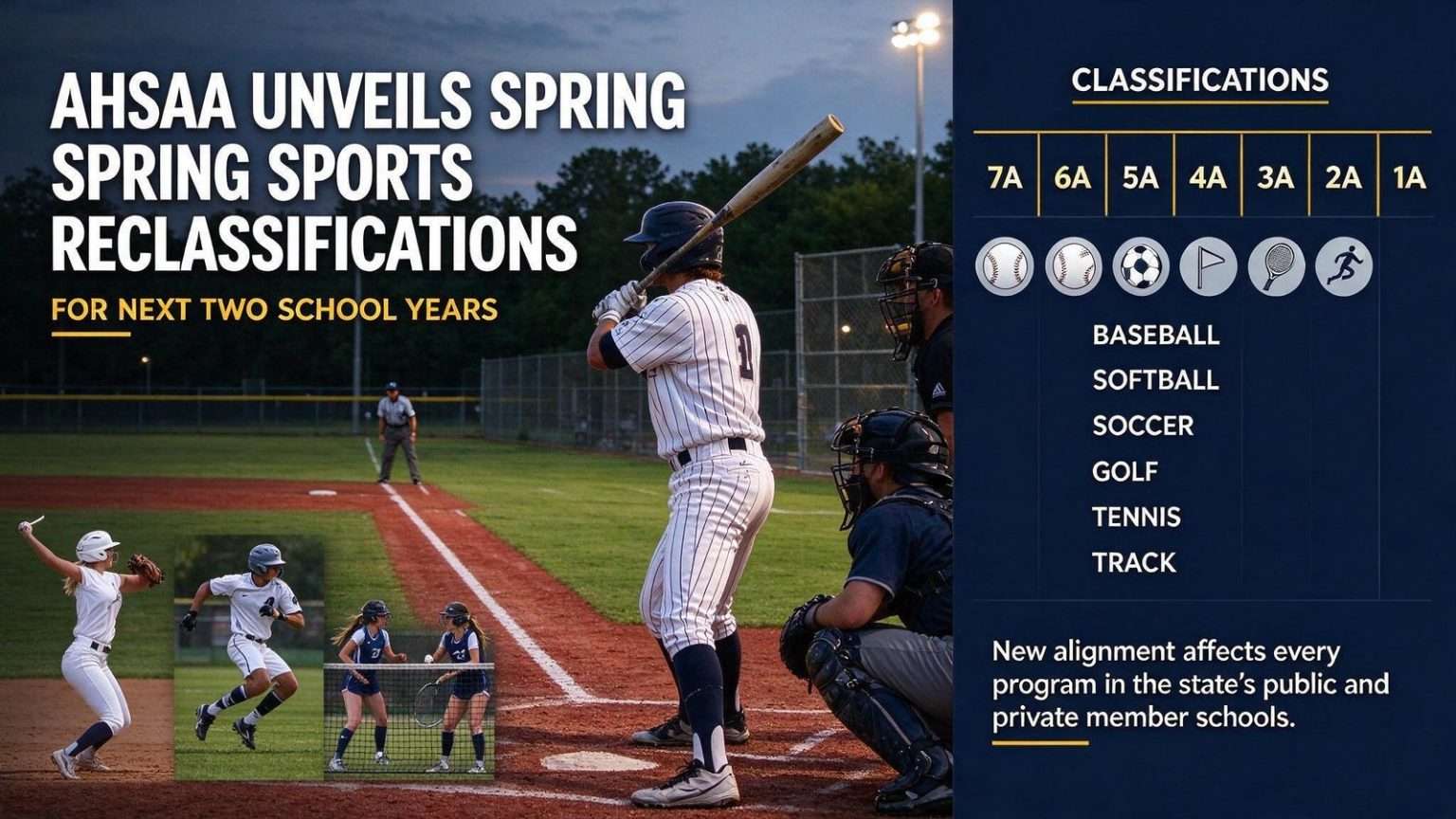
The Alabama High School Athletic Association has released its reclassifications for spring sports covering the next two school years, reshuffling how baseball, softball, soccer, golf, tennis and outdoor track teams across south Alabama will be grouped for competition. The new alignment affects every program in the state’s public and private member schools, from the largest 7A powers to the smallest 1A schools on the county roads of south Alabama.
The adjustments are based on school enrollment, the competitive balance factor the AHSAA applies to successful private programs, and a 1.85 multiplier assessed to private schools. The formula determines which classification each team competes in, and it is revisited on a two-year cycle so that growing schools and successful programs are grouped against comparable competition.
Reclassification is one of the most consequential decisions the association makes, because it shapes schedules, playoff paths, and championship odds for two full school years. A move up or down a class can turn a perennial contender into an underdog, or give a program that has outgrown its classification a fairer field. For spring sports — which often draw smaller crowds than football and basketball — the stakes are no lower for the athletes who train year-round.
The AHSAA, which governs interscholastic athletics for public and private schools across Alabama, divides member schools into seven classifications based on average daily membership figures, with the largest schools in 7A and the smallest in 1A. Within each classification, schools are grouped into areas and sections for regular-season and postseason competition, with championship brackets built from those groupings.
Local programs on the move
Several local programs will move up a class. Bayshore Christian’s baseball team climbs from Class 1A to Class 2A, and Mobile Christian’s baseball team jumps from Class 4A to Class 5A after both repeated as state champions and were bumped by the competitive balance formula. The two programs have been among the most consistent winners in their classes, and the formula is designed to move exactly that kind of sustained success up the ladder.
The competitive balance factor, adopted to address the dominance of some private school programs, applies additional weight to private schools that win championships or reach the final rounds repeatedly. The idea is to separate consistently successful private programs from the public schools they compete against, whose enrollments alone do not capture the difference in recruiting reach and resources some private programs enjoy.
St. Paul’s boys’ golf team moves to Class 7A, Section 1, while the Saints’ boys’ and girls’ soccer teams also rise to Class 7A. The Mobile private school’s programs will now compete against the largest schools in the state, a significant jump in the depth of competition they will face week to week and in the playoffs.
All of Orange Beach’s athletic programs shift from Class 2A to Class 4A, driven mainly by enrollment. The coastal city’s school system has grown rapidly as the community has expanded, and the enrollment-based move takes every Dolphin program up two classes at once. The Orange Beach softball team, a back-to-back state champion, would have moved up regardless on competitive balance grounds — meaning the program faces a dramatically tougher classification either way.
The AHSAA board had voted earlier to shift golf, outdoor track and tennis from sectional play to area play, but rescinded that plan after deciding it needed more time to study the factors involved. Sectional play, which places more teams in each section than area competition, remains in place for now — meaning the postseason qualification math for those three sports stays as it was for the coming cycle.
The distinction between area and sectional play matters to coaches and athletes. With fewer teams in an area, each regular-season area contest carries more weight, and the path to qualifying for state competition narrows. Sections group more schools together, spreading the qualification field wider and giving teams more routes into the postseason. The board’s decision to pause the change keeps the larger sectional groupings for golf, track and tennis while the study continues.
For the schools affected, the reversal means another two years of familiar postseason logistics. Athletic directors plan travel, officials, and facility assignments around sectional assignments, and last-minute changes can ripple through scheduling for entire conferences. The board’s caution reflects those practical concerns as much as any philosophical question about competitive fairness.
What the multiplier means for private schools
The 1.85 multiplier applied to private school enrollment figures has reshaped classification across the state since its adoption. A private school with a modest actual enrollment can find itself classified two or three classes above schools with the same number of students, a mathematical consequence meant to account for the private schools’ ability to draw students from a wider geographic area than a neighborhood public school.
The multiplier’s effects show up across south Alabama’s private school programs. St. Paul’s move to 7A in multiple sports, and the competitive balance bumps that pushed Bayshore Christian and Mobile Christian baseball up, are the visible results of formulas that have stirred debate among coaches and administrators since their adoption. Supporters argue the rules finally level the playing field; critics say they punish successful programs regardless of how they achieved success.
For public school programs in the affected classes, the changes can open doors. When a dominant private program moves up, the classification it leaves behind sees a wider-open playoff field, and the schools that have spent years running into that program in the postseason get a new competitive window.
Complete area and sectional assignments for each spring sport have been posted for the schools in the local coverage area. Coaches and athletic directors are now working through the details — which rivals land in which area, how far the travel runs stretch, and what the road to a state championship looks like under the new alignment.
For fans in south Alabama, the realignment sets up two years of new matchups. Local rivalries that fell into different classes will pause, and new ones will form as schools find themselves grouped together for the first time. The state championship brackets in baseball, softball, soccer, golf, tennis and track will look different this time next year — and every program moving up a class will spend the offseason preparing for the step in competition that comes with it.
For the athletes themselves, the reclassification cycle changes the texture of a high school career. A freshman who enters a program in one class may graduate having competed in two or three, with playoff memories shaped by lineups that no longer exist. Coaches use the two-year windows to build toward runs at championships, and a realignment that splits a roster’s prime years across classes can upend those plans in a single announcement.
The spring sports calendar adds another wrinkle. Unlike football, whose classifications and schedules are set well before the fall, spring sports share facilities, buses, and coaching staffs with winter programs still finishing their seasons. When a school moves up a class, its spring coaches often learn their new opponents at the same time their gym and field time is still committed to basketball or indoor track, compressing the adjustment period.
Travel is a frequent concern in the realignment math as well. South Alabama’s coverage area stretches from the Mississippi line to the Florida border, and a section assignment that pairs a Mobile school with schools in Montgomery, Birmingham, or the Tennessee Valley can double a team’s overnight trips. Athletic directors weigh those distances against gate receipts and school budgets when evaluating the alignment’s practical effects.
Competitive balance remains the most debated piece of the system. The AHSAA’s approach — enrollment for everyone, plus a multiplier and a success factor for private schools — is more aggressive than the simple multipliers many state associations use, and south Alabama has seen its effects directly in the moves by St. Paul’s, Mobile Christian, and Bayshore Christian. Each realignment cycle renews the argument among coaches about whether the formula measures fairness or merely penalizes winning.
The two-year cycle also gives displaced programs a clear horizon. Rivalries interrupted this year return in the next alignment, and enrollment trends can shift schools back down the ladder as quickly as they moved up. For the coaches and athletes affected, the task is simpler: prepare for the classification in front of them, and let the formulas sort the rest when the next cycle arrives.
What is not in dispute is the consequence for the coming two school years: the largest private programs in Mobile will compete in 7A, two of the area’s most successful baseball programs will face bigger classifications, and Orange Beach’s rising enrollment will test every Dolphin team against 4A competition. The posted assignments start that clock now, with offseason conditioning, summer league play, and fall workouts all building toward the first real test of the new alignment.