

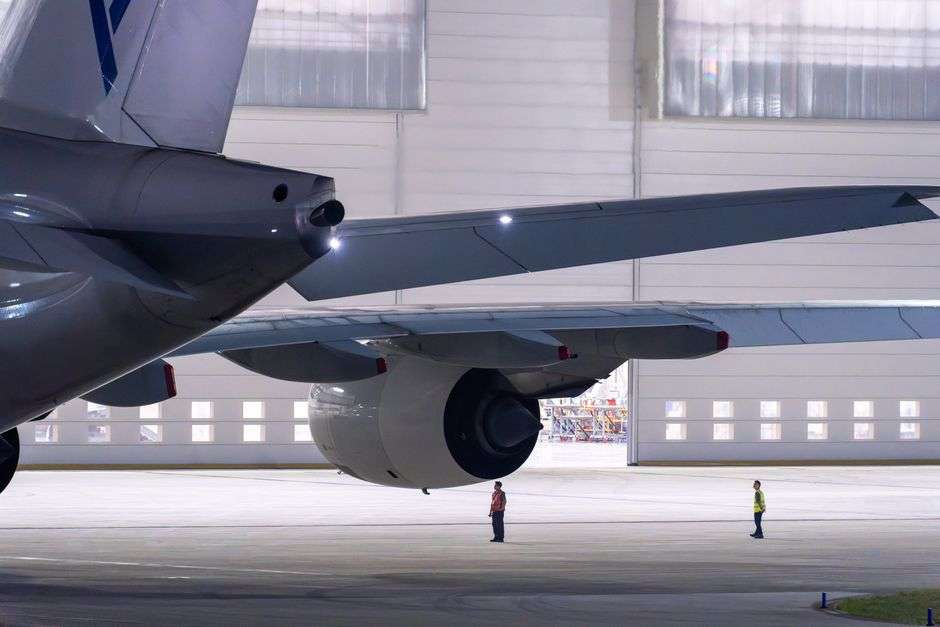
Airbus confirmed this week that commercial aircraft production will resume on schedule at its Mobile manufacturing campus, bringing employees back to the assembly line after a three-week pause tied to the COVID-19 pandemic. Airbus spokeswoman Kristi Tucker said work would restart Wednesday, April 29, under the same enhanced hygiene and social distancing measures the company put in place before the shutdown. The restart keeps one of the Gulf Coast’s most prominent industrial operations on something close to its original timetable, even as the pandemic scrambled manufacturing schedules around the world.
The Brookley Aeroplex facility will return to full staffing, Tucker said, and any employees who had been working remotely during the pause will continue to do so as production ramps back up. That split arrangement — assembly workers back on the line, office and support staff staying home where their work allows it — became the standard playbook for manufacturers restarting during the outbreak, and it lets the company reduce the number of people on site at any given time without slowing the work that has to happen face to face.
Airbus announced the Mobile production pause on April 6 as the coronavirus outbreak spread across the country, idling the final assembly line where the company builds A220 and A320 family jets for airline customers. The three-week stoppage froze the steady rhythm of a plant that had been producing aircraft at an accelerating rate, leaving aircraft in various stages of completion waiting on the line while company officials watched travel restrictions reshape the airline industry their jets are built to serve.
A Coordinated Global Shutdown
The Mobile shutdown mirrored moves the aerospace giant made at two of its facilities in Germany, which were also paused as the company reassessed health and safety protocols across its global manufacturing network. Airbus took similar action in Europe, halting production and assembly work in France and Spain for four days so it could put stricter health and safety measures in place before restarting operations. Those facilities have since staggered their return to work depending on local conditions, an approach that treated each site as its own decision rather than a single global order.
Production and assembly in France has been ramping back up gradually since March 23, while commercial aircraft wing production in the United Kingdom and aircraft assembly work in Spain and Canada remained paused, a reflection of fluctuating parts inventories and evolving government restrictions in each country. The patchwork illustrates the nature of modern aircraft manufacturing: a single jetliner is assembled from components built across borders, and when a wing plant sits idle, the final assembly lines downstream feel it within days. Restarting one site while another stays dark requires constant coordination between factories that normally operate in lockstep.
Company officials have said the temporary production pause did not result in layoffs, with employees continuing to be paid during the idle period. That decision kept hundreds of Alabama paychecks intact through the shutdown and spared the Mobile area the first-round job losses that other corners of the aviation industry absorbed as air travel collapsed in the spring of 2020.
Why Brookley Matters to Mobile
The Mobile campus has become an increasingly important piece of Airbus’ U.S. manufacturing footprint since the plant opened, employing hundreds of workers who build jets for airlines operating throughout North America. The site was the company’s first final assembly line in the United States, a milestone that put Mobile on the same map as Toulouse, Hamburg and Tianjin in Airbus’ worldwide production system. From the A320 family line the company later added A220 assembly, making the campus one of the few places on earth where both aircraft families take shape under the same roof.
A sustained shutdown at the Brookley site would have rippled through the broader Mobile-area economy, affecting suppliers and contractors who depend on the aerospace industry’s presence along the Gulf Coast. The aeroplex, built on the grounds of the former Brookley Air Force Base at Mobile’s airport, hosts a cluster of aviation firms that grew up around the Airbus operation, from parts suppliers to maintenance and modification companies. Each aircraft that rolls out of the final assembly line supports work far beyond the plant’s own walls, in businesses that service the site, move its materials and feed its workforce.
The return to production this week signals that Airbus expects its Mobile operations, along with the additional safety protocols now in place, to keep the assembly line running even as the pandemic continues to affect manufacturing schedules elsewhere in the company’s global network. The measures that carried the plant through the restart — enhanced cleaning, spacing on the line, face coverings and staggered schedules — remain in place as employees settle back into a routine that looks different from the one they left three weeks earlier.
What the Restart Means for Airlines
The restart also matters to the customers waiting on Mobile-built jets. The A320 family — which includes the A319, A320 and A321 — is the best-selling narrowbody aircraft line in the western world, and U.S. carriers in particular have made it the backbone of their domestic fleets. The A220, the smaller, longer-range twinjet Airbus acquired through its purchase of the program’s Canadian manufacturer, gives airlines an efficient option on thinner routes, and Mobile is one of only two places in the world building it. Every week of paused production pushes deliveries back, and airlines managing through a collapse in travel demand have been renegotiating delivery schedules in real time.
For now, the company is treating the Mobile restart as evidence that its safety protocols can support continuous production. The same enhanced hygiene and social distancing measures adopted before the shutdown — deep cleaning of shared surfaces, spacing between workstations, limited contact between shifts — carried over into the restart without modification, according to the company. Employees returning Wednesday, April 29, found the line much as they left it, with completed work stages marked and inspected so that the aircraft could resume their movement down the line without rework.
The pandemic has tested the aerospace industry’s supply chain in ways few events have. Parts inventories that depend on air freight have been squeezed by the sharp reduction in passenger flights, since airliner bellies carry a large share of the world’s air cargo. That constraint, combined with differing national restrictions, explains why some Airbus facilities — the United Kingdom wing plants, the Spanish and Canadian assembly sites — remain paused even as France, Germany and the United States resume work. Company planners in Mobile are managing a supply stream that arrives unevenly, ramping production as components allow.
Mobile’s Aerospace Base
Mobile’s rise as an aerospace city is one of the region’s defining economic stories of the past two decades. When the Air Force closed Brookley Field in the late 1960s, the city lost its largest employer, and the aeroplex that grew up on the site spent decades rebuilding an industrial base piece by piece. The port city’s long history with aviation — from seaplane operations on the bay to military flight activity during World War II — gave the region a base of mechanical talent to draw on, and the aeroplex’s hangars and runway infrastructure made it the natural landing spot for a major aircraft builder.
Airbus’ decision to locate its first U.S. final assembly line there transformed that site into the anchor of a Gulf Coast aerospace corridor that now stretches across the region, and the campus has grown with each new program the company has added.
The plant’s presence has attracted training programs, community colleges and engineering partnerships that prepare local workers for aerospace careers, giving the region a workforce pipeline that recruiters cite when they court other manufacturers. Suppliers, machine shops and specialized service firms have opened operations nearby to be close to the assembly line, and the economic ripple extends into construction, logistics and hospitality across Mobile and Baldwin counties. Every indicator the company offers that production will stay steady — and the April 29 restart is the strongest one available — is treated locally as economic news for the entire region.
For the employees walking back through the gates Wednesday, the restart ends three weeks of uncertainty about whether the plant’s momentum would survive the pandemic. The company’s answer — full staffing, pay maintained through the pause, no layoffs, and the same safety measures that were in place before the shutdown — sets the framework for the weeks ahead, as the Mobile campus resumes its place in Airbus’ global production network while the world around it continues to change. Assembly line workers, quality inspectors, and support staff will rebuild the plant’s output rate gradually, exactly as their counterparts in France have done since March 23, with the goal of returning to the production tempo that made the Mobile campus one of the fastest-growing aircraft plants in the Airbus system.