Airbus Sends Three Palmer Pillans Students to Germany for Flying Challenge Milestone
Three Palmer Pillans Middle School eighth graders left Mobile Regional Airport this week for Munich, Germany, to join Airbus Foundation Flying Challenge students from around the world for the program's 10th anniversary.
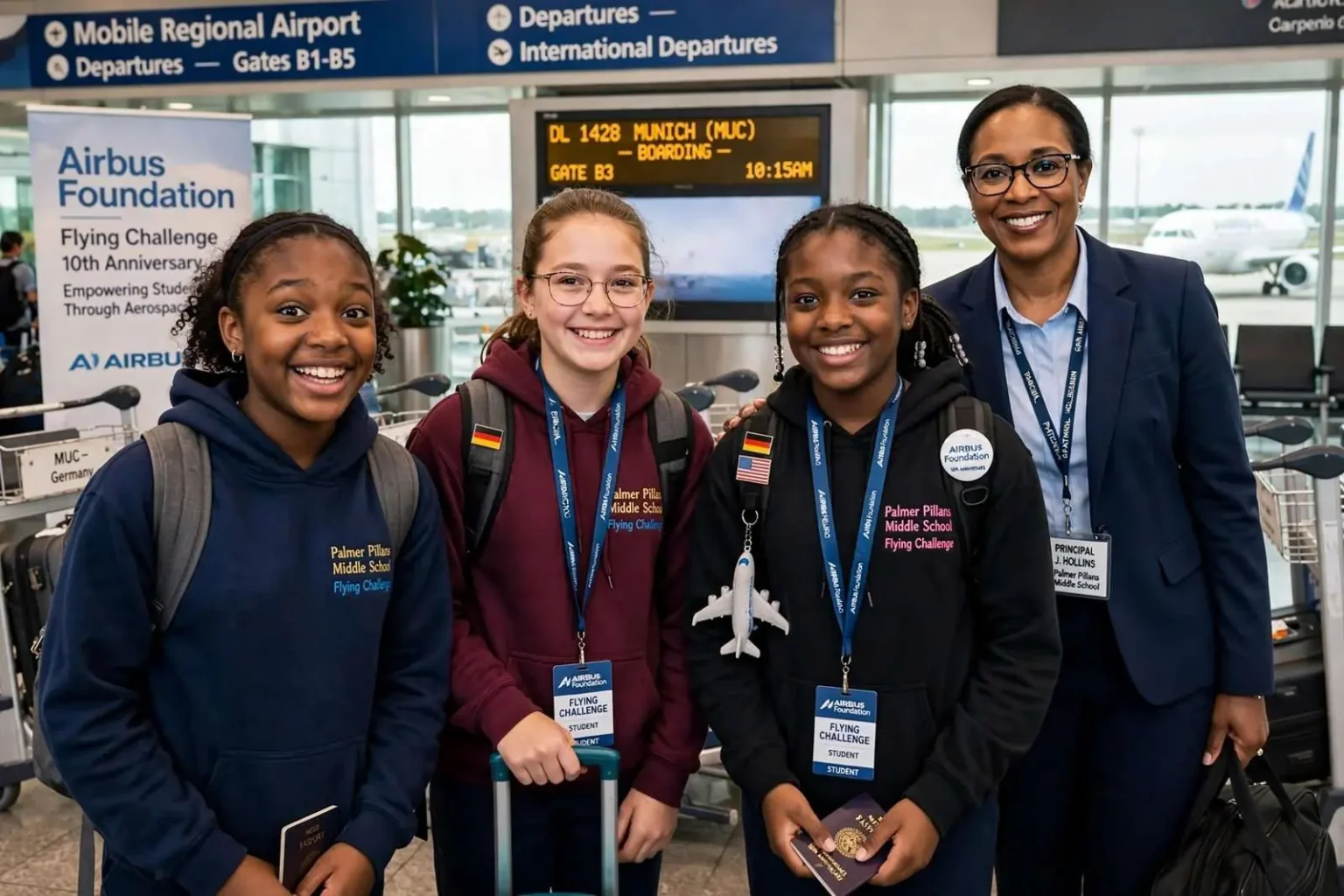
Three Palmer Pillans Middle School students boarded a flight out of Mobile Regional Airport this week bound for Munich, Germany, marking the first international trip for all of them and only the second time any of the three had flown on an airplane at all. Eighth graders Nicole Goodwin, Alexis Vander and Al’Landria Jackson are traveling overseas as part of the Airbus Foundation’s Flying Challenge program, which is celebrating its 10th anniversary this year with an international gathering of student participants from across the globe.
The trip is a first of many kinds for the trio. None of the three had ever left the country before, and only Vander had previous flying experience. For Jackson, simply boarding the plane was enough to set off a wave of excitement. “Everything is going on,” Jackson said before departure. “I’m really excited.”
Goodwin echoed that enthusiasm while admitting to a few nerves of her own. “I’m most excited about seeing Germany,” she said. “I’ve never been there. I’m kind of nervous, but more excited than nervous.”
The students left Wednesday accompanied by two chaperones, including Palmer Pillans Principal Jacinda Hollins, who is traveling with the group throughout the trip.
A program three years in the making
Mobile’s chapter of the Flying Challenge is now in its third year locally, according to David Trent, site director for Airbus Engineering at the Brookley Aeroplex. The program pairs 50 Palmer Pillans students with 35 Airbus employee mentors who work with them on the principles of flight along with broader science, technology, engineering and math coursework.
“We’re trying to get students to realize staying in school is important,” Trent said. “We’re trying to get them to realize good grades are important.”
Goodwin, Vander and Jackson were selected out of the 50 local participants for the Germany trip because of their enthusiasm and how well they represented both the school and the program, Trent said.
While in Germany, the Mobile students will join Flying Challenge participants from Wichita, Kansas, along with young people from China, the United Kingdom, France, Germany and Spain for the program’s anniversary celebration. The itinerary includes an anniversary ceremony, a tour of Munich — Germany’s third-largest city — and an Airbus air show featuring parachute jumpers and vintage aircraft.
Amid all the excitement over the packed schedule, Vander said what she’s looking forward to most is what the trip will mean back home. “It means a lot to me because it should make my mom very proud, which I like to do,” she said. The students are scheduled to return to Mobile on Monday.
A partnership built around aerospace
The Flying Challenge program is a partnership between the Airbus Foundation, the United Way of Southwest Alabama, the Gulf Coast Exploreum Science Center, the Mobile Area Education Foundation and the Mobile County Public School System, and is aimed at exposing local middle schoolers to aerospace careers and STEM fields through hands-on mentorship from Airbus employees.
That structure reflects how Airbus has grown into Mobile’s economy. The company’s final assembly line at the Brookley Aeroplex, which builds single-aisle airliners for customers across North America, made the city an Airbus town a decade ago, and the Flying Challenge extends that industrial presence into the classroom. Employees who volunteer as mentors come from engineering, production and support roles, giving students direct contact with adults who hold exactly the jobs the program hopes to inspire.
Palmer Pillans, which serves students in the city’s west side, was selected as the program’s local partner school, and its 50 participating students meet their mentors through a schedule of lessons and activities built around aviation themes. The curriculum covers the physics of flight, aircraft design and the pathways that lead from middle school math to aerospace careers, along with tutoring support aimed at keeping participants on track academically.
An international milestone
The 10th anniversary gathering in Munich brought together Flying Challenge chapters from around the world for the first time at this scale, and Mobile’s delegation joined students from Wichita and from five countries for a week of shared activities. The anniversary ceremony, the city tour and the Airbus air show were designed to reward the students’ year of work while showing them the scale of the industry their curriculum points toward.
For the three Mobile students, the journey carried personal milestones stacked inside the program’s celebration. Goodwin, Vander and Jackson each boarded a plane for only the second time or less, collected their first passport stamps, and represented their school in front of international program partners. Their chaperones, including Principal Hollins, accompanied them through every leg of the trip, from Mobile Regional Airport’s departure gates to the return flight scheduled for Monday.
Program organizers say the international gatherings serve a purpose beyond celebration. Students who see peers from other countries working through the same curriculum grasp that aerospace is a global industry, and the friendships formed at anniversary events have become part of how the program keeps students engaged through high school.
The choice of Munich as the host city added its own lessons. Germany’s third-largest city is home to Airbus’s headquarters operations and a century of aviation history, and the students’ tour gave them a look at the industry’s roots as well as its present. The air show, featuring parachute jumpers and vintage aircraft alongside modern hardware, tied the two together.
Back in Mobile, the program’s local partners describe the Germany trip as the program’s capstone for this cohort, the reward that shows the 50 students in the current chapter what the work can lead to. For Goodwin, Vander and Jackson, the answer to the question of what the program leads to is already in hand: a week abroad, a new sense of possibility, and a story to carry home when they land Monday.
Mentorship at the core
The heart of the Flying Challenge model is the ratio of mentors to students, and the Mobile chapter’s 35 Airbus employees working with 50 middle schoolers is designed to give every participant consistent adult attention. Mentors commit to the full school year, showing up not just for the aviation lessons but for the check-ins about grades, attendance and the small obstacles that derail students in the middle school years. Trent’s framing of the mission, convincing students that staying in school matters and that grades matter, reflects the program’s origin as a dropout-prevention effort wrapped in an aerospace theme.
The Airbus Foundation created the Flying Challenge a decade ago as the company’s global youth initiative, launching chapters near Airbus sites in Europe and later expanding to North America. Mobile and Wichita, the two American host cities, both sit beside Airbus manufacturing operations, which is how the company justifies the investment: the students in the program today are the potential workforce, and the potential customers’ neighbors, of the plants next door.
Local partners give the Mobile chapter its structure. The United Way of Southwest Alabama coordinates community support, the Gulf Coast Exploreum Science Center hosts hands-on sessions that connect the curriculum to exhibits, and the Mobile Area Education Foundation links the program to the school system’s broader academic initiatives. The Mobile County Public School System, the state’s largest district, provides the classroom access and teacher coordination that keep a year-long program running inside the school calendar.
Why Palmer Pillans
The program’s home at Palmer Pillans places it at a school whose students have fewer opportunities for travel and enrichment than peers in wealthier parts of the county, which is precisely the population the Airbus Foundation targets. Program officials have noted that many participants had never ridden on an airplane before joining, making the Germany trip for Goodwin, Vander and Jackson a milestone not just for them but for their classmates watching from home.
The selection of three students from the 50-person cohort was based on enthusiasm and how well they represented the school and the program, according to Trent, criteria that reward engagement over grades alone. That approach, mentors say, is deliberate: the program wants students who will carry the experience back into the school community and show their peers what participation can lead to.
The broader context matters too. Mobile’s public schools serve a city where aerospace has become the signature industry, and the gap between the industry’s growth and the local workforce pipeline is a recurring theme in the region’s economic development discussions. Programs like the Flying Challenge are part of the answer the business community offers, a long-term bet that a middle schooler who meets an engineer at 13 might apply for a job, or an engineering program, at 18.
When the three students return to Mobile on Monday, they will rejoin the 47 classmates in their chapter still working through the curriculum, carrying stories from Munich, new friends from six countries, and firsthand proof of where the program’s year of mentorship can lead.