Forecaster rates Alabama 2nd District race between Figures and Marques a tossup
A University of Virginia forecasting group moved the race between U.S. Rep. Shomari Figures and state Rep. Rhett Marques to tossup, while other forecasters still rate it Leans Republican.
A national election forecaster has moved the Alabama 2nd District race into its tossup column, signaling that the contest between U.S. Rep. Shomari Figures, a Democrat, and Republican state Rep. Rhett Marques could be closer than the district’s recent voting history suggests.
The forecasting team at the University of Virginia announced the ratings change Tuesday. It was the group’s second move toward Figures in about a week: the Center for Politics had shifted the district from “Likely Republican” to “Leans Republican” the week before, then moved it to “Toss-up.” Other organizations that handicap congressional races continue to rate the district as “Leans Republican,” meaning the forecasters do not agree on how competitive the race has become.
Voters will settle the question on Tuesday, Nov. 3.
What the forecasters said
In explaining the shift, the University of Virginia group acknowledged that the district’s numbers lean Republican. President Donald Trump carried the district by 14 points in 2024, the group noted, and Democrat Doug Jones lost there by four points in his 2020 U.S. Senate race against Republican Tommy Tuberville.
That 2020 matchup has a sequel this year. Jones and Tuberville are now facing each other again, this time in the race for governor, and the forecasters said the top of the ticket could influence the congressional contest.
“In a bluer environment, it is possible to see Jones (who is now running for governor) and Figures putting together a winning coalition there,” the group wrote in its analysis. The forecasters pointed to cities such as Montgomery, one of the district’s main population centers, as places where such a coalition could take shape.
J. Miles Coleman, who works for the forecasting group, said he sees signs of a broader pattern across the region following redistricting.
“Something is going on in the South this year,” Coleman said.
He tied that trend to the legal fight over voting rights. “There is potential backlash to the Voting Rights Act being basically gutted, and African American voters have the most to lose,” Coleman said.
In a phone interview Tuesday, Coleman said the center is often “flying blind” when it sets ratings, so it weighs factors such as fundraising, outside money and Democratic enthusiasm in Alabama. Those signals, he said, have been moving toward Figures.
“With the cost of living being like the dominant issue, and basically Donald Trump widely being seen as not doing enough there, I think there could be more backlash against Republicans in just poor regions of the country. The South, you could see something like that,” Coleman said. “I think Democrats, because of that, might have a bit more upside in a region like the Deep South compared to a wealthier state like New York.”
Coleman also said having Doug Jones at the top of the Democratic ticket helps Figures. Jones is the last Democrat to win a statewide race in Alabama, defeating former Alabama Supreme Court Chief Justice Roy Moore in a 2017 special U.S. Senate election.
“I wonder if with the Voting Rights Act being kind of really curtailed by the Supreme Court over the summer, if that’s going to lead to any kind of enthusiasm with the African American vote,” Coleman said.
He added that campaign spending can reveal how parties and outside groups read a race. “You have to read between the lines sometimes. These organizations probably do their own kind of internal polling and they wouldn’t be spending if they didn’t see the race as competitive,” he said.
A tossup rating does not predict a winner. It reflects a forecaster’s judgment that neither candidate holds a clear advantage, and ratings can shift again as Election Day approaches and as new polling, fundraising and turnout information becomes available.
A district reshaped again
The 2nd District has been at the center of Alabama’s long-running redistricting battle for several years. In 2023, the U.S. Supreme Court upheld a lower-court ruling in Allen v. Milligan that found Alabama’s congressional map likely violated Section 2 of the Voting Rights Act by diluting the voting strength of Black residents. A court-drawn map then created a new version of the 2nd District that gave Black voters an opportunity to elect a candidate of their choice. Figures won the seat under that map in 2024.
That map stretched the district from Mobile through Montgomery to the Georgia line. Federal judges had rejected the Legislature’s 2023 plan for diluting Black voting strength, and in a May 2025 ruling the court again found the Legislature’s plan unlawful.
This year the legal ground shifted. The U.S. Supreme Court’s decision in Louisiana v. Callais weakened Section 2 of the Voting Rights Act by raising the bar for proving racial discrimination, and a June 2 order from the high court stayed a lower-court injunction, allowing Alabama to use the 2023 map that had previously been struck down. A special session of the Alabama Legislature in May had already set up an August special primary for four affected congressional districts.
Under the 2023 lines, the 2nd District takes in southeast Alabama and became more Republican. The district now includes all of Lowndes, Montgomery, Macon, Russell, Bullock, Barbour, Pike, Crenshaw, Butler, Coffee, Dale, Henry, Houston and Geneva counties, along with the northeast corner of Covington County and the southern half of Elmore County. Federal court records show the change lowered the district’s Black voting-age population from 48.7% to 39.9%, and the district was rated R+7.
Marques supported the change and argued for going further. In June, he called for a congressional map designed to elect Republicans to all seven of Alabama’s U.S. House seats.
Figures, a Mobile native, would have been drawn out of the district under the 2023 map, and he recently moved to Montgomery. The U.S. Constitution requires House members to be at least 25 years old, U.S. citizens for at least seven years and residents of the state they represent; it does not require them to live in their district. In a statement Tuesday, Figures said he still represents “60% of the people and half of the counties in the new district.” Marques has suggested his own local roots make him the better fit.
The result is a district considerably more favorable to Republicans. Figures is one of several Black Democrats in the South trying to hold seats that were altered by redistricting in 2026.
Figures has made the redraw a theme of his campaign. Speaking at a rally in Montgomery last week, he told supporters that the new lines were designed to defeat him.
“They tried to make this district one that we cannot win,” Figures said. “But momma didn’t raise no quitter.”
The Republican challenger
Marques, a state representative from Enterprise, is seeking to flip the seat for the GOP. He has the endorsement of President Trump and appeared with the president at a rally in Mobile earlier in October.
Marques has argued that Figures is out of step with the district, accusing the incumbent of representing “craziness over common sense.”
Trump weighed in on the race himself this week. “Shomari Figures is Reckless, Radical, and Dangerous!” the president wrote in a social media post.
Marques won the Aug. 11 special Republican primary with more than 50% of the vote in a six-candidate field. He has also been endorsed by the National Federation of Independent Business and launched a website framing the contest as “craziness vs. commonsense.” In a written statement Tuesday, Marques said he would advocate for a more affordable Alabama, safer communities, and veterans and active-duty service members. He pledged to lower taxes and to “save our district, our state, and our country from falling to the destructive far-left.”
“I am proud to have the support of local grassroots organizations that know the values, priorities, and needs of our area,” Marques said. “Crisscrossing this district to bring our common-sense message directly to hardworking Alabamians has been an honor, and I’m working hard to earn every single vote on Tuesday.”
Republicans are working to build support for Marques and to turn out voters across a district that, by the numbers, includes many people who have backed Trump in past elections. Their strategy rests on the district’s 2024 presidential results and on the changes made to its boundaries this year.
Issues on the campaign trail
Both candidates have been crisscrossing the district in the final week before the election. Taxes, affordability and health care have been among the leading issues as each tries to persuade voters that he is better positioned to address household costs and access to medical care.
For Figures, the path to victory depends on strong turnout in Democratic-leaning areas, particularly urban centers such as Montgomery, and on the possibility that the governor’s race draws additional Democratic voters to the polls. For Marques, the path relies on consolidating the Republican-leaning voters who supported Trump in 2024 and who form a large share of the reconfigured district’s electorate.
Figures has pointed to his work on health care access, including his efforts to keep Jackson Hospital in Montgomery open. “When I first heard Jackson Hospital was closing, or that they were thinking of closing, the first thing I did was I got on a plane … and I convened the governor’s office, the city, the county, the Blue Cross Blue Shield representatives, the management group of the hospital and the operating group of the hospital to talk about what was going on,” he said at an August town hall in Montgomery with Jones.
His campaign website lists education goals, including higher teacher pay and advocacy for federal money to modernize schools. In September he introduced a bill to cover full college tuition, fees, books and job training for dependents of educators, first responders and social workers with at least 20 years of qualifying service. That same month he filed legislation aimed at blocking the Trump administration from importing 300,000 tons of beef below market value, a plan that drew criticism from farmers and politicians across Alabama.
“We have a solid record of delivering for the district, and in less than two years in office, I’ve brought home nearly $20 million to help our struggling rural hospitals, build affordable homes, support our local law enforcement, and more. I’ve fought for relief for our farmers and free college tuition for the families of teachers, social workers, police officers and firefighters,” Figures said Tuesday.
He also criticized the administration on costs. “Republicans have to answer for why they are supporting reckless tariffs and a war that are driving up gas and diesel prices, which is costing us all and crippling our state’s largest industry – agriculture. People here are tired of what’s going on and this November they will voice that frustration,” Figures said. He has also attacked Marques’ 2019 vote for the Rebuild Alabama Act, which raised the state gas tax and passed the Legislature with broad support.
Latest developments: Trump post, Figures’ reply
Trump’s Monday post on Truth Social renewed the endorsement he first gave Marques in June, ahead of the special primary. The president praised Marques’ legislative and business background and said he would advance Trump’s priorities on taxes, agriculture, energy and immigration. He accused Figures of opposing tax relief on tips, overtime and Social Security benefits and criticized his positions on immigration and transgender issues. The message was one of several congressional endorsements Trump posted within minutes that used substantially similar language against Democratic candidates.
Figures answered on Facebook on Tuesday, accusing the president of lying.
“Dang, Donald! Yall must really be nervous!” Figures wrote. “I appreciate the shout out! It’s motivating a lot of voters down here calling my name out like that with all those lies! We’ll show you better than we can tell you though.”
Figures also mocked Trump with a reference to the Jeffrey Epstein files and closed with a challenge tied to the debate dispute: “P.S. Since Rhett is scared to debate, maybe you should come do it for him.”
Earlier this month, Figures accepted several debate invitations, including from the Montgomery Chamber of Commerce and the Christian Coalition for Alabama. Marques has said he will not take part, arguing a debate would give Figures a platform to help Democrats win control of Congress.
What the tax record shows
Trump’s tax claims rest on a single vote. On July 3, 2025, Figures voted against H.R. 1, the president’s broad tax-and-spending package, which included new deductions for tips and qualified overtime pay. His vote was against the entire bill, not a stand-alone measure on tips or overtime.
The federal overtime deduction generally applies to the premium portion required under federal overtime law, the extra half in time-and-a-half pay, and is subject to limits; it does not exempt all overtime earnings from tax. The law also did not repeal federal income taxes on Social Security benefits. It created a temporary deduction of up to $6,000 per eligible taxpayer age 65 or older, subject to income limits, for tax years 2025 through 2028, while the rules on how much of a recipient’s benefits are taxable stayed the same, according to the Congressional Research Service.
Alabama had its own overtime tax exemption, which originated with House Minority Leader Anthony Daniels, D-Huntsville, in 2023. It passed with bipartisan support and took effect Jan. 1, 2024, before Trump announced his federal proposal in September 2024. Republican legislative leaders allowed the state exemption to expire June 30, 2025. Daniels’ bill to extend it drew bipartisan support but never received a vote; GOP budget leaders said they prioritized broader tax cuts, including a reduction in the grocery tax.
Polls and money
Public polling on the race is limited. A Democratic-sponsored survey by Tulchin Research for House Majority PAC, conducted Aug. 24-31 and released Sept. 9, found the candidates tied at 47%. That poll predates the campaign’s closing weeks. Private polling commissioned by business interests shows Figures leading Marques.
Federal Election Commission filings through Oct. 14 show Figures raised $2.7 million and spent $1.5 million. Marques raised $1.7 million, spent $1.5 million and had $178,000 on hand. Pre-general election reports show Figures raised $297,900 in the period ending Oct. 14, compared with $81,000 for Marques.
Outside groups have tilted the other way. Committees including MAGA Inc. and No Going Back, both backed by Trump; the Alabama-based Civic Renewal Fund; Utah-based Defending Our Values PAC; Alabama Christian Conservatives; South Carolina-based Thank You for Your Attention to This Matter PAC; and Maryland-based Defending America’s Future have spent nearly $4.9 million combined supporting Marques or opposing Figures, according to FEC filings through Oct. 14.
Outside spending supporting Figures or opposing Marques totals more than $1.9 million over the same period, from groups such as Project 218, Georgia-based Black Voters Matter Action PAC, Chicago-based Progressive Turnout Project, Pennsylvania-based AB PAC and Washington-based Rolling Sea Action Fund. The Democratic Congressional Campaign Committee has also sponsored ads for Figures.
National surrogates on the trail
U.S. Sen. Cory Booker, D-N.J., campaigned with Figures in Montgomery and Dothan last week. “He’s brought millions and millions of dollars back to Alabama to help create jobs, help expand business opportunity, help people, and that’s what he stands for,” Booker said. “So I could be anywhere in the country. I get lots of invitations. I had to be here for Shomari because we need him back. And when I say we, the people of Alabama really need him back in office.”
U.S. Rep. Jasmine Crockett, D-Texas, joined Figures at a Montgomery rally Tuesday evening. “We don’t have the numbers right now, and the goal is to at least get the numbers in the House so we can stop some of the harm that is happening to everybody,” Crockett said, adding that a Democratic majority would mean Republicans “wouldn’t be the ones dictating what bills actually make it to the floor.”
Figures said the national attention reflects “two realities.” “The first reality is that this is a seat that we can win. This is not a long shot. This is not a pipe dream,” he said. “The second reality is that we are unified.”
On the Republican side, U.S. House Majority Leader Steve Scalise, R-La., joined Marques last week at a Dothan stop focused on law enforcement, and Trump has repeatedly endorsed Marques online and at his Oct. 2 rally in Mobile.
Why the race matters beyond Alabama
The outcome could carry consequences well past the state line. Republicans hold a narrow majority in the U.S. House of Representatives, so every competitive district is important to both parties.
For Republicans, flipping the 2nd District would add a seat toward retaining control of the chamber and continuing to advance President Trump’s agenda. For Democrats, holding the seat would help offset losses elsewhere and keep the party within reach of a House majority.
That national stakes dynamic helps explain the attention the race has received from the president and from national forecasters in its closing days.
What voters should know
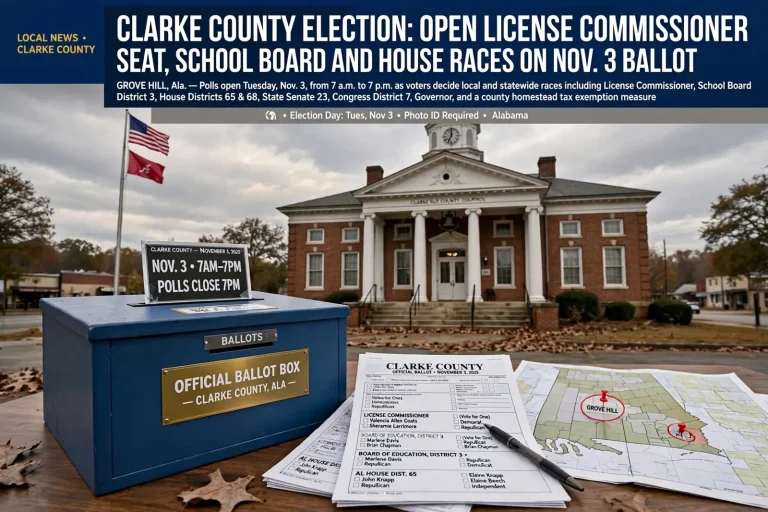
The general election is Tuesday, Nov. 3. In Alabama, polling places are open from 7 a.m. to 7 p.m., and voters must present an acceptable photo ID to cast a ballot. Voters who are in line when polls close are allowed to vote.
Residents who are unsure whether they live in the 2nd District under the new boundaries, or who want to confirm their polling place, can check their registration through the Alabama Secretary of State’s office or contact their county board of registrars. Because the district lines changed this year, some voters may find themselves in a different congressional district than in 2024.
Sample ballots are available through the Alabama Secretary of State’s website and county probate offices ahead of Election Day, giving voters a chance to review the congressional race alongside the governor’s race and other contests before heading to the polls.