Lottery, Gambling Top Seniors’ Wish List as Alabama Silver Haired Legislature Sets 2027 Priorities
Delegates to the Alabama Silver Haired Legislature ranked a standalone lottery, legalized gambling, repeal of the CHOOSE Act, an independent senior services department and Medicaid expansion as their top priorities.
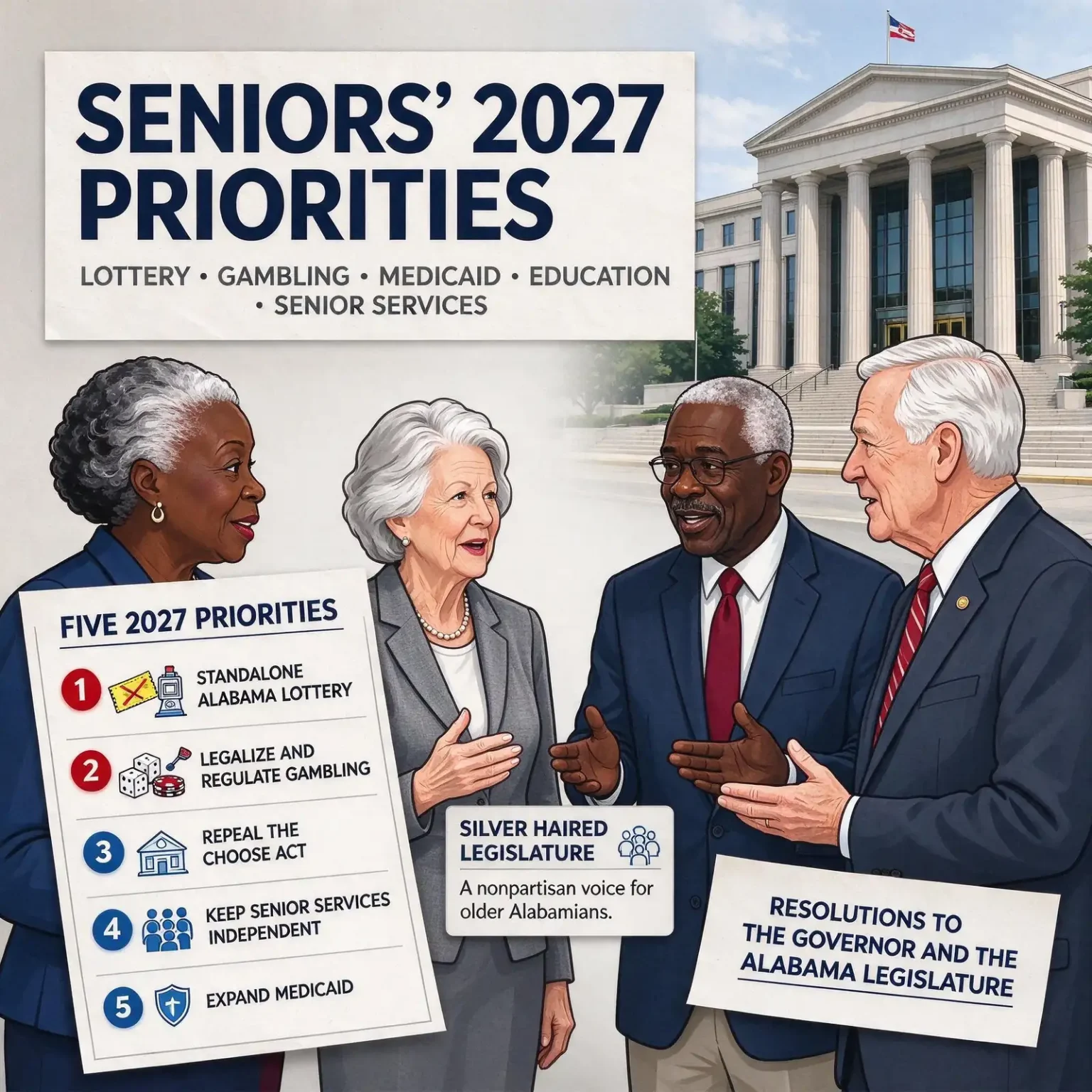
MONTGOMERY, Ala. — A state lottery and legalized gambling topped the list of Alabama Silver Haired Legislature priorities adopted when older Alabamians gathered in Montgomery for the group’s annual session Oct. 5-7.
Delegates selected five resolutions to forward to the governor and the Alabama Legislature for consideration as possible legislation. Along with the lottery and gambling measures, the list calls for repealing the state’s CHOOSE Act school choice program, keeping the Alabama Department of Senior Services as an independent agency and expanding Medicaid.
Four delegates represented the Alabama Tombigbee Regional Commission region at the session: Chairperson Shirley McClurkin, Josephine Blackwell, Gerry Burford and Richmond Chaney.
The five priorities
Ranked in order of priority, the resolutions approved by the Silver Haired Legislature call for:
- 1. Establishing a standalone Alabama lottery.
- 2. Legalizing and regulating gambling in Alabama.
- 3. Repealing the CHOOSE Act.
- 4. Maintaining the Alabama Department of Senior Services as an independent department under its current structure.
- 5. Allowing Alabama to participate in Medicaid expansion under the Affordable Care Act.
What is the Alabama Silver Haired Legislature?
The Alabama Silver Haired Legislature is a nonpartisan, nonprofit organization that represents older residents and brings their needs and concerns to state lawmakers. The Alabama Legislature created it in 1991, and the bill was signed into law by Gov. Guy Hunt. The group held its first session in 1993, according to the state’s senior services agency.
Any registered Alabama voter age 60 or older can apply to take part. Delegates are elected by their peers and represent seniors in districts that mirror those of the Alabama House of Representatives.
Delegates spend the year identifying the needs of older residents in their home areas by attending meetings and taking part in community events with senior organizations. They draft resolutions on issues affecting seniors, then bring those proposals to the annual session.
The session, usually held each October in Montgomery, is modeled on the real Legislature. Members introduce, debate and vote on resolutions, and in a final session they rank the issues they consider most important. The top-ranked resolutions are then sent to the governor and lawmakers. The process also serves an educational purpose, giving participants a firsthand look at how bills move through the legislative process.
While the group’s resolutions carry no force of law, they give legislators a ranked snapshot of what organized seniors from across the state say they want.
A lottery and gambling at the top
The top two priorities touch on one of the longest-running debates in Alabama politics.
Alabama is one of only a handful of states without a state lottery. Voters rejected a proposed education lottery in a 1999 statewide referendum, and lottery and gambling proposals have come up repeatedly in the Legislature since then without making it to the ballot. In 2024, a package that would have created a lottery and authorized casino gambling and sports betting passed the House but fell one vote short in the Senate.
Because the Alabama Constitution prohibits lotteries, a state lottery would require lawmakers to approve a constitutional amendment and send it to voters for a final decision.
By ranking a “standalone” lottery first and broader gambling legislation second, the seniors’ resolutions appear to separate the two questions. Supporters of a standalone lottery have argued in past sessions that a narrower proposal could have a better chance of passing than a comprehensive gambling package.
Repealing the CHOOSE Act
The third resolution calls for repealing the CHOOSE Act, the education savings account law Gov. Kay Ivey signed in 2024. The program provides state-funded accounts that families can use for private school tuition and other approved education expenses, as well as support for homeschooling families.
Supporters say the program gives parents more options for their children’s education. Critics have argued that it diverts money from the state’s Education Trust Fund, which pays for public schools. The program has been phased in, with eligibility first limited by income before opening more broadly.
Keeping senior services independent
The fourth priority asks the state to keep the Alabama Department of Senior Services as an independent department under its current structure.
The department is the state agency that administers programs for older adults and people with disabilities, often working through regional agencies on aging. Those regional agencies connect seniors to services such as meals, in-home help, Medicare counseling and caregiver support. Through its statewide AgeLine, the department also offers information and referrals for older Alabamians and their families.
The resolution did not detail any specific proposal to change the department’s structure.
Medicaid expansion
The fifth resolution asks that Alabama be allowed to participate in Medicaid expansion under the Affordable Care Act.
The federal health law allows states to extend Medicaid coverage to more low-income adults, with the federal government paying most of the cost of the newly eligible population. Alabama is one of a minority of states that has not expanded the program. State leaders have long cited the state’s share of the cost as a reason not to expand, while hospital groups and other supporters have argued that expansion would help rural hospitals and cover thousands of uninsured working adults.
Local delegates
The Alabama Tombigbee Regional Commission region, which includes Clarke and Monroe counties among others in southwest and west-central Alabama, sent four delegates to this year’s session: Chairperson Shirley McClurkin, Josephine Blackwell, Gerry Burford and Richmond Chaney.
The regional commission also operates the area agency on aging that serves seniors in its counties. Residents who want to learn more about the Silver Haired Legislature or about services for older adults in the region can contact the commission or the Alabama Department of Senior Services.
What happens next
The Alabama Legislature’s next regular session begins in early 2027, after the Nov. 3 general election seats a new governor and a new Legislature. The Silver Haired Legislature’s resolutions will be forwarded to the governor and lawmakers ahead of that session, where any action on the priorities would have to begin with a legislator filing a bill.