Alabama A&M, Auburn Extension to Host Forestry Workshop at LP Building Solutions in Thomasville
Alabama A&M and Auburn extension programs will host a free forestry continuing education workshop, including a mill tour, at LP Building Solutions in Thomasville on Friday.
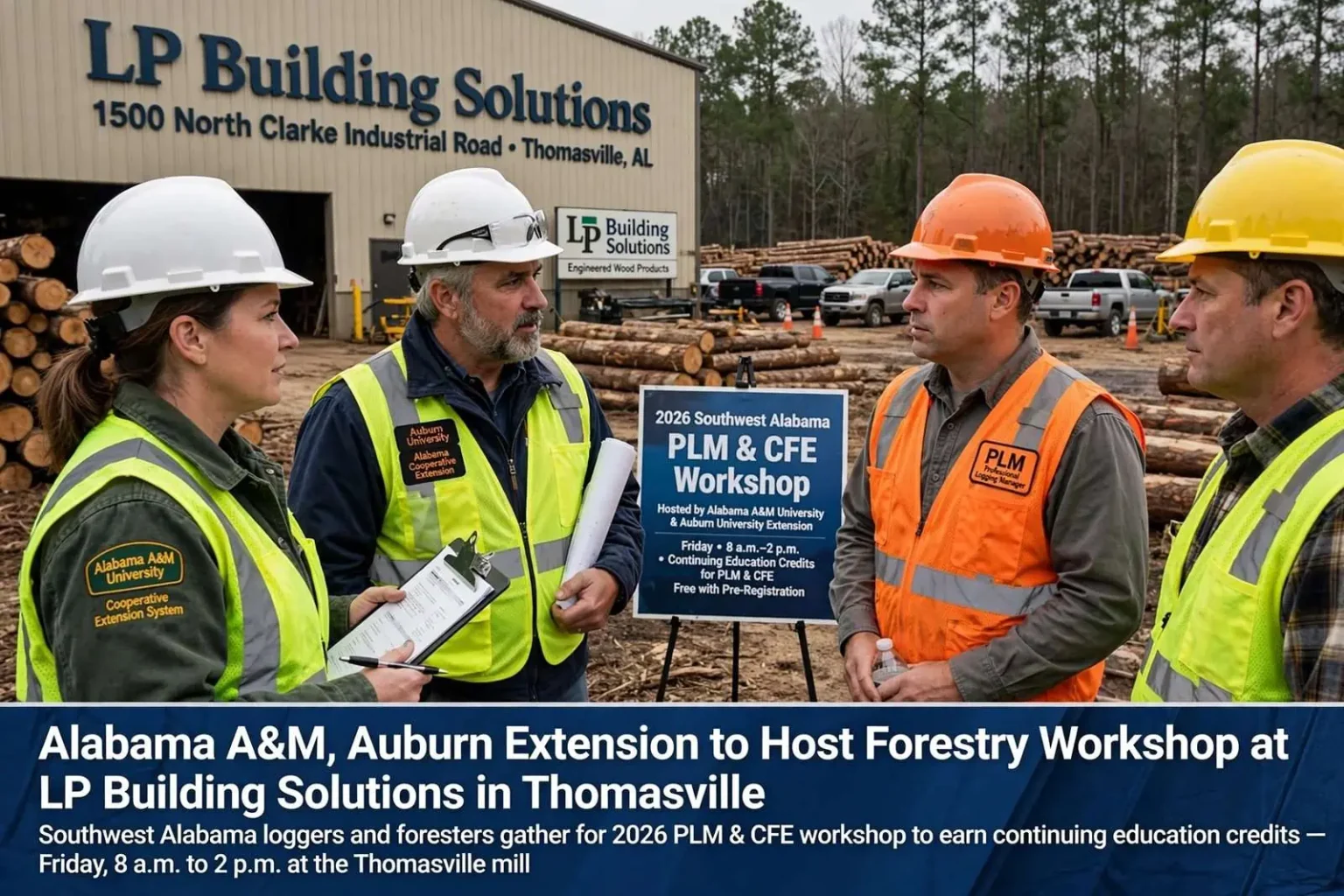
Forestry and logging professionals in southwest Alabama have a chance this week to earn continuing education credit at a workshop hosted at LP Building Solutions in Thomasville. The extension programs of Alabama A&M University and Auburn University will present the 2026 Southwest Alabama PLM and CFE workshop on Friday, bringing together loggers and foresters from across the region for a day of instruction, mill knowledge, and the credit hours they need to keep their professional credentials current.
The event allows attendees to earn credit hours needed to maintain their Professional Logging Manager certification or to fulfill Continuing Forester Education requirements, the two credentials that keep Alabama’s logging and forestry professionals in good standing. For working loggers, the PLM designation is not an honorific; it is a standing requirement tied to how timber is harvested in the state, and keeping it current means staying trained in the practices that protect water quality, safety, and the long-term health of the state’s forests. For registered foresters, CFE hours serve a parallel purpose, ensuring that the professionals who manage timberland keep pace with changing science, regulation, and markets.
The venue itself is part of the draw. The workshop will include a tour of the LP Building Solutions mill, giving attendees a firsthand look at how the region’s raw timber is transformed into engineered building products at one of southwest Alabama’s major industrial operations. For loggers whose loads feed mills like this one, seeing the manufacturing end of the supply chain provides context that classroom sessions cannot, from how raw material is received and sorted to what mill operators look for in the wood that arrives at their docks.
Who is behind the workshop
The extension programs of Alabama A&M University and Auburn University are the two land-grant institutions that together anchor the Alabama Cooperative Extension System, the statewide outreach arm that carries university research into the field. Forestry and wildlife programming is one of the system’s core missions in a state where timber is a leading agricultural industry, and the two universities have long divided and coordinated their outreach so that loggers, landowners, and foresters in every region have access to training close to home. A joint workshop under both names signals exactly that mission: university expertise delivered in a working-industry setting rather than a campus auditorium.
Alabama’s forests cover a majority of the state’s land area, and the forest products industry supports tens of thousands of jobs across sawmills, pulp and paper operations, and engineered-wood plants, with a heavy concentration in the state’s rural counties. Southwest Alabama, including Clarke County where Thomasville sits, has been timber country for generations, and the professionals the workshop serves are the people who harvest, transport, and manage that resource. Training requirements like the PLM program exist because the industry’s environmental footprint depends directly on the practices of individual logging crews, from streamside buffers to road construction on sloped ground.
The Professional Logging Manager program is Alabama’s continuing-education framework for logging professionals, requiring periodic training hours to maintain active status. Topics covered across the PLM curriculum range from sustainable harvesting practices and Best Management Practices for water quality to safety, business management, and regulatory updates. Continuing Forester Education hours play the same role for registered foresters, who must accumulate approved hours on a recurring cycle to keep their licenses active.
Thomasville, the largest city in Clarke County, has built its economy around the forest products industry, and the LP Building Solutions operation on North Clarke Industrial Road is among the city’s anchor employers. The mill converts regionally harvested timber into engineered wood products, the kind of manufactured building materials that have become a staple of modern construction. Hosting the workshop at the mill places the training where the industry actually operates, close to the logging crews and timber buyers who supply it, in a part of the state where forestry is not an abstract subject but the backbone of the local economy.
The setting also reflects the working relationship between mills and loggers. Engineered-wood manufacturing depends on a steady, well-managed flow of raw material, and the loggers who deliver it are the industry’s front line. A mill tour shows attendees the receiving end of their work: how trucks are weighed and unloaded, how wood is sorted by grade and dimension, and how the quality of harvest and transport practices affects what the mill can produce. That feedback loop, from harvest practices to finished product, is one of the quiet strengths of holding a logging and forestry workshop on active industrial ground.
Practical details for attendees
Organizers have asked participants to wear long pants and closed-toed shoes for the mill tour, a requirement consistent with industrial plant safety rules. Working mills are active manufacturing environments with moving machinery, heavy vehicles, and wood-processing equipment, and visitors are expected to dress for that setting. The requirement is a small detail that underscores the nature of the event, which is designed to put professionals into the spaces where the industry works rather than to keep them behind a projector screen.
The workshop runs from 8 a.m. until 2 p.m., a schedule that lets attendees complete their credit hours and still travel home the same day. Lunch will be provided, and the workshop is free to attend, removing the cost barriers that can keep independent loggers and small-firm foresters from pursuing continuing education. Organizers note that pre-registration is required, so anyone planning to attend should register in advance rather than arrive at the door, both so that credit hours can be properly documented and so that lunch and materials can be planned for the right headcount.
The address for the event is straightforward: LP Building Solutions is located at 1500 North Clarke Industrial Road in Thomasville. For attendees coming from across southwest Alabama, the location sits within reach of the region’s timber-producing counties, from the Black Belt into the coastal plain, making the Friday workshop accessible as a day trip for most of the logging and forestry professionals it targets.
The partnership behind the workshop is as notable as the event itself. Alabama A&M University in Huntsville and Auburn University are the state’s two land-grant institutions, and their extension programs jointly operate the Alabama Cooperative Extension System, which delivers research-based education in agriculture, natural resources, and community development in all 67 counties. By pairing their forestry and logging outreach for a regional workshop, the universities put both institutions’ expertise in front of southwest Alabama professionals in a single day, and the credit hours attendees earn count toward credentials recognized statewide.
Continuing education of this kind matters in an industry where practices evolve with research and regulation. Water quality rules, equipment technology, safety standards, and market conditions all change, and the credit-hour framework exists to make sure the people working in the woods and managing the timberland stay current. A logger who maintains PLM status is, by definition, a logger who has kept up with that training cycle, and the workshop model, in-person sessions combined with facility tours, has long been the preferred way to deliver it, because the material lands better when it is taught in an industrial setting alongside peers.
The bigger picture for southwest Alabama
Events like the 2026 Southwest Alabama PLM and CFE workshop also reflect how the region’s forestry economy sustains itself. Timber in Alabama is a renewable crop, harvested and replanted on a decades-long cycle, and the industry’s long-term health depends on trained professionals at every link: landowners who manage their stands, foresters who plan and supervise the work, loggers who execute the harvest, and mills that process the wood. Each professional credential in that chain represents hours of accumulated training, and workshops like this Friday’s event are where those hours are earned.
For Thomasville and Clarke County, the choice of the LP Building Solutions mill as the venue reinforces the city’s identity as a forest products hub. Industrial employers like the mill provide the demand that supports logging jobs across the surrounding counties, and a well-trained logging workforce is part of what keeps that operation competitive. A free, daylong workshop that refreshes the credentials of the region’s loggers and foresters is a modest investment with returns that ripple through the supply chain.
Professional logging and forestry workers in southwest Alabama who need PLM or CFE credit hours have a direct path to them this week: the 2026 Southwest Alabama PLM and CFE workshop, presented by the extension programs of Alabama A&M University and Auburn University, runs Friday from 8 a.m. until 2 p.m. at LP Building Solutions, 1500 North Clarke Industrial Road in Thomasville. The event includes a tour of the mill, lunch is provided, and attendance is free with pre-registration required. Participants should come dressed for the mill floor, with long pants and closed-toed shoes, and leave with the credit hours that keep Alabama’s forestry professionals certified, current, and connected to the industry they serve.