Alabama Auditor Sorrell Predicts Closed Primary Law Will Pass in 2027
State Auditor Andrew Sorrell predicts legislation closing Alabama's party primaries will pass in the 2027 legislative session.
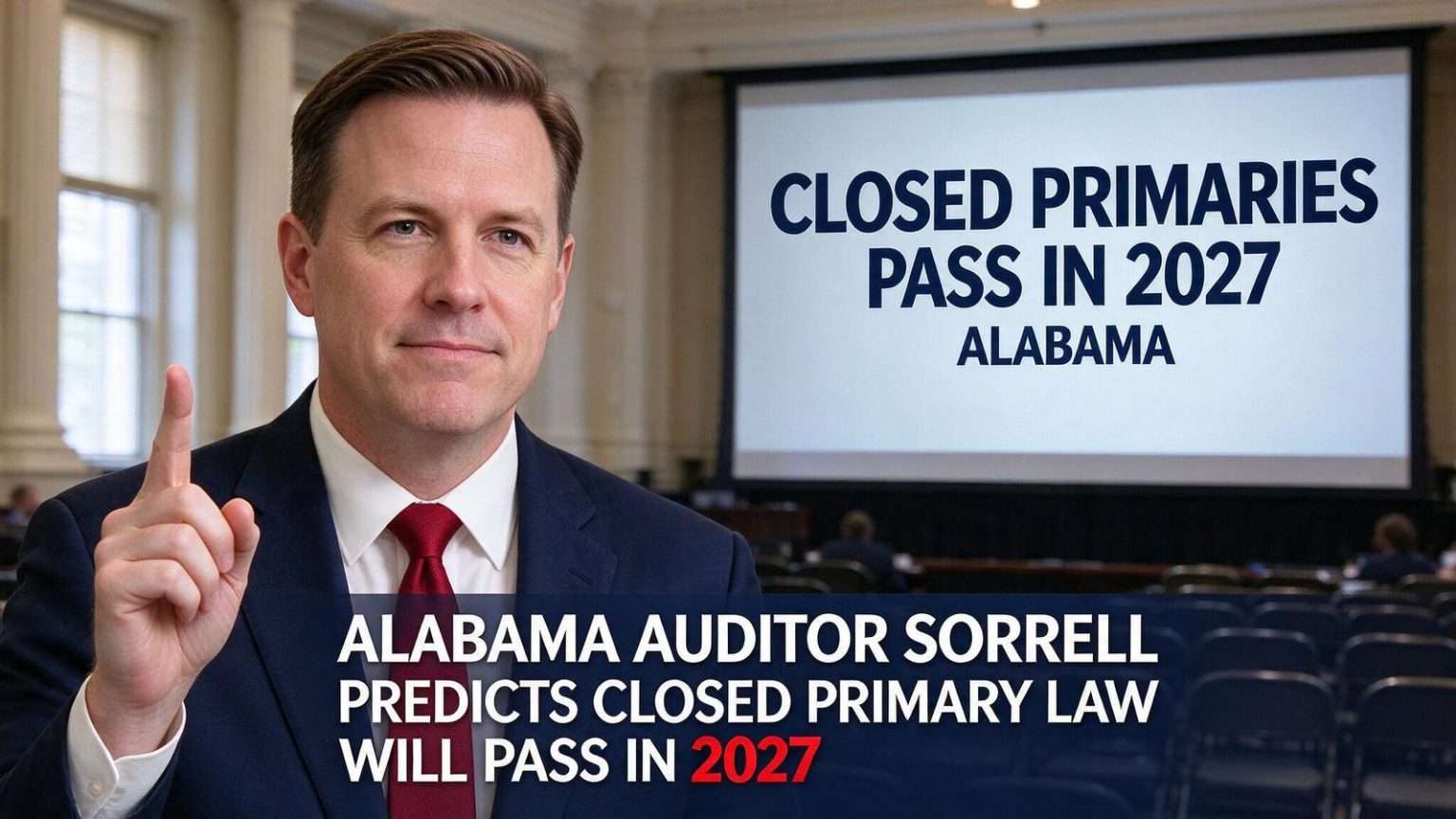
State Auditor Andrew Sorrell said during a radio interview this week that he expects legislation closing Alabama’s party primaries to finally pass during the 2027 legislative session, after a similar effort stalled in the state Senate last year.
Sorrell said a faction of elected officials in Montgomery worked last session to keep legislation ending crossover voting from becoming law. “They were toying with us,” he said. “There were reasons that the bill was introduced and moved through the House quickly, and it had to do with some comments that Nathaniel Ledbetter made about his opinions on the value of the Republican Party. That moved the bill through the House quickly, and then it stalled in the Senate. I believe the plan was never for that bill to make it all the way through last session. That’s exactly what I believe happened.”
Crossover voting — the practice of members of one party casting ballots in the other party’s primary — is possible in Alabama because the state has no system of registration by party. Any qualified voter may choose either party’s ballot on election day, and in a state where Republican primaries effectively decide most statewide and legislative races, supporters of closed primaries argue that voters outside the party should not help choose its nominees. Critics of closure counter that restricting primaries would disenfranchise independent-minded voters and add a new layer of election administration to a state that has never maintained party rolls.
A Platform Fight at the State Party Level
Sorrell also discussed a closed-primaries amendment he authored to the Alabama Republican Party’s platform. “We have never amended the platform in nine years. The platform has never once been amended. My goal was to pass the first-ever amendment to the Alabama Republican Party platform,” he said. The amendment states support for legislation prohibiting members of other political parties from voting in Republican primaries.
Sorrell said it passed unanimously by voice vote at an Aug. 1 meeting attended by 300 to 350 people. “There was not a single person in there who said no when Chairman Stathagen asked for no votes,” he said.
Sorrell said the platform change gives the state party chairman new leverage to push lawmakers on the issue. “What we’ve done is we’ve given the chairman of the Republican Party the ability to go to the legislature and say the party now demands this,” he said. “We literally put it in our platform. So if a legislator, a senator or a House member, is going to vote against party registration, they’re not just voting against party registration. They’re not just voting against a resolution of the party; they’re voting against the written platform of their own party.”
Why the Legislative Path Has Been Hard
The 2027 session Sorrell pointed to will open the next four-year cycle in the Alabama Legislature, a fresh start that supporters of the measure hope will reset the arithmetic that sank it before. Bills that fail in one session can be carried over or reintroduced in the next, and the intervening legislative elections will have reshaped both chambers by the time lawmakers reconvene. Sorrell’s read of last session was blunt: in his view, the bill’s rapid movement through the House was designed to burn off political pressure while its defeat in the Senate was preordained.
The dynamics he described are familiar ones in Montgomery. The Alabama House, with its large Republican majority, has repeatedly been the faster mover on party-aligned legislation, while the Senate’s smaller membership gives individual senators more leverage to slow or bury bills that divide their conference. A closed-primary bill touches sitting legislators directly — it changes the electorate that decides their own renomination — which is part of why similar measures in other states have often taken multiple sessions and sustained outside pressure to become law.
Supporters of closure point to the structure of Alabama elections as the core of their argument. In most of the state, winning the Republican primary is tantamount to winning the office, so the electorate that matters is the primary electorate. If voters who intend to support the other party in November can still participate in that primary, they can push a party’s nomination toward a candidate it would not otherwise choose. Closed-primary advocates describe that as a form of interference; opponents describe the same voters as independents exercising a legitimate choice in publicly funded elections.
Implementation is the other obstacle. Closing primaries would require some mechanism for verifying party affiliation, which Alabama has never collected. States that run closed primaries maintain party registration at the time of voter registration or through a separate declaration process, with varying rules about how and when a voter may change affiliation. Creating such a system in Alabama would touch registration forms, absentee voting, and list maintenance at the county level, giving secretaries of state and county registrars a practical stake in any bill that reaches the floor.
The State Auditor’s Unusual Platform
Sorrell’s advocacy is itself notable because of the office he holds. The Alabama State Auditor’s constitutional duties are narrow — chiefly maintaining records of state property and inventory — and the office carries little formal influence over election law. That has historically made the position a platform from which ambitious politicians build a public profile, and Sorrell has used it that way, speaking on party organization and election policy well outside the technical bounds of his job description. His authorship of a platform amendment, rather than legislation, reflects the only tools available to a constitutional officer who wants to move a bill he cannot sponsor.
The amendment’s unanimous adoption is the detail Sorrell leans on hardest. Party platforms are typically rewritten wholesale at conventions with little individual scrutiny, and a document that has gone unamended for nine years suggests the party treats it as background text rather than a binding agenda. Amending it at all — and doing so on a contested subject, by a voice vote with no recorded opposition — turns a boilerplate document into an organizing commitment that officeholders in the party now have to reckon with when they vote on the underlying bill.
What Happens Next
The practical effect of the platform change will be tested when the next bill arrives. A chairman armed with a platform commitment can make the vote a loyalty question for Republican legislators, press candidates to commit during primary campaigns, and rally county parties behind the measure. Sorrell’s prediction of passage in 2027 amounts to a bet that the combination of a fresh quadrennium, an expressed party demand, and another round of legislative elections will change enough minds to move the Senate where persuasion alone did not.
Opponents of the change, inside and outside the party, will meanwhile continue to make their own case: that primaries are public elections administered with public money, that adding a registration hurdle could suppress overall turnout, and that Alabama’s one-day crossover tradition has deep roots in a state where Democratic primaries once played the identical gatekeeping role that Republican primaries play now. The debate over who gets to vote in a party’s nominating contest is, in that sense, very old in Alabama — the parties have simply traded places.
For now, the legislation remains on the horizon rather than the calendar. Sorrell said his expectation is that the bill that stalled last year will return with the new session, backed this time by a party platform that names closed primaries as an explicit demand, and that the Senate stall of the previous year will prove to have been the last roadblock rather than a permanent one.
The radio interview in which Sorrell laid all of this out was aimed at exactly the audience most likely to pressure legislators on the issue: politically engaged Republican voters who follow party machinery closely. By walking listeners through the mechanics of the Senate stall and the platform vote, he was effectively distributing a narrative that casts support for the bill as a test of party fidelity and last year’s failure as the product of deliberate maneuvering rather than ordinary legislative friction.
That framing matters because Alabama legislators answer first to primary electorates, and a widely repeated story about who blocked the bill can follow a senator into the next campaign. Sorrell’s account — that the House passage was staged, that a faction in the Senate never intended to let the bill reach the governor’s desk, and that the platform now stands as the party’s official demand — gives closed-primary advocates a ready-made question for any incumbent running for renomination in 2026 and beyond.
Whether the 2027 session fulfills Sorrell’s prediction will depend on the same forces that decide most contested legislation in Montgomery: the priority leadership assigns to the bill, the coalitions that form for and against it, and whether the party’s stated demand translates into sustained pressure on the members who control the Senate’s calendar. Sorrell said he believes the pieces are now in place; the session itself will supply the verdict.