Alabama Bill Would Give Firefighters Supplemental Cancer Coverage
HB360 would give Alabama firefighters supplemental cancer insurance. Mobile Fire Chief Mark Sealy, a cancer survivor, backs the measure.
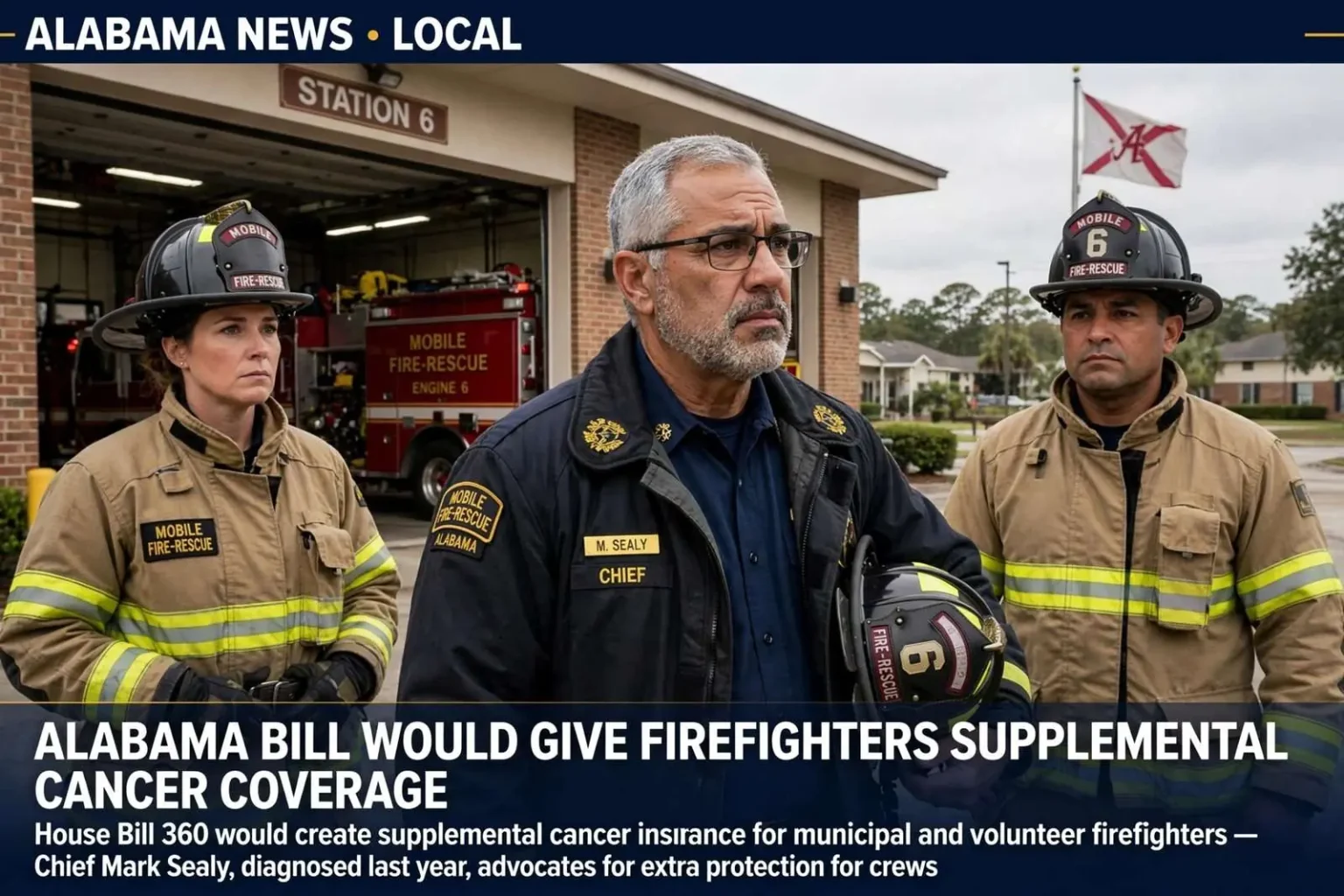
A bill moving through the Alabama Legislature would create a supplemental cancer insurance policy for municipal and some volunteer firefighters — an issue Mobile’s fire chief knows personally. House Bill 360 aims to close the gap left by standard workers’ compensation, which often leaves firefighters and their families to absorb the cost of cancer treatment that follows years of breathing smoke, chemicals and toxins on the job.
Firefighters face elevated cancer risks from exposure to smoke, chemicals and toxins encountered on the job. Fires today burn materials far different from what earlier generations of firefighters faced: plastics, synthetics, treated fabrics and household chemicals release a dense mix of carcinogens when they burn. Those substances soak into turnout gear, settle on skin and linger in fire stations, which means exposure does not end when the truck rolls back into the bay. Health researchers have documented elevated rates of several cancers among career firefighters compared with the general public, a finding that has pushed departments nationwide to change how gear is cleaned, how crews decontaminate after fires, and how departments protect their people over long careers.
A chief’s personal connection
Mobile Fire-Rescue Chief Mark Sealy has been one of the bill’s most prominent advocates. He was diagnosed with early-stage kidney cancer last year and has spoken openly about how the news hit home, describing the moment as something no one ever expects to hear about themselves.
“Cancer is prevalent, it’s always somebody else,” Sealy said in discussing his diagnosis. “If someone else tells you, you have cancer it really is a shock.”
Sealy’s position puts him inside the very risk the bill addresses. Mobile Fire-Rescue crews respond to structure fires, vehicle fires and hazardous materials calls across Alabama’s fourth-largest city, and like firefighters everywhere they routinely work in smoke-filled environments even with modern protective equipment. Veteran company officers and chiefs often carry decades of cumulative exposure from thousands of emergency responses, and the health effects of that exposure can surface years after the fires themselves.
“Firefighters are inherently subjected to a higher risk of cancer than the public,” he said, adding that a supplemental policy could provide “an extra layer of protection for a member and their family,” especially when treatment keeps them off the job.
What the bill would do
House Bill 360 would establish a supplemental cancer insurance policy for municipal firefighters and some volunteer firefighters, paid coverage that sits on top of whatever workers’ compensation and health benefits already apply. The idea is straightforward: if a covered firefighter is diagnosed with cancer, the policy provides a benefit that can help replace lost income, offset treatment costs and support the family while the member undergoes care. Standard workers’ compensation was built around sudden, immediate injuries — a fall, a burn, an injury at a scene — and it often struggles to accommodate an occupational disease that may not appear until long after the exposures occurred.
That structure matters in Alabama, where fire protection outside the cities depends heavily on volunteer departments. Volunteer firefighters hold other jobs and train on their own time, and a cancer diagnosis for one of them can mean the loss of both a breadwinner’s income and a small department’s trained responder at the same time. A supplemental policy, backers argue, gives those men and women a financial safety net that the existing system simply does not provide.
The workers’ compensation gap
The problem the bill targets is one that fire service advocates have described for years. Workers’ compensation systems generally require an injured worker to show that an injury arose out of and in the course of employment, a test that works well for a broken leg suffered at a crash scene but poorly for a cancer diagnosis. Cancer has many possible causes, and an insurer can argue that a firefighter’s disease came from family history, lifestyle or any number of factors unrelated to the job. For a firefighter already facing chemotherapy, surgery and time away from work, fighting that argument can be overwhelming.
Some states have responded by adding presumptive provisions to their workers’ compensation laws, which treat certain cancers in career firefighters as job-related unless an employer can prove otherwise. Alabama has been slower to move in that direction, and that is where supporters say a supplemental insurance policy offers a practical middle path: rather than rewriting the entire workers’ compensation framework, the state would ensure that firefighters with cancer have dedicated money available when they need it most.
Advocates note that the cost of treating cancer is not only medical. A member who is off the job for treatment may exhaust leave, lose overtime that families depend on, or face out-of-pocket costs that a regular paycheck would have covered. A supplemental benefit is designed to fill exactly those holes, which is why Sealy described it as protection for “a member and their family” and not just for the individual firefighter.
Fire service exposure on the Gulf Coast
The issue resonates across the Gulf Coast, where departments from Mobile to Baldwin County respond to a heavy volume of structure and vehicle fires each year. Modern firefighting also brings repeated exposure beyond active fires: crews handle hazardous materials spills, respond to industrial incidents along the port and petrochemical corridor, and work around diesel exhaust in their own stations. Studies of firefighter health have repeatedly pointed to the cumulative nature of these exposures, and national fire service organizations have urged departments to treat cancer prevention as a core safety function alongside heart health and roadway safety.
Departments in Alabama have already begun changing practices. Many now require a second set of turnout gear so contaminated items are not worn in living quarters, mandate gross decontamination at the scene before crews ride back, and encourage annual physicals that can catch disease early. Those measures reduce risk, but they cannot eliminate it, and they do nothing for firefighters whose exposure came in earlier decades. A financial backstop, supporters of House Bill 360 say, is the missing piece.
The amendment and what comes next
The legislation remained in committee as lawmakers weighed a new amendment requiring cities to approve the coverage by a two-thirds vote before it takes effect. That requirement would give municipal councils across the state a direct decision on whether to opt in, rather than having the coverage apply automatically. Supporters of the amendment argue that cities should control whether they take on the expense; opponents counter that a supermajority threshold makes it far easier for coverage to stall, since a handful of council members can block what a simple majority favors.
For Mobile and other Alabama cities, the decision would carry real budget implications, but also real stakes for the workforce. Fire departments already compete for qualified candidates, and benefits packages are part of how cities recruit and retain them. If the bill advances with the amendment attached, the choice will land with city councils, including the Mobile City Council, in the session ahead.
For now, the bill’s advocates — a fire chief among them, with his own diagnosis behind him — are pressing lawmakers to keep it moving. Sealy’s argument, in essence, is that the people who run toward the smoke should not be left to face the consequences alone.
Why firefighters are at higher risk
The science behind the bill traces back to how fires burn in modern homes and businesses. A half-century ago, household contents were dominated by natural materials such as wood, cotton and wool, and fires burned more slowly and released different combustion products. Today’s interiors are filled with polyurethane foam furniture, composite building materials, electronics and synthetic fabrics, all of which produce a heavier load of toxic compounds when they ignite. Firefighters arriving minutes after ignition work in that environment, and even with self-contained breathing apparatus, skin absorption of chemicals that pass through soot-contaminated gear has been identified as a major exposure route.
Fire service health researchers have documented elevated rates of several cancers among career firefighters compared with the general public, and the International Agency for Research on Cancer now classifies occupational exposure as a firefighter as carcinogenic to humans. That classification, based on years of study, gave new weight to arguments in statehouses across the country that cancer should be treated as an occupational hazard of firefighting rather than an unlucky coincidence.
The exposure question also extends to the firehouse itself. Diesel exhaust from apparatus idling in the apparatus bay, contaminated gear stored near living quarters, and old habits like wearing bunker gear into the kitchen have all been recognized as avoidable exposures, and departments that adopted stricter hygiene rules did so precisely because the evidence of risk became impossible to ignore. Mobile Fire-Rescue and departments across Baldwin, Mobile and surrounding counties have taken part in that broader shift in recent years.
What it means for local families
Behind the legislative language are households across Mobile County and beyond. When a firefighter is diagnosed with cancer, the impact lands on spouses, children and extended family who juggle appointments, transportation and bills while a breadwinner is in treatment. Municipal health coverage may pick up a share of medical costs, but it does not replace lost overtime, cover every out-of-pocket expense, or stretch through months when a member cannot work at all. Those are the gaps a supplemental policy is written to fill, and they are the gaps Sealy described when he spoke about an extra layer of protection for members and their families.
The stakes are also practical for the departments themselves. Treating cancer as a recognized occupational risk is part of a larger effort to professionalize firefighter health, from baseline medical exams when a recruit is hired to regular screenings through a career. Fire service organizations argue that recognizing the risk — and funding against it — is one of the clearest ways a state can tell its firefighters that the hazard they carry home from every fire is real and acknowledged.
Lawmakers on the committee now hold the decision on whether the bill advances. With the two-thirds amendment under discussion, the outcome will shape not only what coverage looks like but which cities end up offering it. For the firefighters who spend their careers absorbing the smoke of other people’s emergencies, the measure would turn a long-recognized danger into a benefit they can count on, and its backers say no family should wait through another legislative session to see that happen.