Alabama Coastal Cleanup Marks 30th Year With New Recycling Partnership
The Alabama Coastal Cleanup returns Saturday, Sept. 16 for its 30th year, with a new partnership to recycle plastic waste collected from roughly 30 sites across Mobile and Baldwin counties.
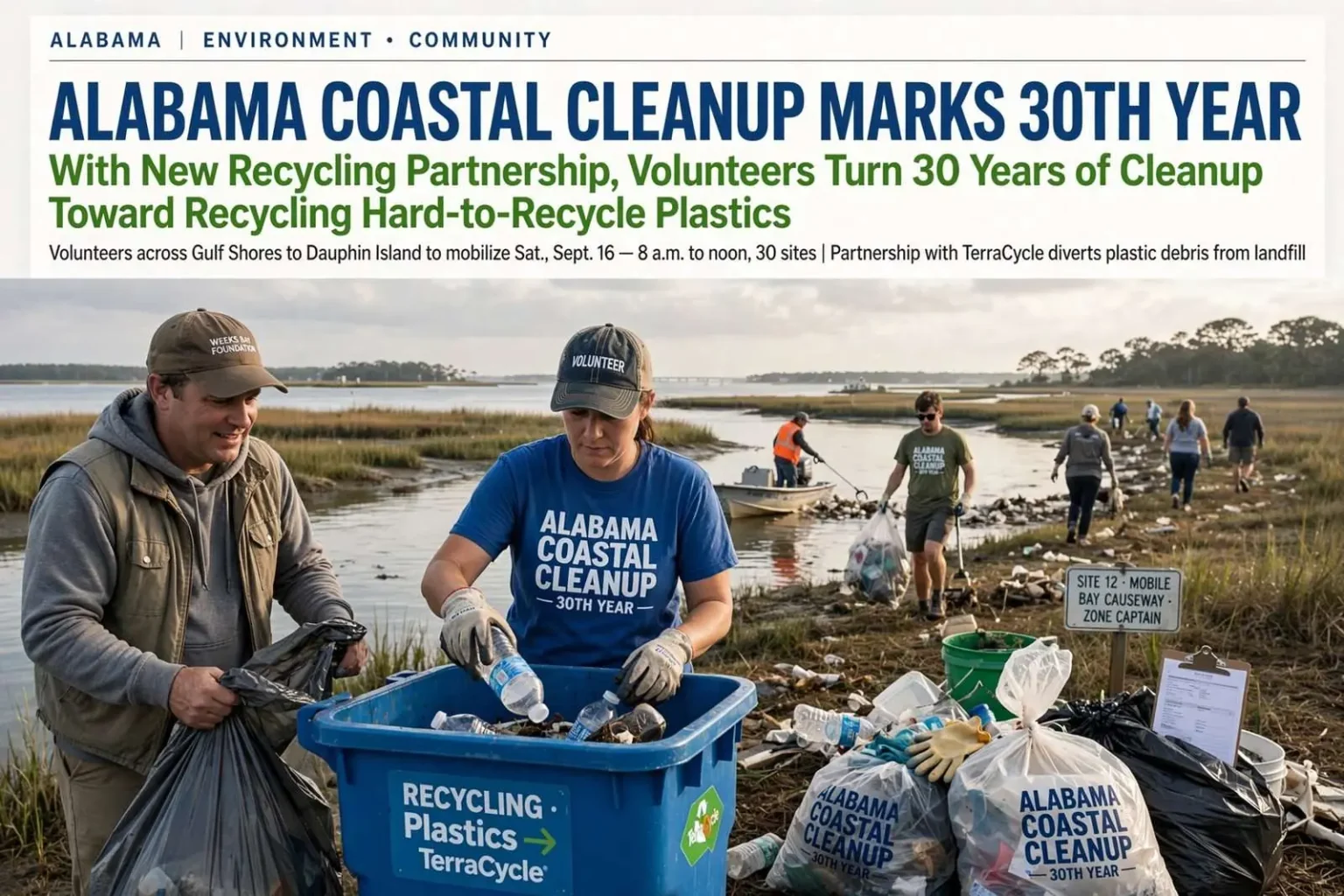
Volunteers up and down the Alabama coast will lace up their boots and grab trash bags on Saturday, Sept. 16, as the Alabama Coastal Cleanup returns for its 30th consecutive year.
The event, billed as the state’s largest single-day volunteer effort, runs from 8 a.m. to noon and invites residents and visitors alike to pull litter from beaches, waterways and marshes stretching from Gulf Shores to Dauphin Island. Organizers describe the cleanup as a chance to “get the trash out of the splash,” and this year’s event will draw volunteers to roughly 30 designated cleanup sites spread across Mobile and Baldwin counties.
Crews will work both on foot along shorelines and in boats on the water, targeting debris that collects in marshes, along causeways and on barrier islands. The geography of the effort is as wide as the coast itself — open Gulf beaches, the back bays, the Mobile-Tensaw delta fringes and the causeway shorelines all fall within the cleanup’s reach, and each zone has its own site captain organizing volunteers on the ground.
Three decades is a long run for any volunteer event, and the cleanup’s persistence says something about the coast it serves. Alabama’s shoreline collects debris from far beyond its own population: currents and storms deliver trash from up the Gulf, while local traffic — beach days, fishing trips, boating outings — adds its share. The cleanup is the one day a year when the entire coastal community turns out to reverse that ledger, and its 30-year unbroken streak has made it as much a fixture of the calendar as any festival.
A new push to recycle
New this year is an expanded push to recycle much of what gets collected rather than simply hauling it to a landfill. The Alabama Coastal Cleanup is partnering with TerraCycle, a company that runs free recycling programs funded by brands, manufacturers and retailers to process hard-to-recycle waste, including the washed-up plastic that regularly turns up on Gulf Coast beaches.
The recycling effort is being supported locally by the Weeks Bay Foundation, Thompson Engineering and the Alabama Coastal Foundation, which worked together to arrange plastics recycling stations at cleanup zones this year.
The addition reflects growing attention to the environmental toll of marine debris, particularly single-use plastics that can persist in coastal waters for decades and pose risks to fish, birds and other wildlife. By diverting collected plastics to TerraCycle’s recycling programs instead of the trash stream, organizers hope to give this year’s haul a second life rather than a spot in a landfill.
Beach plastic is uniquely difficult to recycle through ordinary channels. Saltwater, sand and sun degrade the material, and municipal recycling programs generally reject it as contaminated. TerraCycle’s model exists precisely for that gap — specialized processing funded by corporate partners — which is why a beach cleanup is an ideal fit. The local support team added a practical layer: stations where volunteers can sort plastics out of their bags before the haul ever reaches a truck.
The environmental logic behind the focus on plastics is straightforward. Unlike paper or natural materials, plastic does not biodegrade in the marine environment — it breaks into ever-smaller fragments that persist in the water and food chain. Bottles and bags floating in the bay are hazards to sea turtles that mistake them for food and to the fish that ingest the fragments. Keeping this year’s collected plastics out of the landfill does not erase the debris problem, but it closes part of the loop: material that would otherwise be buried gets processed back into usable form, and the cleanup’s footprint shrinks accordingly.
Three decades of numbers
The scale of the cleanup has grown steadily since it began in 1987. Last year alone, more than 4,200 volunteers turned out to collect close to 36,700 pounds of trash from sites between Gulf Shores and Dauphin Island.
Cumulatively, since organizers began formally tracking totals at the first cleanup three decades ago, more than 1.6 million pounds of trash have been pulled from Alabama’s coastline and waterways and disposed of properly.
Those totals put the event in national context. The Alabama cleanup operates alongside the Ocean Conservancy’s international coastal cleanup network, which coordinates similar efforts worldwide and tracks debris data from the volunteer reports. Each bag of trash logged by an Alabama volunteer contributes to that global picture — the items counted, the plastic types recorded — feeding the dataset that researchers and policymakers use to understand where marine debris comes from and what it is doing to coastal ecosystems.
The volunteer base itself is part of the accomplishment. More than 4,000 participants in a single morning represents schools, churches, civic clubs, businesses and families — a cross-section of both counties. For many young volunteers the cleanup is a first hands-on lesson in where litter goes, and organizers have long counted on the event’s educational ripple effect: a child who spends a morning pulling cigarette butts and bottles from a beach returns home with different habits.
The site captain system is what makes a dispersed event function as one operation. Each of the roughly 30 zones has a captain responsible for registering volunteers, distributing supplies, keeping the tally of what is collected and managing the disposal of the haul. Many captains have held their posts for years, and the institutional memory they carry — which coves catch the most debris, where boats can land, how to staff a causeway site — is a large part of the event’s accumulated expertise. New volunteers can request a particular zone or simply sign up where help is needed most.
Every volunteer who signs up to collect trash receives a T-shirt and cleanup supplies. Residents interested in participating, or in reaching a site captain to sign up for a specific location among the roughly 30 cleanup zones, can visit www.AlabamaCoastalCleanup.com or call 251-928-9792. Updates on the event are also posted to the Alabama Coastal Cleanup page on Facebook.
Who is behind it
This year’s cleanup is presented by the Poarch Band of Creek Indians, with additional support from a long list of sponsors that includes ExxonMobil, Alabama Power Company, the City of Gulf Shores, the City of Orange Beach, Riviera Utilities, Baldwin EMC, The Home Depot, Republic Services, NOAA, the Ocean Conservancy, Alabama PALS (People Against A Littered State) and the Alabama Department of Conservation and Natural Resources’ State Lands and Coastal divisions, among many others whose contributions help fund supplies, logistics and site coordination across both counties.
The sponsor roster illustrates what a three-decade volunteer event requires behind the scenes. T-shirts, gloves, bags and data cards for thousands of volunteers do not materialize without funding, and the logistics — distributing supplies to 30 sites, hauling collected debris, coordinating boats along the causeways — depend on corporate and public partners whose contributions cover the event’s operating costs. That a cleanup can attract this breadth of backing, from federal agencies to local utilities to the cities whose beaches benefit most, reflects how thoroughly the event has embedded itself in coastal civic life.
Why a single morning matters
Four hours of volunteer labor might seem like a small response to a debris problem that accumulates year-round, but the cleanup’s value compounds in several directions at once. The immediate effect is the removal of tons of trash from places where it harms wildlife and degrades the coast’s most valuable asset — its appearance. Beyond that, the data gathered feeds national research. And beyond both, the event recruits thousands of residents into an annual habit of stewardship that shows up in less visible ways through the rest of the year.
The marshes and causeways included in this year’s zones deserve particular mention, because that is where much of the worst debris collects. Plastic bottles, fishing line, foam and bags snag in the grasses at the marsh edge and stay there, out of sight of beachgoers but not out of reach of the birds, fish and crabs that live among them. Boat crews targeting those areas reach litter that shoreline walkers cannot, which is why the cleanup’s footprint extends beyond the sand.
The causeway zones carry their own history of debris. Long before the cleanup organized coverage there, the shorelines along Mobile Bay’s causeway accumulated decades of wind-blown and storm-driven litter that no single volunteer effort could clear. Regular annual passes by cleanup crews, combined with county and state maintenance, have gradually changed that picture — proof, organizers note, that repeated volunteer attention does more than a single heroic effort. The same holds for the barrier islands, where weekend boating traffic leaves behind a tide of cans and plastics that the September cleanup works to keep in check.
As the 30th edition approached, organizers framed the milestone simply: the coast’s debris problem has not gone away, but neither has the community’s willingness to fight it. On Saturday, Sept. 16, from 8 a.m. to noon, volunteers from Gulf Shores to Dauphin Island will write the next line in a tally that now exceeds 1.6 million pounds — and, for the first time, a portion of what they collect will head to recycling rather than a landfill, giving the cleanup’s fourth decade a goal its founders never had.