Cruise Terminal Car Counts Showed Mobile Was Pulling Passengers From Across the South
Car counts from the Alabama Cruise Terminal in downtown Mobile showed nearly 27,000 vehicles in the first 11 months of cruising, with passengers driving in from more than 50 states and Canadian provinces.
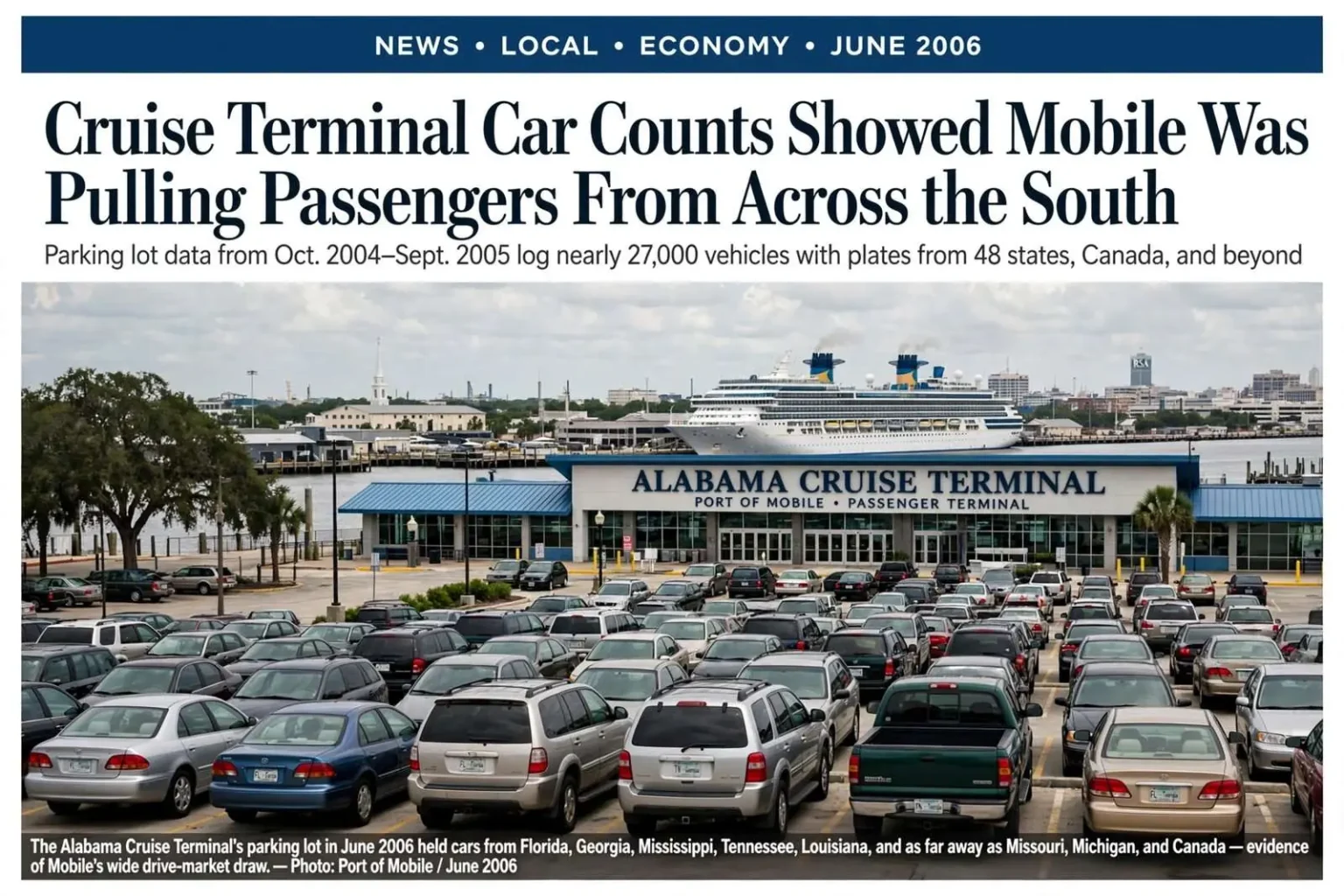
Parking lot data released in June 2006 offered the clearest evidence yet that the cruise business in downtown Mobile was drawing passengers from well beyond Alabama’s borders. Car counts from the Alabama Cruise Terminal showed nearly 27,000 vehicles in the first 11 months of operation, with license plates from virtually every state in the union. For a city that had invested heavily in a cruise terminal on the gamble that travelers would drive hundreds of miles to sail from Mobile, the lot was the scoreboard — and the plates told the story the city had been hoping to read.
The first 11 months
Between Oct. 16, 2004, and Sept. 3, 2005, the terminal logged 26,901 vehicles. Alabama accounted for the largest share by far, at 10,641 cars, but the out-of-state totals told the more interesting story: Florida — 3,368; Georgia — 3,312; Mississippi — 1,982; Tennessee — 1,798; Louisiana — 744; Missouri — 593; Kentucky — 512; Arkansas — 490.
The tail ran long and wide. Indiana, Illinois, Ohio, North Carolina, Texas and Michigan each sent hundreds of cars — proof that Mobile’s draw extended well beyond the adjacent states into the midwestern drive market that cruise lines prize. Ontario, Canada, contributed 54; Quebec, three; New Brunswick, one. Hawaii’s 46 vehicles carried an asterisk in the original data, which noted they represented military personnel reassigned to the mainland — a reminder that the Gulf Coast’s military connections, from Pensacola to the ports along the Gulf, put transplanted service members in Mobile’s passenger pool alongside vacationing families.
Reading the numbers geographically, the pattern made immediate sense. Mobile sits within a day’s drive of an enormous share of the American South: Atlanta is roughly five hours away, Nashville and New Orleans about four, Memphis and St. Louis within reach of a long morning’s start. A family in any of those cities could load the car on a Saturday and be standing on a cruise ship’s gangway by Sunday afternoon — no airfare, no connecting flights, no baggage fees.
The spring 2006 season
A second tally covering March 27 through June 15, 2006, showed 7,791 vehicles over roughly 11 weeks, with a noticeably different geographic pattern: Alabama — 2,390; Mississippi — 1,233; Louisiana — 965; Florida — 684; Georgia — 662; Tennessee — 467.
The shift is worth pausing over. In the first period, Florida and Georgia ranked second and third. In the spring 2006 numbers, Mississippi and Louisiana had climbed above both. The intervening event was Hurricane Katrina, which struck the Gulf Coast in August 2005 and devastated the port and tourism infrastructure of New Orleans and the Mississippi coast. With cruise operations disrupted to the west, Mobile’s terminal became the nearest embarkation point for a large population of Gulf Coast travelers — residents of New Orleans and the Mississippi Gulf Coast who would previously have driven to their own ports now found Mobile was the drive that worked.
The Katrina effect cut in Mobile’s favor in another way as well: hotel and motel stock on the Mississippi coast was damaged or occupied by displaced families and recovery workers, making pre-cruise and post-cruise lodging in Mobile a practical necessity for those travelers. The spring 2006 numbers captured a port benefiting from its neighbor’s misfortune — a windfall no one would have wished for, but one that demonstrated exactly how much of the terminal’s business was elastic, drive-market demand rather than local loyalists.
Why car counts mattered
Cruise passenger counts alone tell a city how many people boarded a ship. Car counts tell it something more useful: where those people came from, and therefore how far the terminal’s gravitational pull extended. A passenger driving from Nashville, St. Louis or Atlanta does not simply park and sail. They buy gas, eat a meal, and in many cases spend a night in a Mobile hotel before or after the cruise. That drive-market economics is the entire business case for a mid-sized regional cruise port.
A cruise ship sailing from Miami or Port Canaveral delivers passengers to a market with a dozen competing attractions; a ship sailing from Mobile delivers a driving family to a downtown that otherwise sees them never. The city’s projections for the terminal — restaurant traffic downtown, hotel nights around the convention district, spending at attractions along the waterfront — all depended on passengers arriving early and lingering late, and the license plates proved the arrivals were happening from far away.
The Alabama Cruise Terminal, which opened in 2004 as a signature downtown investment, was built on precisely that bet: that Mobile could serve as the embarkation point for a driving radius stretching hundreds of miles into the interior South. The numbers made the case. More than 16,000 of the first 26,901 vehicles came from outside Alabama, meaning roughly three in five cars in the terminal lot belonged to visitors. For a port operating on the scale Mobile was, that out-of-state share was the difference between a regional attraction and a local amenity — and it validated the marketing pitch cruise lines had used when they agreed to homeport ships on the Mobile River in the first place.
The longer arc of Mobile’s cruise business
The cruise business in Mobile proved volatile in the years that followed. Ships came and went as cruise lines redeployed vessels to more profitable markets, and the terminal spent stretches without a homeported ship at all before service returned. Cruise lines are famously mobile tenants — a vessel can be repositioned to the Caribbean, to Europe or to a new homeport with a season’s notice, and operators continually rebalance capacity toward the itineraries and departure cities that sell best. Mid-sized ports like Mobile live at the mercy of those decisions.
The volatility made the 2004-2006 data more valuable, not less, because it documented what the market looked like when the terminal was fully operating. The license-plate surveys established Mobile’s catchment: a homeport on the Mobile River draws from every Gulf state, the lower Midwest, the Tennessee Valley and the Southeast — and, in the spring after Katrina, from a coast full of travelers with no port of their own. Any future operator considering Mobile would find in that data a ready-made answer to the question of where the passengers come from.
For a city arguing that its waterfront could be an economic engine rather than merely an industrial one, a parking lot full of out-of-state plates was as persuasive a piece of evidence as anyone could ask for. The cars came from Alaska to Rhode Island, and from every state that touches the Mississippi River; the passengers they carried spent their money on the way through town; and the terminal’s first two years proved that, given a ship to sail on, the drive market would find Mobile.
The terminal and the downtown revival bet
The car-count data landed in the middle of a larger argument about downtown Mobile’s future. The Alabama Cruise Terminal opened in 2004 on the Mobile River waterfront as part of the city’s push to add civic attractions to a district long dominated by industry — a period that also produced the convention center expansions, the RSA tower investments and the early stages of the waterfront planning that continues today. Cruise passengers were imagined as the vanguard: tens of thousands of visitors a year delivered to the foot of downtown, many of them with an evening or a morning to fill.
The license-plate survey supported the vision in specifics as well as generalities. The heavy representation of Tennessee, Missouri, Kentucky and Arkansas — markets with no coastline of their own — showed that Mobile was functioning as a substitute seaport for the landlocked interior South. Those travelers were the ones most likely to need a hotel room before an early embarkation, and their cars in the lot were exactly the customers downtown restaurants and attractions had been built to capture.
Local travelers mattered differently. Alabama’s 10,641 vehicles, and the strong Mississippi and Louisiana showings in both periods, represented the short-drive market that could sustain weekend sailings on a year-round basis. A healthy regional port needs both audiences: the far-flung drivers who fill hotels, and the near-market families who fill weekday sailings and return twice. The 2004-2006 counts showed Mobile drawing each in volume.
What the plates meant for the future
The survey methodology itself — counting vehicles at the terminal lot by license plate — was a low-cost, high-value piece of market research. Ports spend heavily on passenger surveys and tourism studies; the parking lot offered a simpler proxy. Every car represented a household that had chosen Mobile over New Orleans, Galveston, Tampa or Port Canaveral for its cruise departure, and the plate told the terminal’s operators which marketing regions were working. Data of that kind informed everything from hotel partnership packages to the pitch materials the port used with cruise lines weighing where to homeport a ship next.
The spring 2006 shift added a lesson about resilience. A port’s catchment is not fixed; it moves with the infrastructure around it. When neighboring ports are operating, they compete for the drive market on proximity and itinerary. When a Katrina knocks them out, the drive market flows to whoever can still sail — and Mobile proved it could absorb the surge. Ports that understand their catchment this way can invest with more confidence, and the 2006 data gave Mobile’s port authority an evidence base that its location, sitting between the growing Atlanta and New Orleans markets, was fundamentally sound.
Looking back from the vantage of the years that followed, the parking-lot numbers stand as the clearest snapshot of the terminal’s founding promise. Nearly 27,000 vehicles in eleven months, three out of five from beyond the state line, plates from every corner of the continent — the raw material of the economic-engine argument, gathered not in a consultant’s model but in a parking lot on the Mobile River, one family at a time.