Alabama EMA Chief Urges Counties to Prepare for Sweeping FEMA Overhaul
Alabama EMA Director Jeff Smitherman urges counties to prepare now for major FEMA funding changes that could reshape disaster relief.
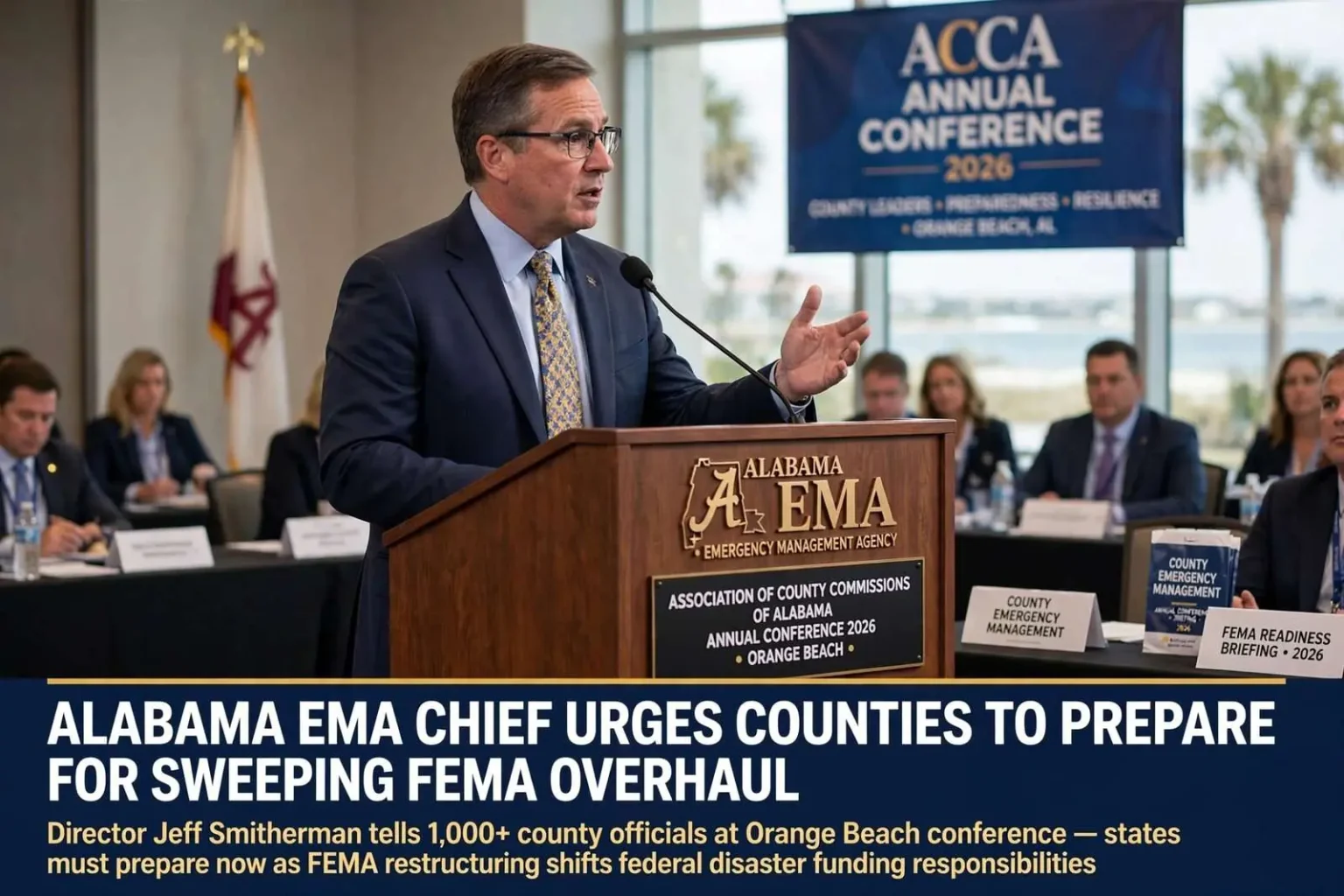
Alabama Emergency Management Agency Director Jeff Smitherman delivered a stark message to county leaders gathered in Orange Beach this week: the federal disaster funding landscape is shifting dramatically, and Alabama must act now or risk being left behind. Smitherman addressed more than 1,000 county officials at the Association of County Commissions of Alabama’s annual conference, outlining the sweeping changes ahead as the Federal Emergency Management Agency overhauls its operating structure and funding processes.
Speaking from a state that has weathered hurricanes, tornadoes, flooding and severe storms for generations, Smitherman framed the moment as a turning point. The federal disaster assistance that Alabama communities have long depended on will increasingly be steered to states that have already prepared the administrative groundwork. Local governments, he argued, cannot afford to wait for guidance from Washington before strengthening their own planning, documentation and recovery capacity.
The FEMA Review Council Report Signals Major Shift
The catalyst for these changes is the FEMA Review Council’s report, released in May 2026, which lays out a blueprint for fundamentally restructuring how the federal agency handles disaster preparedness and response. The plan places significantly more responsibility on individual states to help their citizens prepare for and manage disasters, rather than relying on a centralized federal approach that historically absorbed much of the front-end planning burden.
For Alabama, that shift carries real operational consequences. The state’s emergency management infrastructure will need to evolve rapidly to meet new expectations about pre-disaster mitigation, project documentation and reimbursement readiness. The changes affect everything from how disaster relief funds are allocated to the level of preparedness documentation states must maintain to qualify for federal dollars, and they will reshape the relationship between state emergency managers, county commissions and FEMA regional offices for years to come.
States That Prepare Now Will Benefit Later
Smitherman emphasized that the coming wave of federal funding will flow to states that have already positioned themselves strategically, and he urged county leaders not to wait for the changes to take full effect before taking action. “The money’s coming – we need to be postured and prepared to handle it,” Smitherman told the gathering in Orange Beach. “If we aren’t doing that work now, then when that money does come then we, collectively as a state, are going to be left behind and other states are going to get that funding.”
The warning is rooted in the practical reality of how disaster grants are awarded. Federal money for debris removal, emergency protective measures, road repairs and infrastructure restoration is typically distributed only after detailed documentation, damage assessments and project worksheets have been completed to FEMA’s specifications. States and counties that have invested in trained grant staff, streamlined procurement procedures and accurate damage-tracking systems generally recover faster and capture more dollars than those scrambling after the storm has passed.
Smitherman’s framing also reflects a broader national trend. The council’s recommendations are designed to push preparedness upstream, rewarding governments that demonstrate they have done the planning work before a disaster hits. For Alabama, where coastal counties face hurricane risk, the Tennessee Valley contends with severe weather and inland communities regularly respond to tornado outbreaks, the case for early preparation is especially strong. The next major event is treated not as a question of if but when, and the question becomes which state will be ready to deploy funds quickly when it arrives.
Implications for Local Emergency Management
The message carries particular weight for Alabama’s county-level leaders, who serve as the first line of defense when disasters strike. Hurricanes, tornadoes and severe weather events have repeatedly shown that the most effective response begins at the local level, with county emergency management agencies coordinating first responders, opening shelters, dispatching resources and keeping residents informed.
Under the new federal framework, counties will likely shoulder a larger share of the pre-disaster workload as well. Documentation requirements, mutual aid agreements, hazard mitigation plans and recovery project files are all expected to receive heightened scrutiny. Smitherman’s message to the more than 1,000 county officials gathered at the Orange Beach conference was that the counties that begin strengthening those systems now will be best positioned to capture funding once the new federal structure is fully in place.
A Conference in Orange Beach
The Association of County Commissions of Alabama’s annual conference brought together officials from across the state to discuss not only federal policy but also the operational realities of running county government. Held on the Gulf Coast in Orange Beach, the gathering underscored the vulnerability of coastal Alabama to tropical systems and storm surge while also highlighting the state’s broader exposure to severe weather of every kind.
Smitherman’s remarks came as the Alabama EMA continues to adjust internally to the federal changes already underway. Agency staff have been meeting with county emergency managers, regional FEMA representatives and other state agencies to align procedures, training and reporting with the new federal expectations. That coordination, he suggested, is itself part of the work Alabama must do now to remain competitive for federal disaster dollars in the years ahead.
What Local Officials Are Being Asked to Do
Beyond listening to the policy overview, county leaders attending the conference were encouraged to review their own emergency operations plans, update hazard mitigation strategies and identify gaps in staffing and equipment that could slow recovery after a federally declared disaster. Many of the same counties already conduct annual exercises with state and federal partners, but Smitherman’s message implied a higher bar going forward, with closer review of whether local plans meet the documentation standards expected under the new framework.
For counties still recovering from past storms, the message also carried a practical reminder. Open projects, unresolved damage assessments and outstanding reimbursement claims may all be affected as the federal rules change, and proactive cleanup of those files can help ensure Alabama does not leave federal money on the table. The EMA has signaled that it intends to help counties work through those backlogs as part of the broader preparation effort.
Looking Ahead
The full implementation of the FEMA Review Council’s recommendations will unfold over months and years rather than weeks. But Smitherman’s appearance at the Orange Beach conference made clear that Alabama’s emergency management community is treating the report as a near-term to-do list rather than a distant forecast. From the coastal counties preparing for another hurricane season to the inland jurisdictions bracing for spring tornado outbreaks, the message was the same: the rules are changing, the money will follow the preparation, and Alabama intends to be ready when it counts.
Why Alabama’s Risk Profile Makes the Stakes Higher
Few states face the range of natural hazards that Alabama does in any given year. The Gulf Coast shoreline brings the threat of hurricanes, tropical storms and storm surge that can reshape beaches, damage ports and inundate coastal roads. Farther inland, the state’s position in the southeast places it squarely in the path of tornado outbreaks that develop quickly during the spring and late fall. Between those extremes, river flooding, severe thunderstorms, ice storms and the occasional drought round out a hazard profile that keeps county emergency managers busy through every season.
That diversity of risk has historically made Alabama one of the larger recipients of federal disaster assistance. From coastal communities that have rebuilt seawalls and boardwalks after major hurricanes to inland counties that have replaced water systems after tornadoes, the federal-state-local partnership has been central to recovery. Under the new framework, that partnership is being renegotiated, and Smitherman’s appearance in Orange Beach was a clear signal that Alabama wants to enter the new era with its planning already in place.
Coordination Across State and County Levels
Alabama’s emergency management structure depends on close coordination between the state agency in Clanton, the state’s 67 county emergency management offices, municipal first responders and federal partners led by FEMA Region IV in Atlanta. That web of relationships has been tested repeatedly, most recently during major hurricane seasons along the Gulf Coast and tornado outbreaks across central and north Alabama. The review council’s recommendations assume that the same network will continue to do the heavy lifting, but with state agencies playing a more deliberate planning role and counties being held to clearer documentation standards.
Smitherman told the conference that his team has already begun meeting with county leaders across the state to walk through what those new expectations will mean in practice. Those conversations are expected to continue as the federal rule-making process advances and as the Alabama EMA refines its own internal procedures. For county leaders, the practical takeaway from Orange Beach was that the era of waiting until after a disaster to think about preparedness documentation is ending, and the era of treating preparedness as a permanent line item is arriving.