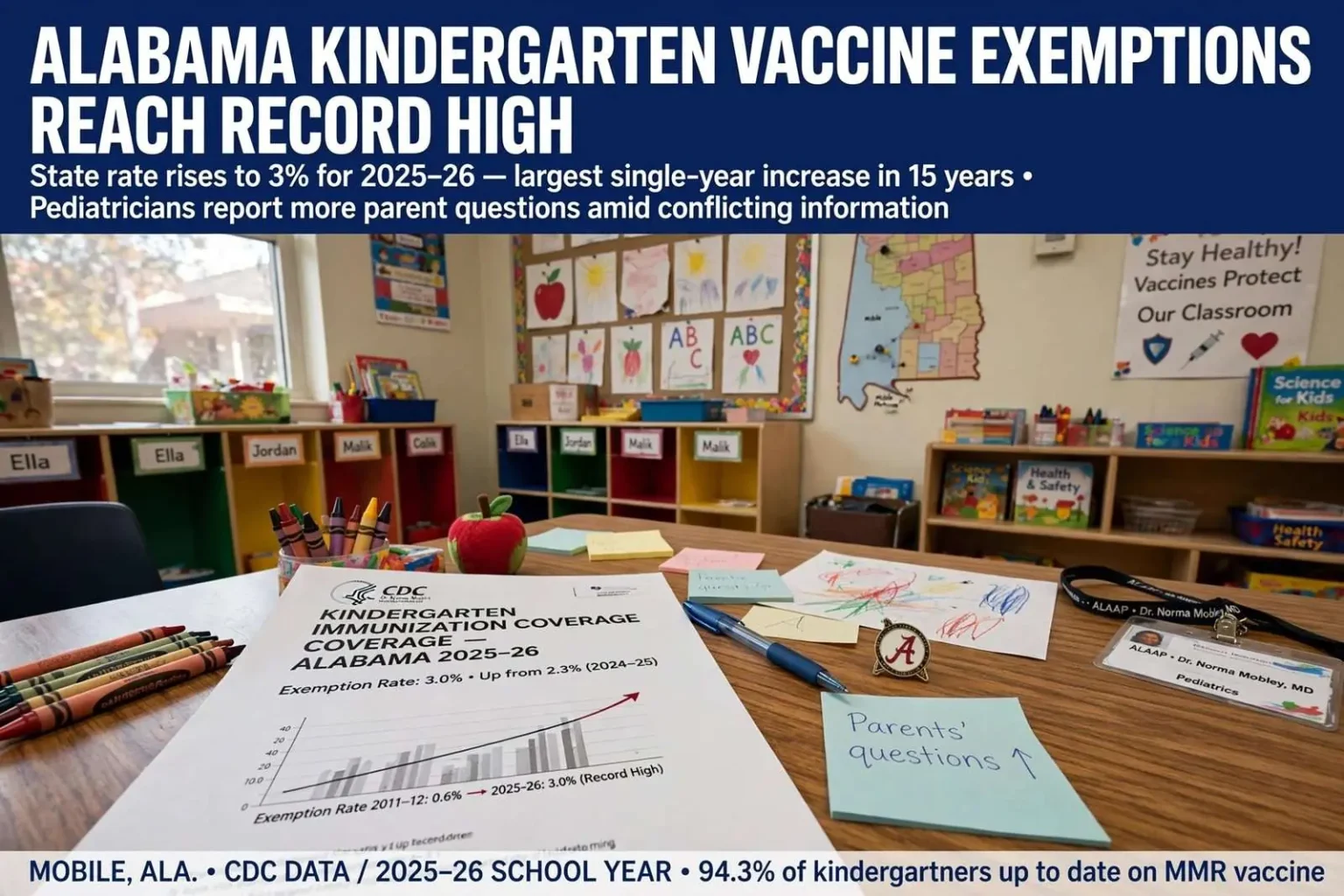
MOBILE, Ala. — Alabama’s kindergarten vaccine exemption rate has climbed to a record high, according to new data from the Centers for Disease Control and Prevention. The rate rose from 2.3% during the 2024–25 school year to 3% during 2025–26, the largest single-year increase in the 15 years of available data. As exemptions rise, pediatricians say they are spending more time answering parents’ questions about vaccines.
“I’m seeing more parents who are very confused,” said Dr. Norma Mobley, president of the Alabama Chapter of the American Academy of Pediatrics (ALAAP). “They’re getting a lot of information from various sources, and some of those sources are not, their area of expertise is not that of medicine or science.”
Dr. Katrina Skinner, a former ALAAP president, said she is seeing similar concerns at her practice in Fairhope. “There’s so much more noise now around vaccines. They’re not sure what’s true, what’s accurate, who do they listen to,” Skinner said.
By the numbers
CDC data show that 1,626 of Alabama’s 53,378 kindergartners — 3% — had an exemption from one or more vaccines during the last school year, and that 96% of those exemptions were for non-medical reasons. By comparison, in the 2011–12 school year, just 0.6% of Alabama kindergartners had a vaccine exemption.
“I am disheartened that it is going up,” Mobley said.
The data also show 94.3% of Alabama kindergartners were up to date on their measles, mumps and rubella (MMR) vaccine doses during the 2025–26 school year.
Concerns about measles
“Prevention of measles depends on at least 95% of the community being covered. So, while our statewide average may still be fairly close to that, if we’ve got pockets in places where there are fewer than 95% vaccinated kids, that puts us at risk for having measles outbreaks in those areas,” Skinner said.
“We definitely want to try to prevent that, if at all possible. When we know that we have something that is safe, proven to be safe and effective, that we can give children that can prevent sickness,” Mobley said.
The trend is not confined to Alabama. According to the CDC, kindergarten vaccine exemption rates rose in 41 states and the District of Columbia during the 2025–26 school year, with 24 states reporting rates above 5%.
What an exemption rate actually measures
An exemption rate is simply the share of children entering kindergarten who have a documented waiver on file excusing them from one or more of the immunizations that states normally require for school attendance. In Alabama, as in every state, vaccination against measles, mumps and rubella is part of the routine schedule that children are expected to have completed before starting school. The CDC aggregates these figures each year from state immunization programs so that public health officials can track whether communities are maintaining the levels of coverage needed to keep contagious diseases at bay.
The detail that most concerns pediatricians is not the overall 3% figure alone but its composition. When 96% of exemptions are for non-medical reasons — religious or philosophical objections rather than a documented medical contraindication — it signals that the overwhelming majority of children opting out could otherwise be vaccinated. Medical exemptions, by contrast, are reserved for children with specific conditions, such as a severe allergic reaction to a vaccine component or a compromised immune system, and they tend to remain rare and stable from year to year.
Why measles is the bellwether
Of all the diseases covered by the kindergarten schedule, measles draws the most attention from clinicians because it is one of the most contagious infectious diseases known. A single infected person can transmit the virus to the large majority of unprotected people nearby, and the virus can linger in the air of a room for up to two hours after an infected person has left. This extreme transmissibility is precisely why public health authorities set the community-protection, or “herd immunity,” threshold for measles at roughly 95%: below that level, the virus can find enough susceptible hosts to sustain itself and spread.
The United States declared measles eliminated in 2000, meaning the disease was no longer circulating continuously within the country. That milestone was achieved through high childhood vaccination coverage. Periodic resurgences since then — including a large multi-state outbreak in 2019 that was the worst the country had seen in decades — have repeatedly been traced to clusters of unvaccinated people, often linked to communities where exemption rates had risen. For Alabama, the concern is that even a statewide average close to the 95% mark can mask local pockets where coverage falls short, and those pockets are where outbreaks take hold first.
The routine vaccination schedule
The MMR vaccine is given in two doses as part of the standard childhood immunization schedule. The first dose is recommended at roughly 12 to 15 months of age, and the second at about 4 to 6 years, the age range that coincides with entry into kindergarten. Two doses are used because a small fraction of children do not develop full protection from the first dose alone; the second dose serves as a booster that brings population-level effectiveness to the high levels documented by public health surveillance. When families claim an exemption rather than completing the series, that two-dose safety margin is never established for the child, and the broader classroom loses a small but cumulative measure of protection.
School entry requirements are the mechanism that keeps these rates high. Every state sets a list of immunizations that children must have before enrolling in public school, and every state also provides a process for opting out under defined circumstances. Alabama’s requirements follow this national pattern, and the annual exemption tally reflects the families who, for medical or non-medical reasons, choose not to comply with the standard schedule. The CDC’s kindergarten survey captures these numbers each year so that trends — such as the one Alabama is now experiencing — become visible to clinicians and health officials before they translate into illness.
The role of Alabama’s pediatricians
The Alabama Chapter of the American Academy of Pediatrics, the professional organization representing the state’s pediatricians, has long made immunization education a priority. Physicians such as Mobley and Skinner occupy the front line of that effort, because the conversations about vaccines most often happen one family at a time, in the exam room. Pediatricians are trained not only to administer the shots but to walk parents through the evidence behind them, to answer questions about timing and side effects, and to distinguish peer-reviewed science from the conflicting claims that circulate online.
Fairhope, where Skinner practices, sits on the eastern shore of Mobile Bay in Baldwin County, one of the fastest-growing parts of the state. Rapid population growth can complicate immunization tracking, as new arrivals enroll in schools and public health staff work to confirm each child’s vaccination record. The dynamic plays out across Alabama’s diverse communities, from the Gulf Coast to the Birmingham metro and the rural Black Belt, each with its own mix of providers, access to care, and sources of health information.
What an outbreak would mean locally
When measles is identified in a community, public health responders move quickly to contain it, because of how efficiently the virus spreads. The standard response involves identifying everyone an infected person may have contacted, determining which of those contacts are unvaccinated, and in many cases excluding unvaccinated students from school for the duration of the incubation period — often measured in weeks rather than days. These exclusion orders, while intended to protect the wider community, can themselves upend families and schools. The underlying goal of high kindergarten coverage is to make such scenarios rare in the first place, by ensuring the virus encounters too few susceptible children to gain a foothold.
The Alabama Department of Public Health, working alongside local county health departments, is responsible for that surveillance and response within the state. As exemption rates edge upward, the margin for early detection narrows, placing added weight on the routine reporting that schools and pediatricians already perform. The record-high figure reported for the 2025–26 school year is, in that sense, both a number in a federal dataset and a signal to the state’s public health infrastructure.
A broader national picture
Alabama’s movement fits a pattern seen across much of the country. With exemption rates climbing in 41 states and the District of Columbia and more than two dozen states now above 5%, public health officials warn that the margin of safety is narrowing in many places. The CDC’s kindergarten surveillance exists precisely to catch these shifts early, before coverage dips far enough to permit outbreaks. For clinicians in Alabama, the record-high exemption rate is a signal to redouble the quiet, repeated work of building trust with families — work that, as Mobley and Skinner describe it, has grown markedly harder in an era of abundant and conflicting information.
Where Alabama stands among its neighbors
Alabama is one of several Southern states where exemption rates have drawn scrutiny in recent years, as regional population growth and shifting attitudes toward routine childhood immunizations reshape the public health landscape. The state’s 3% figure places it below the handful of states where exemptions have climbed past 5%, but the trajectory — a fivefold increase from the 0.6% recorded in 2011–12 — is what alarms pediatricians. Sustained year-over-year growth, even from a low base, can erode community protection faster than headline numbers suggest, because the children affected are not evenly spread across the state but concentrated in particular schools and neighborhoods. Tracking that concentration, and supporting the pediatricians who counsel families within it, is the work that lies ahead as Alabama’s exemption rate reaches a level the state has not previously recorded.