Alabama lottery bill clears Senate committee
A paper-ticket lottery bill from Sen. Greg Albritton cleared an Alabama Senate committee and now heads to the full Senate for a vote.
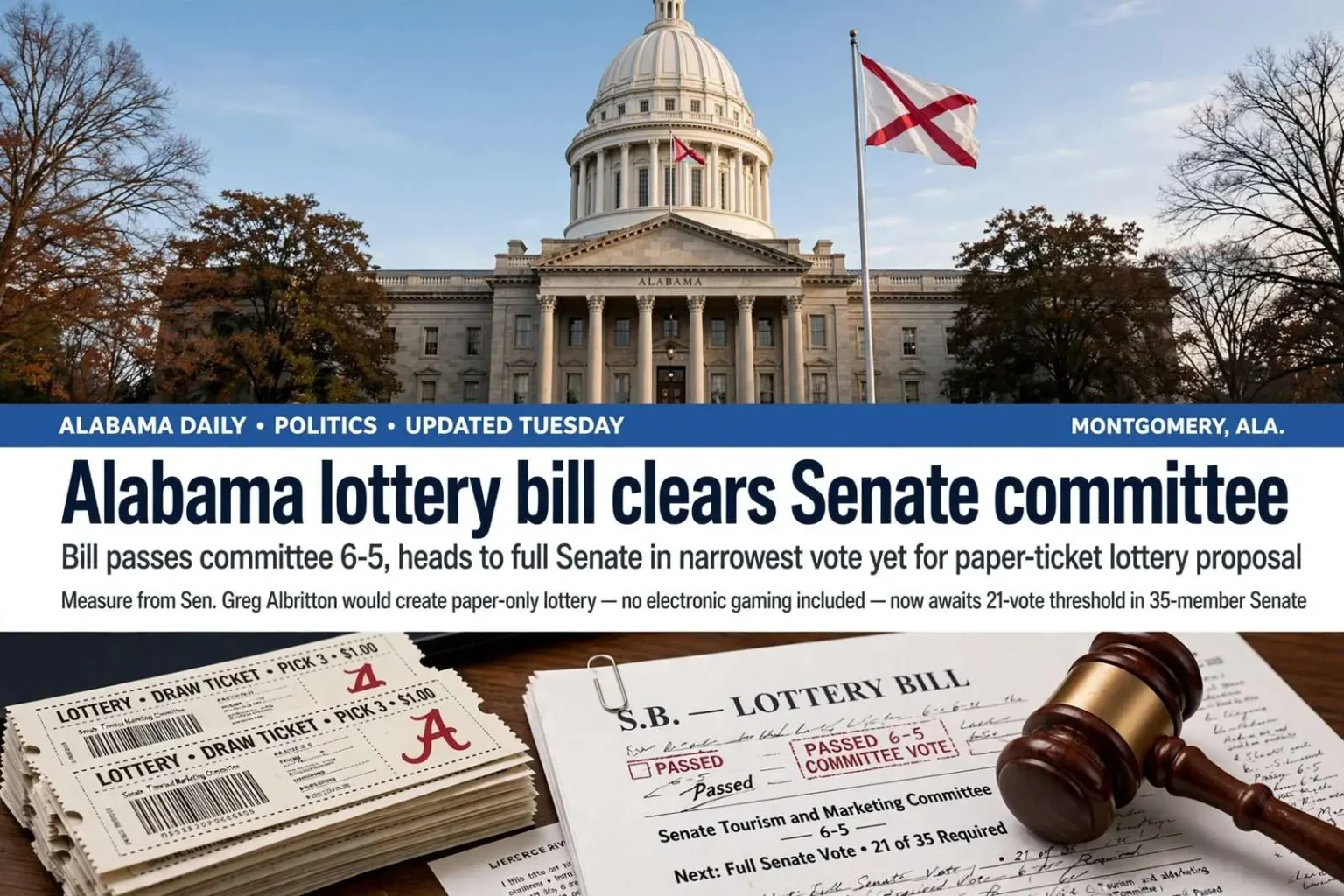
MONTGOMERY, Ala. — A bill that would create a paper-ticket lottery in Alabama cleared a state Senate committee Tuesday on a 6-5 vote and now heads to the full Senate for a vote, advancing one of the narrowest versions of a gambling proposal the Legislature has considered in years of debate over the issue. The single-vote margin in committee signaled how closely divided the Senate remains on any expansion of gaming, even one deliberately stripped down to the simplest form a lottery can take.
The proposal, introduced by Sen. Greg Albritton, would establish a state lottery offering only paper tickets — the traditional draw-game tickets sold at retail counters in the dozens of states that already operate lotteries. What the bill pointedly does not include is any electronic gaming: no video lottery terminals, no casino-style machines, no slots at racetracks or other venues. Lawmakers have described it as a “clean” lottery bill for exactly that reason, a measure that creates a lottery and nothing more, avoiding the fights over casinos and electronic bingo that have sunk broader gaming packages in past sessions.
The Senate Tourism and Marketing Committee advanced the measure, sending it to the full Senate where its fate remains uncertain. A 6-5 committee vote is the thinnest possible margin of passage, and the bill will need 21 votes in the 35-member Senate to clear constitutional hurdle requirements attached to gaming legislation, a threshold that has proven difficult for gambling bills throughout Alabama’s recent history of lottery debates.
A minimal approach to a long-running fight
Alabama remains one of the few states in the country without a state lottery, and the question of creating one has circulated through the Statehouse for decades. Neighboring Georgia, Florida, Mississippi, Tennessee, Louisiana, and Arkansas all operate lotteries, and Alabamians cross state lines in substantial numbers to buy tickets — money that flows into other states’ education funds and general budgets while Alabama collects none of it. That dynamic is the core argument lottery supporters make every session: the demand already exists, and the only question is whether the revenue is captured at home or exported.
Past attempts have foundered on the details that the Albritton bill is designed to avoid. Comprehensive gaming packages that bundle a lottery with casino regulation, electronic bingo at greyhound tracks, compacts with the Poarch Band of Creek Indians, and new gaming commissions have repeatedly stalled because each element attracts its own coalition of supporters and opponents. A paper-ticket-only lottery sidesteps most of those fights — there are no casinos to license, no machines to regulate, no tribal negotiations to conclude — but it also forgoes the larger revenue those elements would generate.
That trade-off is the crux of the debate. Critics of a paper-only lottery argue it surrenders the biggest revenue opportunities and creates an operation that would be small compared to what neighboring states run. Supporters counter that a simple lottery is the only version that can actually pass, and that establishing one — even in minimal form — is better than another year of watching ticket money leave the state. The committee vote suggested that even the minimal version faces resistance from senators who oppose gambling in any form and others who see a paper-only bill as not worth doing.
The McClendon bill and the broader gaming landscape
Meanwhile, a separate lottery bill from Sen. Jim McClendon, which would allow for electronic gaming, is not being considered this week. The McClendon measure represents the other school of thought in the Alabama lottery debate — the view that if the state is going to enter gaming at all, it should authorize the video lottery terminals and electronic games that generate far more revenue per location than paper tickets alone. That bill’s absence from this week’s calendar is itself significant: it suggests legislative leadership is testing whether the narrower, cleaner version can move first, rather than risking another floor fight over a comprehensive package.
The two-bill dynamic has played out in Montgomery before. Broader bills that pair a lottery with electronic gaming have sometimes attracted more support from lawmakers who want maximum revenue for education or the state budget, and more opposition from those who oppose any expansion beyond a traditional lottery. The Tourism and Marketing Committee’s advancement of the paper-ticket bill while the electronic gaming measure waits gives the Senate a chance to consider the options in sequence rather than forcing an all-or-nothing choice between them.
How the state would use lottery revenue has always been central to the politics of the question. In neighboring states, lotteries were often sold to voters as education funding mechanisms, and the scholarships and pre-K programs funded by Georgia’s lottery in particular have been held up for years by Alabama supporters as the model they want to replicate. Whether an Alabama lottery’s proceeds would be dedicated to education, directed to the general fund budget, or split among purposes remains a decision the Legislature would have to make — and one that shapes which lawmakers can support the bill.
What happens next
With the committee vote secured, attention shifts to the full Senate, where the bill will need to attract the votes its five-vote committee margin suggests it does not yet have in hand. Lottery legislation in Alabama has historically required coalitions that cross party lines and ideological lines, pairing anti-gaming senators who nonetheless see the futility of the status quo with gaming supporters willing to accept a smaller bill. Whether Albritton can assemble that coalition this session — or whether the paper-ticket approach simply splits the difference and loses both sides — will be visible on the Senate floor.
Any legislation creating a lottery also faces the structural realities of setting one up. Even a paper-ticket-only lottery requires a commission or corporation to run it, contracts with vendors, retailer networks across the state, and the draw infrastructure that neighboring states use — all of which take time to stand up after passage. Supporters argue that delay is another reason to act now; every session without a lottery is another year of ticket sales flowing to Georgia, Florida, Tennessee, and Mississippi.
For now, the bill advanced by the committee on the 6-5 vote represents the narrowest path Alabama lawmakers have taken toward a lottery in years. Whether the full Senate follows the committee’s lead or the measure joins the long list of lottery bills that died in Montgomery, this week’s vote ensures the debate will at least get a floor airing — something years of Albritton proposals and broader gaming packages have not always managed to achieve.
The view from around the state
Public opinion on a lottery has long run ahead of the Legislature’s willingness to act. Polling over the years has consistently found majorities of Alabamians telling surveyors they would vote for a state lottery, and referendums on the question have been urged by supporters who want the issue taken out of the legislative back rooms and put directly before voters. Lawmakers, however, have kept the decision in their own hands, where a relatively small number of opponents has repeatedly been able to stall bills in committee or on the floor.
Religious and anti-gambling groups remain the most consistent opposition, arguing that a lottery preys on the residents least able to afford it and that the promised revenue never matches the projections. Rural legislators weigh those concerns against the reality that their counties export money to neighboring states’ lotteries every week, and that a portion of whatever revenue a lottery generates would flow back to local budgets and schools. The 6-5 committee vote reflected exactly that split — senators from similar districts reaching opposite conclusions about whether a clean, paper-only lottery is a compromise worth taking.
The full Senate debate will give Albritton the chance to make that case directly: that after decades of all-or-nothing fights over comprehensive gaming, a simple paper-ticket lottery is the version of the question Alabama can actually answer, and that the 6-5 committee margin is a starting point rather than a ceiling. Whether his colleagues agree will be decided in the chamber where so many lottery bills have gone before.
The mechanics of the bill itself are worth noting for what they exclude as much as what they include. There is no provision for video lottery terminals at racetracks, no expansion of electronic bingo, no framework for casino licensing, and no negotiated compact with the Poarch Band of Creek Indians, whose operations in Atmore, Wetumpka, and Montgomery already anchor Alabama’s gaming landscape. By leaving all of those questions unanswered rather than answered, the bill keeps the scope of the state’s entry into gaming to a single, familiar product — the draw ticket — and leaves every other gaming question for another day and another bill.
That simplicity has a practical benefit beyond politics: oversight. A paper-ticket lottery is among the easiest forms of gaming to regulate, with centralized draws, standardized retailer agreements, and years of operational models to borrow from the six states that surround Alabama. Supporters argue that starting simple reduces the risk of the regulatory failures that have complicated gambling enforcement elsewhere in the state, and gives lawmakers a clean baseline if they later choose to consider broader gaming legislation on its own merits.