
Alabama Music Box Keeps Its Joe Cain Sunday Tradition Alive with the Pine Hill Haints’ Return
The Pine Hill Haints brought their Joe Cain Day tradition back to Mobile's Alabama Music Box in February 2013, with Grayson Capps at Callaghan's.
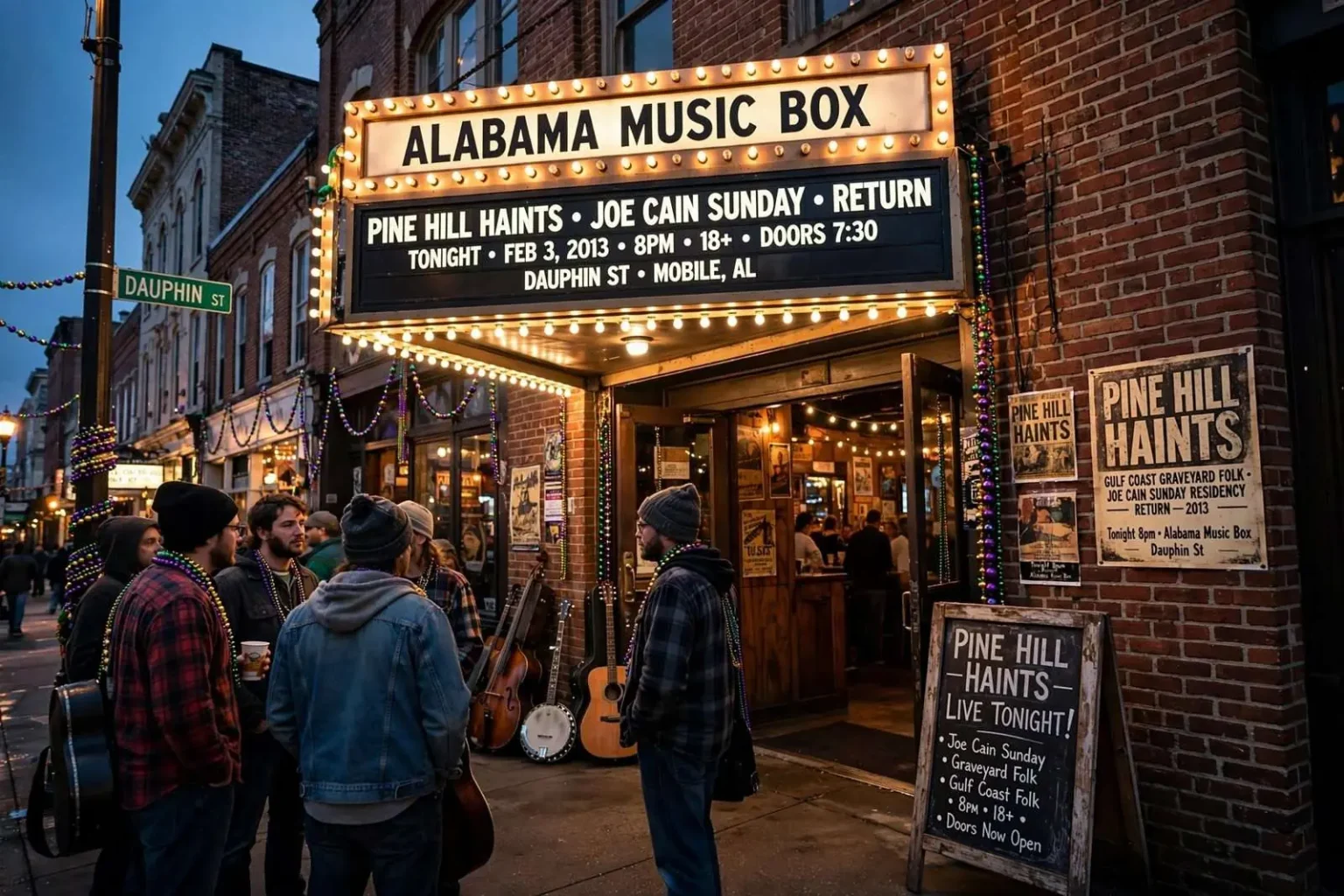
Joe Cain Day — the uniquely Mobile Sunday that sits between the Ionic and Comic Cowboys parades in the Mardi Gras calendar — gained two newer musical traditions by 2013: Grayson Capps’ annual appearance at Callaghan’s Irish Social Club and the Pine Hill Haints’ Joe Cain Sunday residency at the Alabama Music Box.
For 2013, the Haints returned to the Dauphin Street venue once again for their Joe Cain Day show, with music starting at 8 p.m. and the event open to ages 18 and up. The date placed the band on stage as the city’s most idiosyncratic holiday wound down — a night slot that let parade-goers carry the day’s revelry straight into an evening of hometown music.
Few acts fit the day’s blend of revelry and reverence better than the Haints, whose graveyard-folk sound has long drawn on Mobile’s own history and folklore — Joe Cain himself being the city’s most storied piece of it, the man who revived Mardi Gras after the Civil War and is buried in Church Street Graveyard.
The Band and the Holiday Fit Together
The Pine Hill Haints have built their identity on the strange, old, and local — songs assembled from ghost stories, murder ballads, and Gulf Coast folklore, performed on a shifting collection of acoustic instruments. A band that writes about graveyards and local legends was never going to miss the connection to a holiday whose central figure lies buried a few blocks from the venue they play.
Joe Cain’s story is the hinge. After the Civil War, Cain revived Mardi Gras in Mobile — a city whose Carnival predated New Orleans’s — by parading through the streets as a fictional Chickasaw chief, restoring the celebration’s spirit when the city was struggling to recover. His burial in Church Street Graveyard made him a permanent fixture of Mobile’s historical geography, and the Sunday that bears his name keeps his memory at the center of the Carnival calendar.
The Haints’ Joe Cain Sunday residency put the band in the role of house musicians for that memory — an annual booking that, by 2013, had become a tradition in its own right, joining the older parades and processions as part of how Mobile marks the day.
Callaghan’s Parallel Tradition
The Alabama Music Box marked the occasion as part of its ongoing run of original-music programming during Carnival season, while just blocks away Callaghan’s Irish Social Club hosted Capps for his own parallel tradition. Together the two shows gave Mobilians a full day of local music bookending the afternoon’s processions.
Callaghan’s, the compact Oaklie neighborhood bar that has long served as a listening room for singer-songwriters, and Capps — a Gulf Coast songwriter whose catalog draws heavily on the region’s salt-air mythology — had by then established their Joe Cain Day appearance as the other half of the city’s musical observance. The pairing gave music fans a choice of rooms, each with its own version of the same local tradition.
That two-venue structure says something about Mobile’s Carnival: the calendar has room for both its grand public rituals and its small-room musical counterparts. The parades fill the streets in the afternoon; the Haints and Capps fill the rooms at night.
What Joe Cain Day Is
Joe Cain Day occupies the Sunday in the Mardi Gras calendar between the Ionic Degenerates’ Sunday procession and the Comic Cowboys’ parade — a slot that keeps downtown Mobile in Carnival mode from one weekend into the next. The day is built around the memory of the man who restarted the city’s celebration after the Civil War, and its centerpiece has long been a procession honoring him rather than a traditional kreu parade.
The day’s tone differs from the rest of the season. Where Carnival’s formal societies bring ordered floats and masked royalty, Joe Cain Day runs looser — a celebration of the city’s folk history, capped by visitors to Cain’s grave and a day’s worth of processions and gatherings downtown. It is the most distinctly Mobile of the season’s days, built around a local legend rather than a national template.
Into that atmosphere, the musical traditions that emerged at Callaghan’s and the Alabama Music Box slot naturally. A holiday born from one man’s theatrical act of civic revival invites music that trades on local story, and both rooms deliver it in different registers — Capps through songwriter narrative, the Haints through graveyard folk.
The Haints’ Sound and the City’s Stories
The Pine Hill Haints’ graveyard-folk catalog reads like a field guide to Gulf Coast folklore — songs of ghosts, local murders, river legends, and restless spirits, delivered with a rawness that suits the material. The band’s members rotate through instruments and arrangements, but the through-line is a body of songs that could not have come from anywhere but the Mobile area.
That rootedness is what made the band’s Joe Cain Sunday residency feel inevitable rather than engineered. A holiday commemorating Mobile’s most famous folk figure pairs cleanly with a band that has spent its career collecting and performing the city’s less famous ones. The 8 p.m. start kept the show within earshot of the day’s afterglow, and the 18-and-up policy matched the venue’s evening format.
The Alabama Music Box’s Carnival-season programming, of which the Haints show formed a part, positioned the venue within the broader holiday economy. Mardi Gras brings visitors and locals alike downtown night after night, and original-music venues compete for that audience against the season’s parade schedule — a challenge the Joe Cain Sunday residency met with an established act and a guaranteed audience.
Traditions Built in Real Time
By 2013, the two shows had crossed the threshold from bookings into traditions — the kind of annual dates regulars plan around and visitors hear about after the fact. Mobile’s Carnival history is full of such accumulations: rituals that started small, repeated annually, and hardened into institutions within a decade.
The parallel structure of the day’s music — Capps at Callaghan’s, the Haints at the Music Box — gave the city a musical equivalent of its parade doubleheader. Fans could split the evening between rooms or commit to one, and either way the soundtrack to Joe Cain Day extended well past the afternoon’s final procession.
For the Haints, the 2013 return continued a residency that had become part of the band’s calendar as fixed as the holiday it celebrated. Few bands anywhere can claim a annual show tied to a civic holiday honoring a man buried within walking distance of the venue — and that is precisely the kind of claim Mobile’s music scene has always specialized in making.
Cain’s Grave and the City’s Memory
Church Street Graveyard, where Joe Cain is buried, sits among the older squares of downtown Mobile, and its most famous resident has drawn visitors every Carnival season for generations. The burial ground predates Cain’s era by decades, and its moss-draped stones hold much of the city’s early history — but Cain’s grave has become the site that receives special attention each February.
The connection between the graveyard and the holiday gives Mobile’s Carnival a local anchor no other city’s celebration shares. New Orleans’s Carnival grew into its international scale, but Mobile’s began earlier and was famously revived by Cain after the war, when the city needed the lift. The Sunday that honors him celebrates that act of civic showmanship, and the music traditions built around the day inherit its storytelling character.
The Haints — whose entire catalog trades on Mobile’s haunted memory — perform within blocks of that graveyard on Joe Cain Day. The geography is close enough that the band’s fans can visit Cain’s grave in the afternoon and hear songs steeped in the same folklore by night, all without leaving downtown.
Downtown’s Carnival-Night Economy
Carnival season transforms downtown Mobile’s nightlife. The parades bring crowds that linger after the last float passes, and the bars and music venues along Dauphin Street and the surrounding blocks absorb the overflow. For original-music venues, the season is both opportunity and obstacle — bigger crowds, but competition from the street festivities themselves.
The Alabama Music Box’s answer has been programming that leans into the season rather than against it: original-music bills, themed nights, and residencies that give regulars a reason to make the venue part of their Carnival routine. The Haints’ Joe Cain Sunday show is the clearest example, timed to a day when the parade schedule ends early enough for a full evening of music.
Callaghan’s plays the same game from a different neighborhood. The Oaklie bar’s songwriter tradition gives Carnival crowds an off-downtown listening option, and its Joe Cain Day date with Capps has become the day’s other musical institution — smaller, quieter, and just as rooted in the city’s identity.
A Full Day, Bookended by Local Music
Stack the 2013 Joe Cain Day schedule end to end and the design shows itself: the Sunday processions through downtown in the afternoon, with the Ionic and Comic Cowboys parades bracketing the day on the calendar, and then the choice of rooms at night — the Haints at 8 p.m. on Dauphin Street, 18 and up, or Capps at Callaghan’s a few blocks away.
That structure — public ritual by day, local music by night — is how a city folds its newest traditions into its oldest. Joe Cain Day itself is barely a century old in a Carnival that predates the Civil War, and the musical residencies layered onto it are younger still. Mobile’s calendar grows the same way its music does: by repetition, year over year, until the addition feels like it was always there.
For the crowd that filled the Alabama Music Box on that Joe Cain Sunday in 2013, the night delivered the band, the holiday, and the city in one package — graveyard folk on Dauphin Street, played a few blocks from the grave of the man who gave the day its name.


