
Alabama Ordered to Repay $315,000 in Same-Sex Marriage Lawsuit
A federal judge in Mobile has ordered Alabama to pay $315,000 in attorney fees to the civil rights lawyers who challenged the state's same-sex marriage ban.
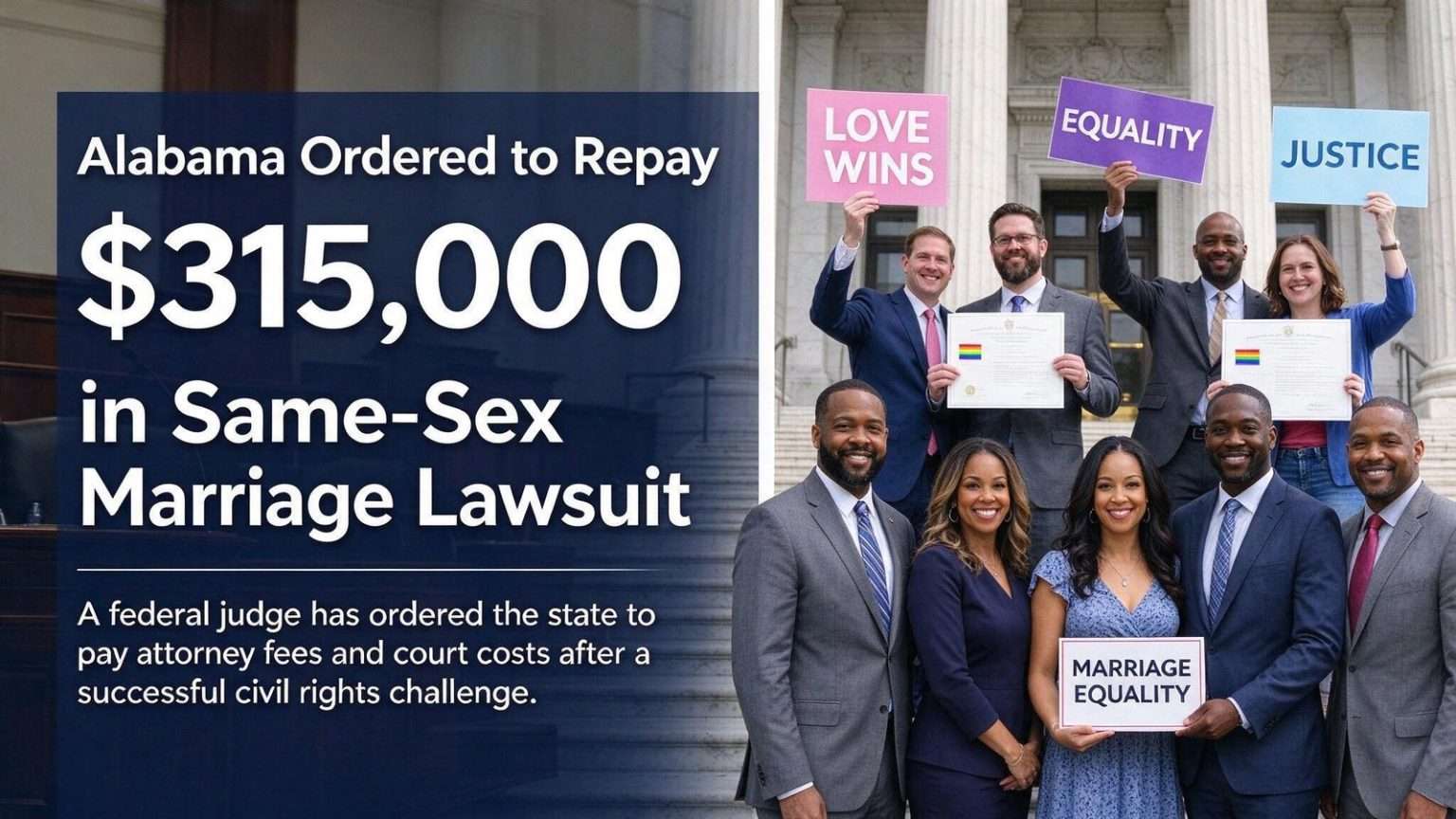
A federal judge in Mobile has ordered the state of Alabama to pay $315,000 in attorney fees and court costs to the civil rights lawyers who successfully challenged the state’s ban on same-sex marriage. U.S. District Judge Callie V. Granade issued the order after the legal teams negotiated the reimbursement amount with the state, bringing a formal close to one of the most hard-fought chapters in Alabama’s long legal battle over marriage equality. The fee award covers years of litigation that began well before the U.S. Supreme Court settled the question nationwide.
The money will be distributed among the organizations and firms that carried the cases: the Southern Poverty Law Center, the ACLU of Alabama, the National Center for Lesbian Rights, Americans United for the Separation of Church and State, and the law firm Fann Law, LLC. Each played a distinct role in the challenge, from the initial filings in federal court to the appeals and enforcement proceedings that followed. The two cases that ultimately struck down Alabama’s ban were filed on behalf of same-sex couples from Mobile County, whose petitions reached Judge Granade’s courtroom in the Southern District of Alabama.
How the Cases Unfolded in Federal Court
Judge Granade ruled against the state’s prohibition on same-sex marriage in January 2015, finding that Alabama’s constitutional amendment and statutory ban violated the constitutional rights of same-sex couples. Her decision came six months before the U.S. Supreme Court’s landmark Obergefell v. Hodges decision, which extended marriage equality to every state in the country in June of that year. At the time of her ruling, Alabama was one of a shrinking number of states whose marriage laws had not yet been invalidated by federal courts, and her order made the state a focal point in the national debate.
The ruling immediately put Mobile County and other jurisdictions at the center of the conflict. While some probate judges began issuing licenses to same-sex couples after Granade’s decision took effect, others declined, citing conflicting guidance from the Alabama Supreme Court, which had directed probate judges in an unrelated case to stop issuing any marriage licenses rather than comply. That standoff created a patchwork of compliance across the state’s 67 counties, leaving couples in some areas able to marry while couples a few counties away were turned away.
After the Supreme Court ruled in Obergefell, litigation in the Alabama cases did not end. State officials continued to resist complying with the court orders, keeping the cases alive in Granade’s courtroom. In June 2016, the judge issued a permanent injunction requiring probate judges in all 67 counties to issue same-sex marriage licenses and to recognize such marriages performed in other states. The injunction also bound then-Attorney General Luther Strange, prohibiting him from enforcing the state’s marriage ban or taking action against officials who complied with federal law.
A Fee Award Years in the Making
The $315,000 reimbursement negotiated with the state covers the attorney fees and court costs the plaintiffs’ legal teams accumulated over the course of the litigation. In civil rights cases brought under federal law, prevailing parties can recover their legal costs from the government, and the amount here was worked out between the lawyers and the state rather than left for the court to calculate after a contested hearing. The negotiated figure reflects the volume of work involved: the cases spanned the original district court proceedings, interventions by state officials, and the extended enforcement phase that followed the Supreme Court’s ruling.
The attorneys who handled the case said they hoped the fee award would serve as a deterrent to future resistance. Scott McCoy, a senior attorney with the Southern Poverty Law Center, noted that the state’s refusal to accept the rulings only made the litigation more expensive for Alabama itself. “Alabama’s resistance to marriage equality did nothing but increase the amount of the legal fees,” McCoy said. “It’s unfortunate that taxpayers must now foot the bill.” The comment pointed to what the legal teams saw as the central irony of the case: every month of additional resistance added billable hours that the state, and ultimately its taxpayers, would be responsible for covering.
For the organizations involved, the award also represented recognition of the scale of the effort. The Southern Poverty Law Center, headquartered in Montgomery with a long history of civil rights litigation across the South, joined forces with the national Center for Lesbian Rights and other advocacy groups to assemble a legal team with the resources to sustain a multiyear fight. The ACLU of Alabama, based in Montgomery, and Americans United for the Separation of Church and State brought additional capacity, while Fann Law, LLC provided local representation rooted in Mobile’s legal community.
What the Ruling Meant for Couples in Mobile and Beyond
The couples who filed the original suits came from Mobile County, and their cases put a local face on a national issue. When Granade’s initial ruling came down, couples lined up at the Mobile County probate office in downtown Mobile as the first licenses were issued, scenes that played out in county courthouses across the state in the weeks that followed. The permanent injunction of June 2016 was aimed squarely at making that access uniform: no matter which county a couple lived in, the probate judge would be required to provide a license.
The order’s reach across all 67 counties mattered because of how county-level marriage licensing worked in Alabama. Probate judges, elected county officials, had been the ones to issue or withhold licenses, and the state’s resistance had played out county by county. By enjoining every probate judge in the state, the federal court removed the discretion that had allowed the patchwork to persist. The recognition requirement also meant that marriages performed elsewhere, in states that had recognized same-sex unions before Alabama did, would be treated as valid within Alabama’s borders.
The injunction against then-Attorney General Luther Strange carried its own significance. Strange, who held the office from early 2015 until his appointment to the U.S. Senate seat vacated by Jeff Sessions in early 2017, had been a named defendant in the enforcement phase of the litigation. The court’s order barred him from enforcing the ban or from using the office’s authority against clerks and judges who followed federal law, a measure designed to prevent the state’s top legal officer from sustaining the resistance through enforcement actions.
The Broader Cost of Resistance
The fee award closed out the financial side of the litigation, but it also documented the cost of the state’s strategy. Legal observers in Alabama noted that the state had multiple off-ramps along the way: after Granade’s 2015 ruling, after the Supreme Court’s decision, and again after the 2016 injunction. Each stage of continued resistance extended the litigation, and each extension added to the fees the state would eventually owe. The $315,000 figure reflects only the negotiated reimbursement, not the state’s own legal expenses in defending the ban, which were borne separately.
The case also became part of the broader record of how marriage equality was implemented across the South. Alabama was among the last states where compliance remained contested after Obergefell, and the Mobile litigation, together with related proceedings, was central to resolving it. For the couples whose suits started the process, the final orders meant that the right to marry in their home county was no longer subject to the views of the local probate judge. For the organizations that litigated the cases, the fee order provided a measure of accountability, ensuring that the burden of the state’s prolonged defense fell on the state itself.
Today, marriage licensing in Alabama operates under a system the legislature overhauled in 2019, converting the process from a judicial act to an administrative one in which probate offices record completed forms rather than issue licenses through a judge’s signature. That change removed judges from the licensing act altogether, a development that followed the years of conflict over same-sex marriage in the state’s courts. The $315,000 order stands as the financial epilogue to that era: a negotiated payment, approved by the same federal judge who struck the ban down, that formally settled what Alabama owed for the fight it chose to prolong.
The $315,000 order also fits into a longer pattern of fee awards in civil rights litigation over marriage laws in other Southern states, where county and state governments that continued defending bans after adverse rulings were later ordered to pay the legal bills of the winning side. Those cases established that resistance carried a price tag, and the Alabama legal teams pointed to that history as they pursued reimbursement. Fee shifting under the federal civil rights attorney’s fees statute exists precisely for this purpose: to make it economically viable for individuals to challenge unconstitutional government conduct, and to discourage officials from maintaining positions the courts have already rejected.
The organizations that litigated the Alabama cases brought decades of combined experience to that effort. The Southern Poverty Law Center, founded in Montgomery in 1971, built its reputation on landmark civil rights cases and has long maintained a litigation staff focused on the Deep South. The National Center for Lesbian Rights, based in San Francisco, had litigated marriage cases across the country and brought deep expertise in the specific legal questions the Alabama challenges raised. Americans United for the Separation of Church and State focused on the constitutional dimension of church-state entanglement in the state’s defense of its ban. Fann Law, LLC anchored the team in Mobile, where the cases were filed and tried.
For residents of Mobile and the surrounding Gulf Coast, the case’s end was largely administrative, but its effects had long since become part of daily life. Couples in Mobile County had been marrying since the spring of 2015, and the intervening years of litigation concerned the counties where licensing had lagged. The final injunction and the fee order together guaranteed that the outcome reached in downtown Mobile would apply identically from Baldwin County to the Tennessee line, and that the cost of the delay would be borne by the state rather than the couples who challenged it.


