Alabama State Government Bayou La Batre
Alabama Oyster Harvest Falls 98% as Public Reefs Close Nov. 18; Bayou La Batre Braces for Losses
Alabama's public oyster reefs close at 2 p.m. Nov. 18 after a 12-day season expected to yield fewer than 400 sacks, a 98% drop from 2024 that is hitting Bayou La Batre harvesters and seafood businesses.
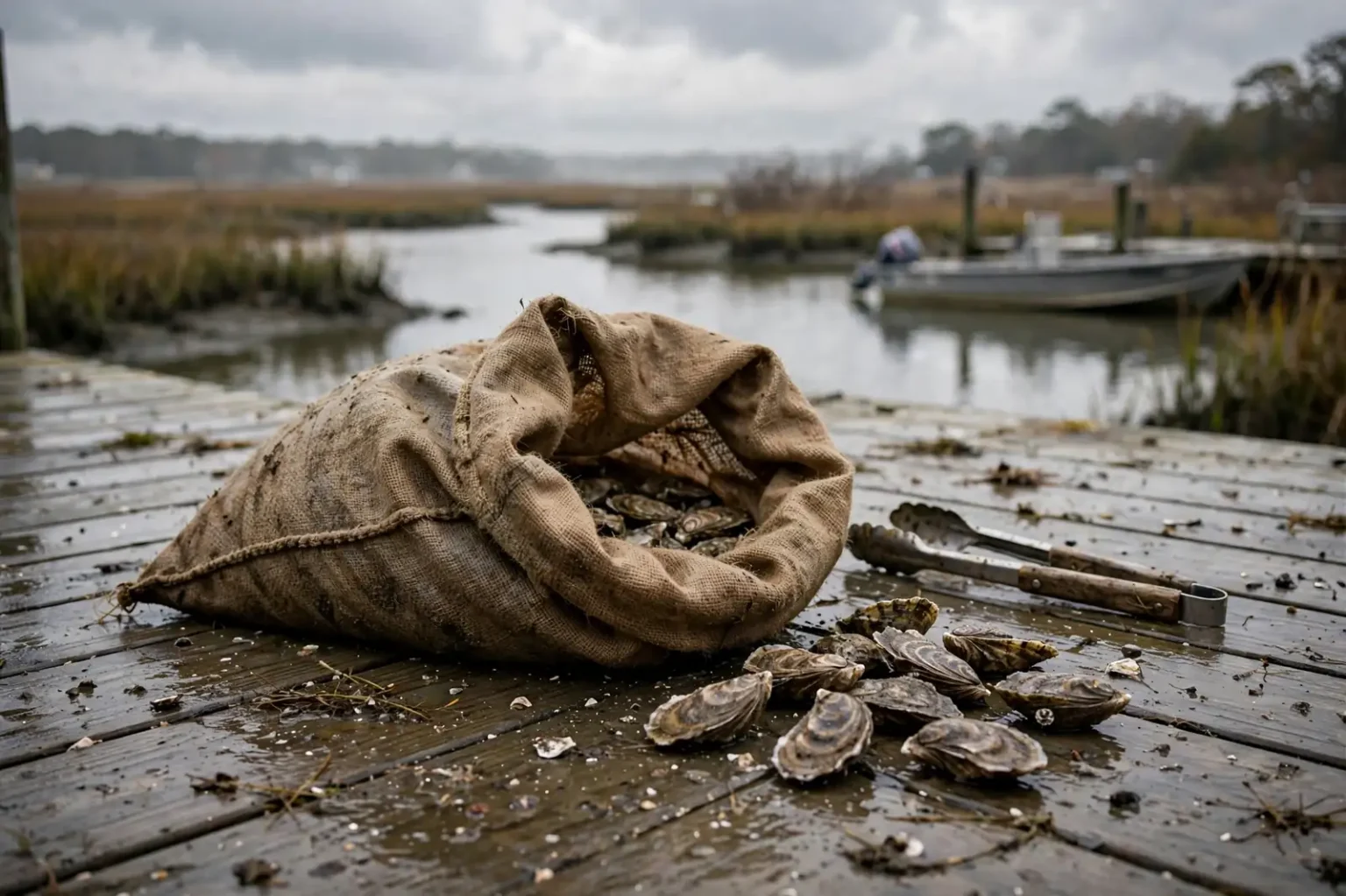
DAUPHIN ISLAND, Ala. — Alabama’s public oyster reefs will shut to harvesting at 2 p.m. on Wednesday, Nov. 18, ending a 2026 season that will have lasted just 12 days and is expected to produce fewer than 400 sacks of oysters for commercial harvesters.
The Alabama Department of Conservation and Natural Resources’ Marine Resources Division announced the closure, which applies to all public water bottoms in the state. The season opened on Nov. 2, and the closing time matches the end of the regular harvest day.
A season by the numbers
The figures show how sharply Alabama’s wild oyster harvest has fallen in just two years:
- 2024: 58 days open, with nearly 25,000 sacks harvested
- 2025: 54 days open, with about 5,000 sacks harvested
- 2026: 12 days open, with a commercial harvest expected to fall below 400 sacks
If the projection holds, this year’s commercial take would amount to less than 2% of the 2024 total and less than a tenth of last year’s harvest.
Why the reefs are closing now
State officials said shutting the reefs will help protect the oysters that remain to spawn, a population they describe as essential to rebuilding Alabama’s oyster resources. Each adult left on the reef is a potential source of the next generation, and oysters also form the reef itself, since young oysters settle on and grow from existing shell.
The closure is being made under Section 9-12-28 of the Code of Alabama 1975, as set out in Rule 220-3-.02, which gives the division authority to open and close public reefs.
Surveys warned of a short season
Before the season began, staff from the division’s Fisheries Section surveyed the state’s reefs. Those surveys found a low density of legal-size oysters in the three areas that were opened this fall, Heron Bay, Cedar Point West and Cedar Point East, signaling early on that the harvest would be limited.
The results fit a broader pattern of generally declining oyster abundance. According to the division’s director, this year’s surveys counted fewer harvestable oysters than the 2025 surveys did, and they also showed a continued drop in the numbers of very young and not-yet-adult oysters, the groups that would supply future harvests.
The director noted that an oyster needs at least 18 months to grow to harvestable size, and said Alabama’s reefs will need a long stretch of good water quality before they can recover enough to support harvests like those of earlier seasons.
How this year’s harvest was managed
The division opened only three areas this fall, the Cedar Point East, Cedar Point West and Heron Bay grids near the causeway leading to Dauphin Island. Harvest was allowed on weekdays from 7 a.m. to 2 p.m., using tongs or by hand.
Commercial catchers needed a commercial oyster catcher’s license and were limited to eight sacks per person, per vessel, per day, a cap that applied to each boat no matter how many licensed catchers were aboard. Recreational harvesters did not need a license but had to buy a harvest tag and report their catch, and they could keep up to 100 oysters measuring at least 3 inches per person each day.
No closing date was set when the season opened. Instead, harvesters checked in at the division’s Oyster Management Station in Coden, where daily landings were recorded, giving biologists a running count of how many oysters were coming off each grid. That system allowed the division to decide when to end the season based on what was actually being taken from the reefs.
How oysters grow and why recovery is slow
Oysters spawn in warm months, releasing eggs and sperm into the water. The resulting larvae drift with the currents for a few weeks before settling onto hard surfaces, ideally old oyster shell, where they attach permanently and become known as spat.
From that point, an oyster cannot move. Its survival depends entirely on the water that flows over the reef. Because it takes at least 18 months for an oyster to reach harvestable size, a single bad year can affect harvests two or more seasons later, and several difficult years in a row can leave reefs with few oysters of any size.
Water conditions are the main problem
Marine biologists point to adverse environmental conditions as the reason oyster numbers have stayed low. The division cited periods when water in the bay was too fresh or too salty, along with stretches of low dissolved oxygen. All of those conditions hurt oyster spawning, survival and growth, and they hit young oysters hardest. The department has also pointed to changing water conditions and warmer temperatures as factors that make it harder for young oysters to survive.
Oysters thrive in brackish water, where river flow and seawater mix. When heavy rains push large volumes of fresh water down the Mobile-Tensaw river system into Mobile Bay for long periods, salinity can fall low enough to stress or kill oysters. When dry spells leave the bay unusually salty, predators such as oyster drills and diseases that favor higher salinity can take a heavy toll. Low dissolved oxygen, which is more common in warm months, can suffocate oysters that cannot move away from bad water.
Restoration work underway
The division said it continues to work with the Alabama Department of Public Health, commercial oyster catchers, seafood dealers and other partners to protect and restore the state’s oysters.
Division staff are also working with researchers at Auburn University to study where oyster larvae settle and how water quality changes through the seasons in Mobile Bay and the Mississippi Sound. The goal is to pinpoint the best places to restore reefs so that new habitat is built where young oysters are most likely to survive.
That research is funded by a $10 million award from the Natural Resources Damage Assessment Trustee Implementation Group, using money from the Deepwater Horizon oil spill settlement. ADCNR Commissioner Ben Stimpson Jr. serves as Alabama’s lead NRDA trustee. The project’s aim is to restore Alabama’s oyster reefs and keep them productive for future generations.
The Deepwater Horizon disaster in 2010 led to legal settlements that set aside billions of dollars for environmental restoration across the Gulf states. The NRDA process is designed to restore natural resources damaged by the spill, and oyster reef projects have been among the efforts funded in Alabama.
Bayou La Batre feels the losses
The steep drop is being felt hardest in Bayou La Batre, the Mobile County fishing town where oyster harvesting has supported families for generations. The expected 2026 commercial total of fewer than 400 sacks represents a decline of about 98% from the nearly 25,000 sacks taken in 2024.
A Bayou La Batre city official said commercial harvesters are struggling and that the commercial seafood business is hurting across the country, not only in Alabama. The official warned that the collapse of the harvest could put many people out of work heading into the holidays, leaving parents unsure how they will provide Christmas for their children, and noted that the problem has been building for years.
The shortage is also reaching local seafood businesses. According to the city official, some restaurants have started buying oysters from Mississippi and Louisiana to keep them on their menus.
Dredging and sediment cited as another cause
While state biologists have focused on water conditions, the Bayou La Batre official also blamed dredging and the dumping of dredged mud in Mobile Bay, saying sediment from projects including work on the Mobile Ship Channel has buried oyster reefs and damaged the habitat where oysters grow. The official also said Alabama has fallen well behind on planting new material to rebuild reefs.
When fine sediment settles on a reef, it can smother living oysters and cover the hard shell surfaces that drifting larvae need in order to attach, which is why the condition of the reef bottom matters as much as the water above it.
Environmental group calls for long-term restoration funding
Mobile Baykeeper, a nonprofit that works on water quality issues in the Mobile Bay watershed, described the loss of oysters on public reefs as a tragedy for commercial harvesters. In a statement, the group said stretches of fresh water and drought do not fully account for why oyster populations have failed to bounce back. Oysters can endure difficult conditions, the group said, but they need clean water and clean shell to complete their life cycle.
The organization called for long-term funding to rebuild reefs by placing large quantities of oyster shell, limestone and live oysters on the bay bottom every year, along with efforts to cut the pollution and sediment flowing into Mobile Bay. It said it supports commercial harvesters and intends to work with all parties on large-scale restoration projects across the bay so oysters can return.
What the closure means for harvesters and diners
For licensed commercial oyster catchers, the closure brings a quick end to a season that offered little income. With fewer than 400 sacks expected statewide, the 2026 harvest is a small fraction of what Alabama’s public reefs produced only a couple of years ago.
Recreational harvesters, who could take oysters under the same grid openings and hours as commercial catchers, will also lose access to public reefs at 2 p.m. Nov. 18.
Diners should still be able to find oysters on menus, though some local restaurants are now sourcing them from neighboring states. Off-bottom oyster farming has expanded along the Alabama coast in recent years, and farmed oysters are raised in cages or bags in the water column rather than harvested from public reefs, so they are not affected by the reef closure.
Key dates
- Nov. 2, 2026: public reefs opened for harvest
- Nov. 18, 2026, 2 p.m.: all public water bottoms close to oyster harvest
About the agency
The Alabama Department of Conservation and Natural Resources manages the state’s natural resources through four divisions: Marine Resources, State Lands, State Parks, and Wildlife and Freshwater Fisheries. The Marine Resources Division oversees the state’s saltwater fisheries, including the public oyster reefs in Mobile Bay and the Mississippi Sound.