Alabama State Government Alabama Port
Alabama Port Authority Leaders Thank Congressional Delegation After Securing $49 Million for Port of Mobile Projects
Alabama Port Authority board members traveled to Washington to thank the state's congressional delegation for helping secure more than $49 million in federal funding for Port of Mobile projects in 2026.
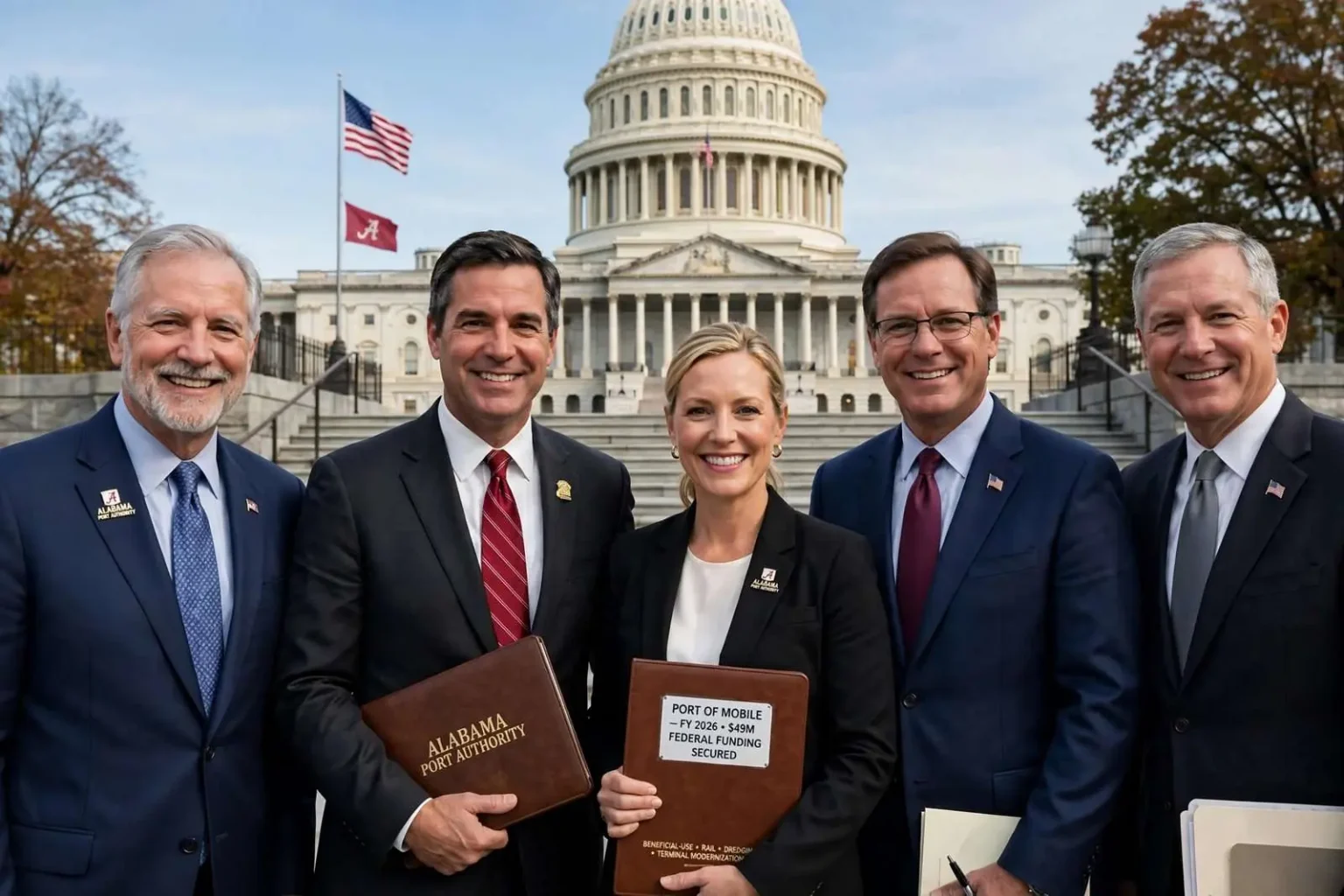
The Alabama Port Authority Board of Directors and members of the agency’s leadership team traveled to Washington to meet with Alabama’s congressional delegation and personally thank them for their continued support of critical projects at the Port of Mobile, capping a year in which more than $49 million in federal funding and appropriations flowed to port modernization efforts.
A First-of-Its-Kind Trip for the Board
Port leaders met with members of Alabama’s congressional delegation to provide an update on ongoing federal investments at the Port of Mobile and to highlight the Alabama Port Authority’s broader role in supporting economic development across the state. Beyond the substance of the briefings, the meetings offered board members a chance to thank delegation members personally for their continued support of projects that strengthen the port’s capabilities and position it for future growth.
“The Port of Mobile is a critical economic engine for the state of Alabama, and we are grateful to Alabama’s federal leaders for continuing to invest in our facilities and infrastructure,” said Zeke Smith, Chairman of the Board of the Alabama Port Authority. “These projects don’t just benefit the Port and the customers we serve. They strengthen Alabama businesses, support thousands of jobs, and create economic opportunity in communities across our state.”
The trip marked the first time the full APA Board had traveled to Washington together for this kind of delegation visit, according to the authority, following a year of what officials described as significant federal support for initiatives benefiting the Port of Mobile.
Where the Money Is Going
More than $49 million in federal funding and appropriations secured for the Alabama Port Authority in Fiscal Year 2026 is set to help modernize facilities, improve operational efficiency, and advance strategic projects meant to reinforce Mobile’s position as what officials call “America’s Gulf Gateway.” According to the authority, that funding breaks down across several distinct projects:
$3.2 million will support development of a beneficial-use site in Upper Mobile Bay, part of a long-term dredging strategy that also creates new wetlands and environmental habitat. $2 million through the Consolidated Rail Infrastructure and Safety Improvements Program is earmarked for improvements at the TASD Interchange Yard, intended to enhance freight rail efficiency and connectivity. Another $2 million through the Port Infrastructure Development Program, or PIDP, will support modernization efforts at the McDuffie Coal Terminal, while $850,000 through the same PIDP program will fund design and engineering work for a future cargo facility at the authority’s main docks.
Additionally, $500,000 will support a study of increased sedimentation affecting the Port of Mobile, and roughly $38 million flowing through the Harbor Maintenance Trust Fund’s Donor and Energy Transfer programs will support dredging and beneficial-use initiatives across Mobile Bay — by far the largest single component of the year’s federal support.
Why Dredging Dollars Matter So Much
The outsized share of funding directed toward Harbor Maintenance Trust Fund dredging support reflects a basic operational reality for deep-water ports: shipping channels silt up over time and require continuous maintenance dredging to remain navigable for the increasingly large vessels calling on U.S. ports. The Harbor Maintenance Trust Fund, financed through a federal tax on imported cargo, exists specifically to fund that kind of channel maintenance nationwide, and “Donor port” and “Energy Transfer” designations within the program direct additional support to ports, like Mobile, that generate significant trust fund revenue relative to what they have historically received back in dredging support.
Beyond the Numbers: Ongoing Expansion Projects
While in Washington, Alabama Port Authority leaders also briefed delegation members on several ongoing projects beyond the newly secured federal funding, including the expansion of the port’s container terminal, intermodal capacity upgrades, and other initiatives designed to strengthen Alabama’s competitiveness in global trade. “Strong revenues are allowing us to reinvest in our facilities and operations, but federal support is critical to making the larger infrastructure investments needed to support sustained growth at the Port of Mobile,” said Alabama Port Authority Director and CEO Doug Otto. “Our congressional delegation understands the impact the Port has on Alabama’s economy, and we appreciate their continued partnership and support.”
The Port’s Economic Footprint
The Port of Mobile ranks among Alabama’s most significant economic engines, supporting more than one in seven jobs statewide, according to the authority. Since 2019, the port has generated $415 billion in economic impact across all 67 of Alabama’s counties — a figure the authority regularly cites to underscore the port’s reach well beyond the immediate Mobile area and into the broader state economy. As Alabama’s only deep-water seaport, the Port of Mobile connects Alabama businesses, manufacturers, and industries with international markets, a role port leaders say depends directly on continued federal investment in the channel depth, rail connectivity, and terminal capacity that keep the port competitive with other Gulf Coast facilities.
How Ports Compete for Federal Dollars
Securing federal funding for port infrastructure is an inherently competitive process, with facilities across the country vying for a limited pool of money available through programs like the Port Infrastructure Development Program and the Consolidated Rail Infrastructure and Safety Improvements Program. Winning multiple discrete grants across several different federal programs in a single fiscal year, as the Alabama Port Authority did in securing its roughly $49 million, typically reflects sustained, multi-year advocacy work by port officials, state economic development agencies, and congressional delegation members working in concert to build the case for federal investment.
That advocacy work often begins years before a project is ultimately funded, requiring ports to complete preliminary engineering and environmental studies — sometimes using smaller planning grants, as the Upper Mobile Bay wetland project’s earlier $2.5 million planning grant illustrates — before a project is mature enough to compete successfully for larger construction funding. Congressional delegation trips like the one Alabama Port Authority leaders made to Washington serve a specific function within that process: they give port officials a direct channel to brief lawmakers and their staff on project status and make the case for continued support in future funding cycles, beyond what written grant applications alone can convey.
\n
Ripple Effects Across the State Economy
\n
The Port Authority’s emphasis on the port’s statewide economic footprint — supporting one in seven jobs and generating $415 billion in impact since 2019 — reflects a deliberate messaging strategy aimed at building support for port investment among Alabama residents and lawmakers who may live hundreds of miles from Mobile and have no direct daily interaction with the port itself. By framing federal port investment as a benefit to manufacturers, farmers, and other businesses across all 67 of Alabama’s counties rather than a parochial Mobile-area interest, port officials aim to sustain the kind of broad-based political support that has helped the authority secure federal funding across multiple presidential administrations and changes in congressional leadership.
Understanding the Federal Grant Programs Involved
The federal programs cited in the Port of Mobile’s funding package each serve distinct purposes within the broader landscape of U.S. freight infrastructure funding. The Port Infrastructure Development Program, administered by the U.S. Maritime Administration, was created specifically to help ports modernize terminals, expand cargo-handling capacity, and improve the connections between marine terminals and inland rail or highway networks — the kind of work reflected in Mobile’s McDuffie Coal Terminal modernization and future cargo facility design funding. The Consolidated Rail Infrastructure and Safety Improvements Program, by contrast, is a Federal Railroad Administration grant program aimed at improving the safety and efficiency of rail infrastructure nationwide, which is why it was the funding source for improvements at Mobile’s TASD Interchange Yard rather than for dockside terminal work. Both programs are highly competitive and oversubscribed in most award cycles, with the U.S. Department of Transportation and its component agencies typically receiving requests for far more funding than they are able to award in any given year, which is part of why port officials describe securing multiple discrete grants across several different programs in a single fiscal year as a meaningful achievement requiring sustained advocacy.
Mobile’s Position in Gulf Coast Port Competition
The Port of Mobile competes for cargo volume within a crowded field of Gulf Coast facilities, including much larger neighbors like the Port of Houston and the Port of New Orleans, as well as similarly positioned regional ports such as those in Gulfport, Mississippi, and Tampa, Florida. As Alabama’s only deep-water seaport, Mobile occupies a distinctive niche within that competitive landscape: it offers direct rail and highway connections into the Southeast’s manufacturing corridor while providing shippers an alternative to the congestion that can build up at the largest Gulf and East Coast facilities during periods of high cargo volume. Terminal modernization projects like those funded through this latest round of federal support are, in that sense, not just about serving existing customers but about maintaining Mobile’s competitiveness against ports that are simultaneously pursuing their own expansion and deepening projects. Shipping lines and cargo owners generally choose ports based on a combination of channel depth, terminal efficiency, inland connectivity, and total transit cost, meaning that a port which falls behind on any one of those dimensions risks losing volume to a competitor even if its other capabilities remain strong.
Bigger Ships, Deeper Channels
Much of the infrastructure investment described by Alabama Port Authority officials reflects a broader trend reshaping ports nationwide: the steady growth in vessel size across the global shipping industry. Container ships and bulk carriers have grown substantially larger over the past two decades, a trend accelerated by the 2016 expansion of the Panama Canal, which allowed considerably larger vessels to transit between the Pacific and the Gulf and East Coasts than the canal’s original locks could accommodate. Ports that cannot maintain sufficient channel depth and berth capacity for these larger vessels risk being bypassed in favor of facilities that can, which is why channel maintenance dredging — funded largely through the Harbor Maintenance Trust Fund programs cited in Mobile’s funding package — has become an increasingly central and continuous cost of doing business for every major U.S. port, not an occasional undertaking. The trust fund itself, financed by a federal tax on the value of imported cargo moving through U.S. ports, has for years generated more revenue than Congress has historically appropriated for dredging and maintenance projects nationwide, a mismatch that has made the fund’s “donor port” and “energy transfer port” designations — under which ports contributing disproportionately to the fund receive priority consideration for additional dredging support — a significant and closely watched policy mechanism for coastal port authorities across the country.
How State Port Authorities Are Structured
The Alabama Port Authority operates as a state agency governed by a board of directors, a structure common among major U.S. ports, where a public authority — rather than a private company or a city government alone — owns and manages port facilities on behalf of the state while contracting with private terminal operators, shipping lines, and other commercial partners for day-to-day cargo operations. That public-authority model allows ports to access government bond financing and to pursue federal grant programs generally unavailable to private infrastructure, while still operating with a degree of commercial flexibility to negotiate leases, terminal agreements, and long-term capital plans much as a private enterprise would. Board leadership and the authority’s professional staff, led in Mobile’s case by a director and chief executive officer, are typically responsible for both the port’s daily commercial operations and its longer-term advocacy work in Washington and Montgomery, a dual role reflected in this week’s delegation visit, which combined an update on completed federal wins with continued lobbying for the port’s next round of infrastructure priorities.