Alabama Power Offers Electrocution Safety Training for Mobile First Responders
Alabama Power is offering electrocution safety training for Mobile-area first responders after a firefighter was shocked at a house fire.
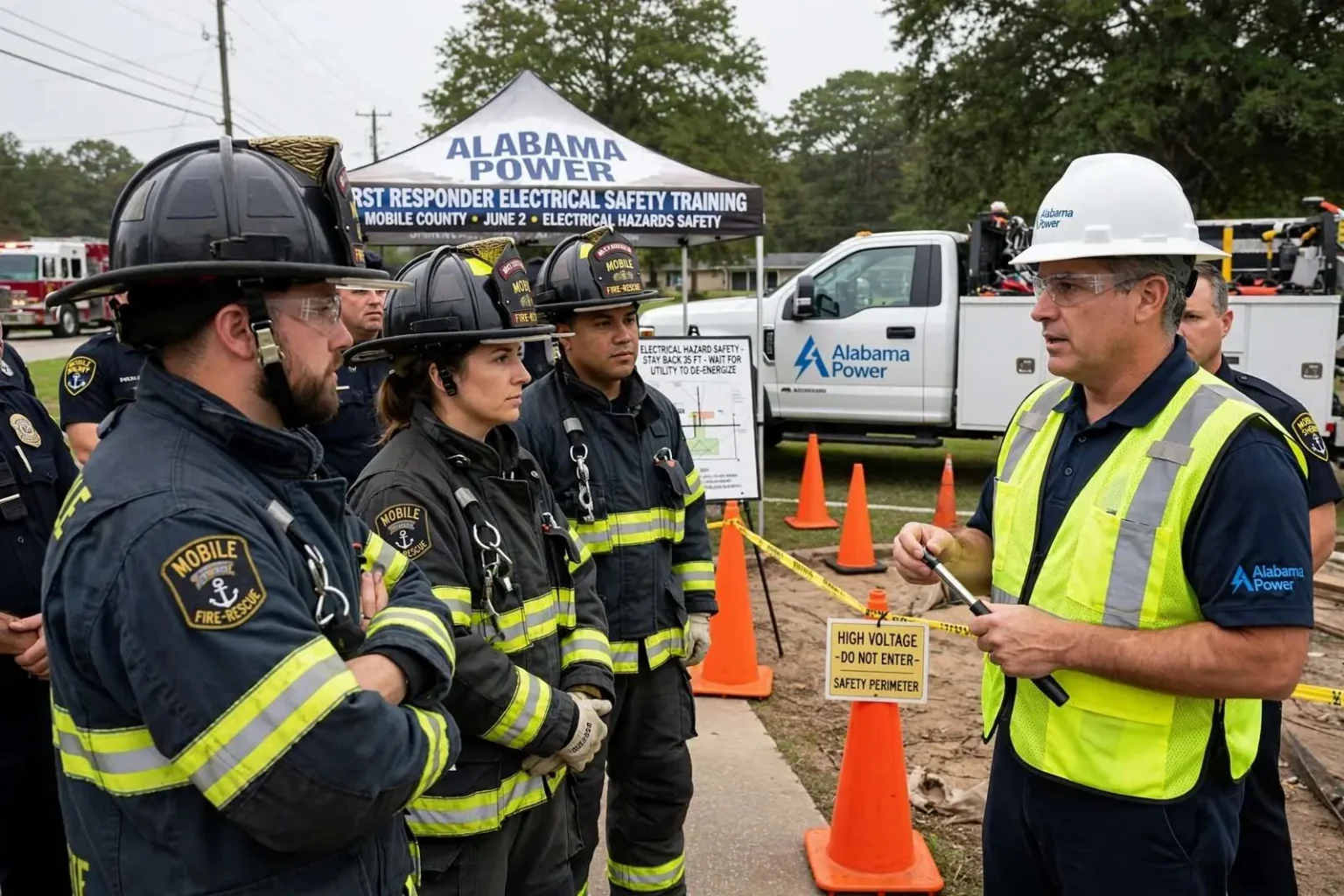
Alabama Power is offering safety training to first responders across Mobile County on how to avoid electrocution, prompted by an incident in which a Mobile Fire-Rescue Department firefighter was shocked while responding to a house fire on May 25. The firefighter received medical treatment after being shocked at the scene.
In response, Alabama Power is hosting an hour-long safety presentation on Thursday, June 2, designed to help first responders recognize and avoid electrical hazards during emergency operations. First responders can choose between two session times: 9 a.m. or 6 p.m. Advance registration is required. Those interested can contact Sharon Murrill with Alabama Power at (251) 463-3736 to reserve a spot.
The training initiative highlights the ongoing risks first responders face from downed power lines and electrified structures during fire and rescue operations, and the importance of coordination between utility companies and emergency services.
The May 25 incident that prompted the program is a reminder of a hazard that fire crews in Mobile confront regularly. When flames reach a structure’s wiring, meter base or service entrance, an entire building can become energized — and the danger is not always visible. A firefighter who contacts a fence, a gutter, a puddle or even a hose stream connected to an energized surface can complete a circuit without ever touching a wire. The Mobile firefighter’s injuries were treated after the shock, but the outcome could easily have been worse, and utility officials said the training was organized so that the lessons are shared before another close call.
Mobile Fire-Rescue Department is one of the largest fire departments in Alabama, operating fire stations across the city and handling tens of thousands of emergency calls each year. Its crews work in a dense urban grid where alleys, vehicle crashes and structure fires routinely put them close to overhead distribution lines, pad-mounted transformers and buried service drops. House fires involving electrical systems are among the most common fire types the department responds to, and every one carries the risk that the same fault feeding the fire has also energized the building’s shell.
Why electrical hazards catch crews off guard
Electricity is invisible, and that is what makes it uniquely dangerous at emergency scenes. A downed distribution line can energize the ground around it, creating a voltage gradient that spreads outward in rings; a line resting in standing water turns the entire puddle into a conductor; and a vehicle tangled in wires stays energized until the utility confirms the power is off. First responders are trained to treat every downed line as live, because lines do not have to spark, smoke or hum to be carrying lethal current.
The voltage carried by neighborhood distribution lines is far higher than the household current that trips a breaker. Even service drops feeding a single home can deliver a fatal shock instantly, and the protective devices that stop faults operate in fractions of a second — but not necessarily before contact has done its damage. Rubber gloves, dielectric boots and distance are the only real protection, which is why the core lessons of utility safety training are deceptively simple: stay back, establish a safety perimeter, and wait for the utility to de-energize.
Alabama Power, which serves Mobile and most of southern Alabama, maintains a long-running outreach program for first responders built around exactly those principles. The utility’s trainers walk crews through the anatomy of the electrical grid — generation, transmission, substations, distribution — and explain how each element behaves during a storm, a vehicle crash or a structure fire. Sessions typically include instruction on the hazards of pole-top and pad-mounted equipment, the proper distance to maintain from downed lines, and the steps to request an emergency disconnect.
The hour-long format chosen for the June 2 sessions reflects the utility’s experience that responders retain more from short, focused presentations than from lengthy classroom blocks. Offering one session at 9 a.m. and another at 6 p.m. acknowledges the realities of shift work: a firefighter on a twenty-four-hour rotation, a police officer working days, or a volunteer responder in the county may only be able to attend one or the other. Advance registration helps the utility plan materials and seating for each session.
The dual timing also opens the training to the full spectrum of first responders across Mobile County, which extends well beyond the city fire department. Municipal departments in Prichard, Saraland, Tillman’s Corner-area volunteer companies and other communities across the county all respond to calls involving downed lines and electrical equipment. Smaller volunteer departments, in particular, often have limited access to specialized training, so a no-cost hour with the utility’s own experts is a practical way to reach crews who might otherwise never get the material.
The coordination between utilities and emergency services
Fire and utility crews follow a division of labor that works only when both sides understand their roles. Firefighters secure the scene, keep bystanders clear, and handle suppression and rescue wherever the electricity permits. The utility is responsible for de-energizing and grounding equipment, and for making the call about when a line is safe to approach. On a busy incident, the arrival of the utility crew can be the pacing item for everything downstream — extrication, overhaul, even allowing residents back to their homes.
Disruptions in that coordination are where injuries happen. A crew that assumes a line is dead because a neighboring house has power, or because the line has been on the ground “long enough,” is relying on assumptions the grid does not support. Automatic reclosing devices can re-energize a fallen line minutes after a fault, which is why utility trainers emphasize that time does not make a downed line safe. The formal protocol is simple and absolute: only Alabama Power personnel declare lines dead, and they do it in person.
The May 25 shock also underscores a less visible hazard — the electrified structure. When fire attacks a building’s wiring, current can route through metal ductwork, plumbing, appliances and structural steel. Fireground commanders are trained to watch for signs such as flickering lights outside the affected area, arcing sounds, and smoke that behaves oddly, and to consider positioning apparatus away from the structure in case energized surfaces make contact. Communicating with the utility early in the incident, rather than after a problem appears, has become the recommended practice.
What responders can expect to learn
Participants in the June 2 presentation can expect a practical curriculum rather than an engineering lecture. Utility trainers typically cover how to recognize the components of the distribution system passing through their response districts; how storms and vehicle accidents interact with that equipment; how to establish and maintain exclusion zones around downed lines; and how to communicate with the utility’s dispatch and field crews during an incident. The sessions also give firefighters a chance to ask questions about specific situations they have encountered on calls in their own stations’ areas.
That local dimension matters. Mobile County’s neighborhoods range from dense downtown blocks to rural stretches near Citronelle and Mount Vernon, and the equipment in each looks different: older wire in historic districts, newer underground service in subdivisions, long rural spans on wooden poles. A training that describes what those differences mean at 2 a.m. in the rain is more useful than generic material, and the utility’s regional staff know the territory because they work it every day.
For the Alabama Power employees who teach the classes, the sessions are also an opportunity to hear from the responders themselves. Utility crews and fire crews work the same storms, the same crashes and the same fires, and each side sees things the other does not. The exchange flows both ways: responders learn where the hidden dangers are, and the utility learns how its equipment appears at an emergency scene and where communication with fire crews can improve.
The financial and human stakes of electrical incidents give the training its urgency. Electrocution is among the leading causes of firefighter deaths nationally, and injuries to utility workers and responders from line contact carry enormous costs — human, legal and operational — for the agencies involved. Compared with those stakes, an hour of instruction is an inexpensive investment, which is why utilities across Alabama have built first-responder training into their regular community outreach.
First responders who want to attend the June 2 training should act quickly, since registration is required in advance and space is limited. Interested personnel can contact Sharon Murrill with Alabama Power at (251) 463-3736 to reserve a spot for either the 9 a.m. or 6 p.m. session. The utility has indicated the program is open to first responders across Mobile County, not just any single department, reflecting the shared nature of the hazard the training addresses.
The May 25 shock that started it all is a story with a good ending — a treated firefighter, a close call, and an institutional response that turned one department’s near-miss into countywide preparation. If the June 2 sessions go as intended, the next crew that arrives at a house fire with energized walls, or a line down across a roadway, will do so with a clearer picture of what they are looking at and a firmer plan for staying alive around it.