MOBILE, Ala. — Alabama is moving forward with plans to study and recover artifacts from the submerged wreck of the Clotilda, the last slave ship known to have landed on American shores, setting in motion one of the most consequential maritime archaeology projects ever undertaken in the United States.
Seeking a dive contractor
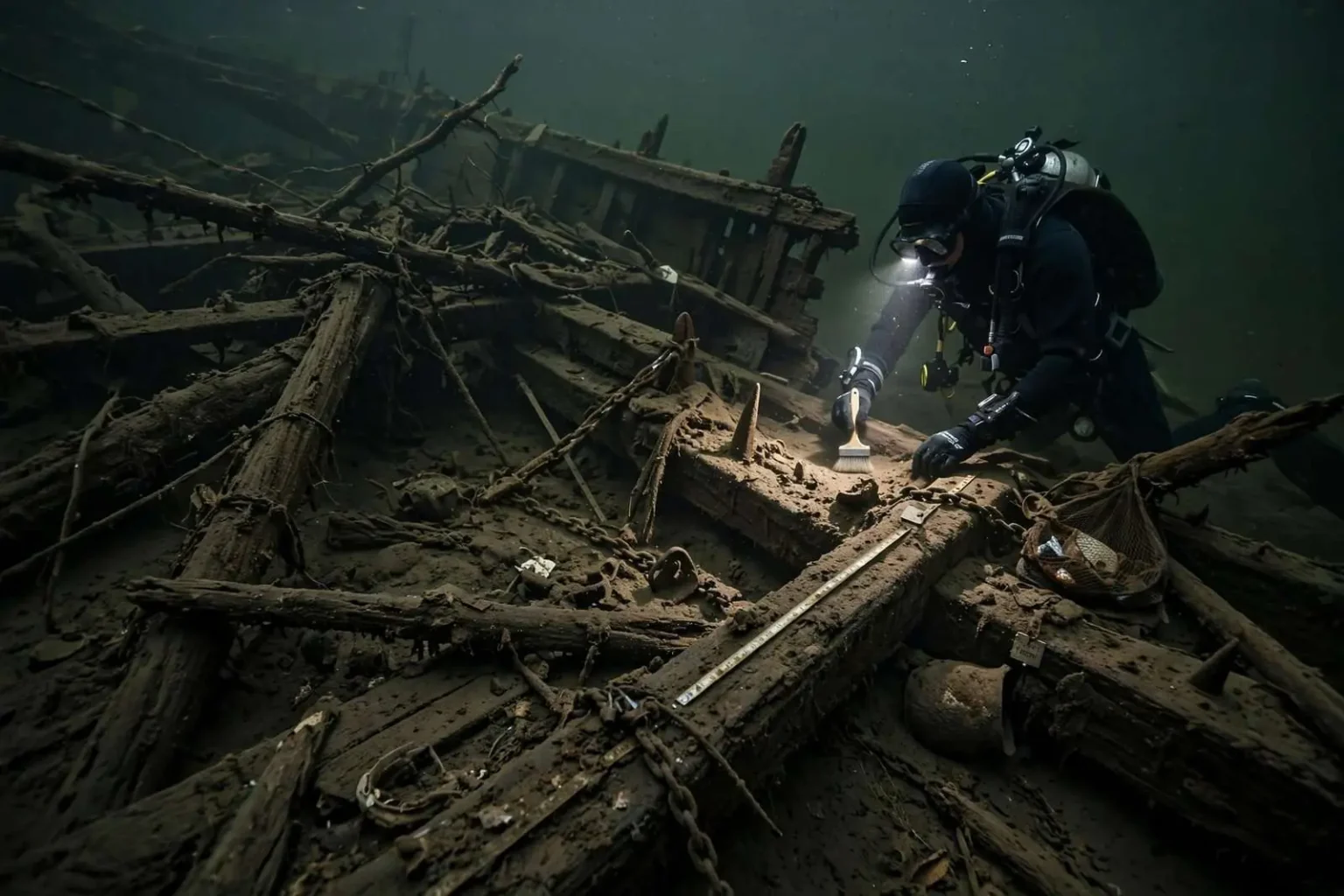
The Alabama Historical Commission has released a request seeking contractors to provide divers who can assess and document the two-masted schooner’s remains near Mobile. Under the scope of work, teams would remove artifacts, test the wreck’s timbers and could collect wood samples and DNA material. The document also raises the possibility of installing a monument at the site — a marker at the spot in the Mobile River where the vessel has rested for more than 160 years.
The request formalizes the next phase of work that has accelerated since the wreck’s identification. Sonar images released by the agency showed the vessel lying on the river bottom, its outline crisscrossed by what appear to be fallen trees or stray timbers — an image of a ship that was never salvaged, only abandoned, and that the river has silently preserved.
Dive contractors responding to the state’s request will face unusual conditions. The wreck lies in dark, fresh water where visibility is minimal, meaning much of the documentation will rely on instruments rather than eyes. Artifacts recovered from the vessel will need immediate conservation care after centuries underwater, and the state’s scope of work reflects the careful sequencing required: document first, sample second, recover what can be preserved.
A crime hidden, then found
The history beneath the request is extraordinary. In 1860 — on the eve of the Civil War — the Clotilda made an illegal voyage financed by wealthy Mobile businessman Timothy Meaher, delivering about 110 kidnapped Africans to Mobile before the ship was burned in a bayou to hide the evidence. The transatlantic slave trade had been outlawed in the United States for more than half a century when the voyage took place, making it not only an atrocity but a federal crime committed deliberately and concealed deliberately.
After emancipation, many of those survivors founded Africatown just north of downtown Mobile — a community built by people who had been born free in their West African homelands, kidnapped, enslaved in Alabama, and then determined to rebuild their own lives on their own terms. Their descendants remain part of the community today, and the Clotilda’s story is not an abstraction there: it is family history, carried in names, traditions and the neighborhood itself.
The search for the wreck’s final location involved years of investigation by a team of archaeologists and researchers, culminating in the announcement in 2019 that the vessel beside an island in the Mobile River had been positively identified as the Clotilda. The findings settled a question that had produced false alarms and hoaxes for decades, including earlier wrecks incorrectly promoted as the lost schooner.
A federal court subsequently granted the state ownership of the wreck, clearing the way for the recovery work now being organized. The ownership ruling matters practically as well as symbolically: it established that the vessel and its contents are state property held in trust for the public, and it gave the Historical Commission legal standing to contract for dive work, artifact recovery and site protection.
Preservation and an exhibit
State officials committed $1 million last month toward preserving what remains of the ship. The commitment funds the specialized conservation work that waterlogged timbers and artifacts require — a process that can take years and that begins the moment an object leaves the river. Artifacts from the Clotilda cannot simply be dried and displayed; each piece must be treated to prevent deterioration that would destroy what centuries of river water accidentally protected.
An exhibit featuring items recovered from the Clotilda is scheduled to open later this year in Mobile, giving the public a direct look at one of the most significant maritime archaeological finds in American history. The exhibit will mark the first time many of the recovered materials have been seen since 1860, and Mobile — the city where the voyage began and ended — is the natural place for that first public encounter.
Why the Clotilda matters
The Clotilda holds a singular place in American history for a grim reason: it is the last confirmed vessel to deliver kidnapped Africans into bondage on American soil. Its discovery provides physical evidence for a story long supported by oral history, memoir and archival record — most notably the account of Cudjoe Lewis, one of the voyage’s survivors, whose recollections kept the ship’s story alive across generations.
The vessel’s remains also carry scientific value that extends beyond the historical record. Wood samples can confirm construction details about the schooner and the Gulf shipbuilding practices of its era. DNA material, collected under the scope of work released by the commission, could one day help connect the wreck to the descendants of those carried aboard — a possibility that researchers and Africatown families alike have described as deeply personal.
For Africatown, the recovery work arrives amid a broader renaissance of attention. The community north of downtown Mobile has drawn renewed interest from historians, journalists and visitors since the wreck’s identification, along with new conversations about preserving its church, its cemetery and its distinctive history for future generations. Descendants have consistently emphasized that the ship’s story must be told alongside the story of what the survivors built afterward — a free, self-determined community that endures today.
The site itself
The location of the wreck in the Mobile River, beside an island, explains both its survival and the difficulty of working on it. The river’s dark, sediment-laden fresh water shielded the burned hull from the shipworms that destroy wooden vessels in saltier environments — a quirk of geography that preserved the Clotilda where most Gulf shipwrecks have long since dissolved. The same conditions, however, mean divers work nearly blind, navigating by sonar, guidelines and touch in currents that stir up silt with every movement.
The sonar imagery released by the Historical Commission offered the public its first detailed view of the site: a vessel lying on the river bottom, its outline crisscrossed by fallen trees or stray timbers that have settled across the hull over the decades. Those obstructions are part of the assessment challenge — teams must distinguish the schooner’s structure from everything the river has deposited on top of it.
The state’s request for contractors also signals an intention to treat the site with the same rigor applied to internationally significant wrecks. Every artifact removed, every timber tested and every sample collected must be documented to archaeological standards, because the Clotilda is not only a state-owned wreck but a piece of national and international history — one whose story is taught far beyond Alabama.
What comes next
The sequence ahead runs from assessment to recovery to conservation to exhibition, and each stage carries its own timeline. The dive contractor selected under the commission’s request will first assess and document the remains; artifact removal follows as conditions and preservation capacity allow; and the $1 million in committed state funding supports the conservation pipeline that recovered materials must pass through before they can be displayed.
Later this year, the scheduled exhibit in Mobile will give the public its first structured opportunity to engage with the recovered artifacts. For many Alabamians, the exhibit will also serve as an introduction to a history the state has only recently embraced telling — the story of the 110 people kidnapped aboard the Clotilda, the crime financed by one of Mobile’s wealthy businessmen, and the Africatown community their descendants sustain to this day.
The monument possibility raised in the scope of work points toward a longer horizon. A marker at the river site would make the location itself a place of memory, joining Africatown’s existing landmarks in telling the story on the ground where it happened. Whatever form the memorial takes, the recovery effort now underway ensures that the Clotilda’s physical remains — the last tangible evidence of the transatlantic slave trade’s final American voyage — will be studied, preserved and shared rather than left to the river.
The exhibit planned for later this year in Mobile will anchor the public side of that work. State officials and partners have described the display of recovered Clotilda materials as a landmark moment for a story that survived generations largely through the spoken word — in Africatown’s churches, its family kitchens and its community gatherings — before the river gave up the ship’s physical proof.
Between the state’s $1 million preservation commitment, the court ruling establishing ownership, the dive contractor request and the coming exhibit, the Clotilda is moving through the full arc of a major archaeological project — from discovery to documentation to public interpretation. Few wrecks in American waters carry comparable weight, and fewer still carry a living community of descendants watching each step. Alabama’s plan, as laid out in the commission’s scope of work, treats that responsibility accordingly: recover what can be preserved, study what the remains can teach, and return the story to the public that owns it.