$4 Million Federal Grant Will Train 550 People Leaving Prison for Gulf Coast Skilled Trades
The Alabama Restart Initiative will use nearly $4 million in U.S. Department of Labor funding to train 550 adults on probation, parole or mandatory release in Mobile and Baldwin counties for welding, pipefitting and other trades in demand along the Gulf Coast.
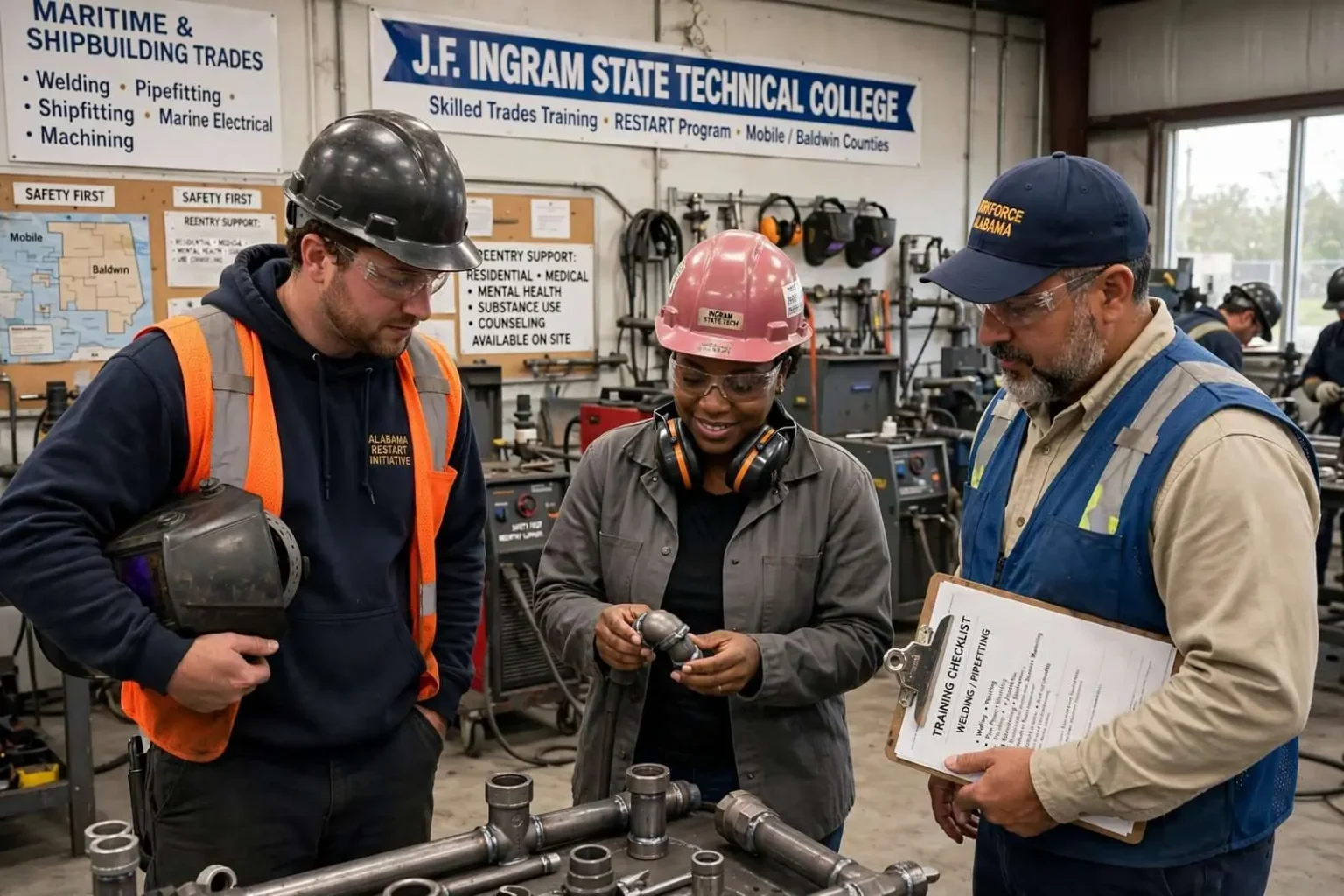
More than $14 billion in new and expanding capital investment along Alabama’s Gulf Coast has created a demand the region cannot currently meet: welders, pipefitters, shipfitters, electricians, machinists and related skilled trades.
A new public-private partnership is going to look for those workers among people leaving prison.
The U.S. Department of Labor has awarded nearly $4 million to the Alabama Restart Initiative, which will train and place 550 adults in Mobile and Baldwin counties who are under active supervision on probation, parole or mandatory release.
The Partners
The funding comes from the Labor Department’s Reentry Employment in Skilled Trades, Advanced Manufacturing, Registered Apprenticeships, and Training program — RESTART.
Partners include:
- Workforce Alabama
- The Alabama Bureau of Pardons & Paroles
- J.F. Ingram State Technical College and the Alabama Community College System
- Southwest Alabama Partnership for Training and Employment
- The Council of State Governments Justice Center
The Labor Department allocated $3,999,999 in FY 2026 program funding to the initiative.
Of that amount, J.F. Ingram State Technical College received $797,444 to provide technical training, industry-recognized credentials and job preparation for participants.
Why Employment Is a Public Safety Question
Alabama Bureau of Pardons & Paroles Director Cam Ward put the case plainly.
“This partnership not only builds a new talent pipeline for critical industries in our state, but it provides a path to stability for those who are reentering society after prison or probation,” Ward said. “That opportunity is essential to public safety because one of the key drivers of recidivism and crime comes from lack of employment.”
The initiative aligns with Alabama’s Reentry 2030 goals, which aim to increase participation in workforce services for this population and cut recidivism by 50 percent.
The logic is straightforward: a person released without income, skills or a job has a narrow set of options, and the state pays for the consequences either way — through incarceration costs or through crime.
Where the Training Happens
The partnership will use existing facilities rather than building new ones.
Alabama Bureau of Pardons & Paroles Day Reporting Centers in Mobile and Baldwin counties and the Perry County PREP Center will serve as training and workforce development hubs. Through those locations, Ingram State will provide education, workforce training and industry-recognized credentials.
Those same centers provide the recruiting pipeline — a direct channel to identify, screen and enroll participants who are already reporting there under supervision.
The program centers on shipbuilding, the maritime trades and advanced manufacturing. Participants can train in areas including welding, pipefitting, shipfitting, marine electrical work, machining, industrial maintenance and maritime safety.
Support Services While Training
Participants will not be left to complete the coursework on their own. Rebecca Bensema, assistant director for reentry at the Alabama Bureau of Pardons & Paroles, said the initiative wraps training in services designed to help people finish the program and get hired.
“While they’re receiving that training, they will be receiving support services, such as residential and medical. There is substance use treatment that’s available. There’s mental health treatment that’s available on site to give them the best opportunity possible to be able to be successful in completing that program and get them out to the shipyard, to get them to work,” Bensema said.
Ingram State’s Role
J.F. Ingram State Technical College President David Walters described where the training leads.
“This federal investment will expand access to workforce training that connects directly to opportunity,” Walters said. “Through this partnership, participants will earn industry-recognized credentials that prepare them for careers in Alabama’s growing maritime industry and related fields, including offshore wind energy, aerospace manufacturing, automotive manufacturing and industrial construction.”
Walters said the program matters because the Gulf Coast continues to draw investment in shipbuilding, maritime industries and advanced manufacturing at the same time Alabama and the nation are working to expand shipbuilding and other maritime capabilities.
“This initiative addresses two important needs facing our state,” Walters said. “Alabama employers need trained, dependable workers, and justice-involved individuals need opportunities to develop marketable skills and build stable careers. Ingram State is proud to provide the education and technical training that will help connect those needs.”
‘Training Alone Is Not Enough’
The most pointed comment came from the organization responsible for connecting participants to employers.
Sydney G. Raine, president of the Southwest Alabama Partnership for Training and Employment, identified the failure mode directly.
“SWAPTE is proud to be a partner in the Alabama RESTART Initiative and to help individuals returning to our communities prepare for meaningful employment,” Raine said. “A critical part of this initiative, however, must be employer engagement and a commitment from businesses to hire these individuals.”
“Training alone is not enough. If we prepare participants for employment but employers are unwilling to give them an opportunity, we are setting them up for failure.”
He defined the standard the program should be judged by: “Our goal is to connect participants with employers who will provide sustainable, career-oriented employment and wages that allow them to become self-sufficient and successfully reintegrate into their communities.”
That is a meaningful caveat from inside the partnership. A credentialed welder with a felony record still needs a company willing to hire him, and a program that produces credentials without placements has not solved anything.
The Scale and Timeline
The initiative will enroll 550 adults age 25 and older in Mobile and Baldwin counties over a 42-month grant period.
Participants will include people recently released from Alabama state prison and under active supervision on probation, parole or mandatory release.
As industry in the Mobile-Baldwin corridor continues expanding, the initiative is designed to adapt to what job creators need — agility the partners describe as critical to the program’s success.
The State’s View
Alabama Department of Workforce Secretary Greg Reed framed the effort in terms of removing obstacles.
“There are multitudes of opportunity available in Alabama, for all sectors of our workforce,” Reed said. “We know that sometimes there are hurdles to entering or rejoining the workforce, and we are here to provide assistance and training to help prospective employees overcome those challenges. We’re proud to be involved in this joint effort to ensure that all Alabamians have an adequate opportunity to be successful.”
Workforce Alabama officials said the initiative is meant to help people overcome barriers to employment, such as a prior felony conviction or other involvement with the criminal justice system, while creating a direct path into jobs that are open now.
The initiative also supports federal efforts to develop programming aimed at surpassing one million new active apprentices nationally.
Measuring Whether It Works
The Council of State Governments Justice Center will provide ongoing assistance on evidence-based reentry and workforce development practices and statewide systems coordination.
“Our goal is to help the state maximize this funding to create real employment pathways that help people succeed in the community after release and stay out of prison in the future,” said Nina Salomon, reentry strategy director at the CSG Justice Center.
The program will track how participants fare on several measures:
- Credentials earned
- Employment
- Earnings
- Job retention
- Enrollment in apprenticeships
- Recidivism
Partners plan to evaluate the program using those results and expand as opportunity allows.
The Underlying Arithmetic
What makes this initiative different from most reentry programming is that it is not primarily a criminal justice proposal. It is a labor supply proposal.
The Gulf Coast has $14 billion in investment arriving and a shortage of people qualified to do the work. Alabama releases people from prison every month who need jobs. The initiative connects one to the other, and the state’s recidivism target comes along as a second-order effect.
Whether it works will depend, as Raine said, on whether employers show up.