MOBILE, Ala. — The Alabama School of Mathematics and Science is reaching out to younger students across the state, inviting 9th- and 10th-graders to learn about its tuition-free STEM boarding program. The recruitment push comes as the school looks to make sure families in every corner of Alabama know that one of the state’s most rigorous public high schools charges nothing for admission.
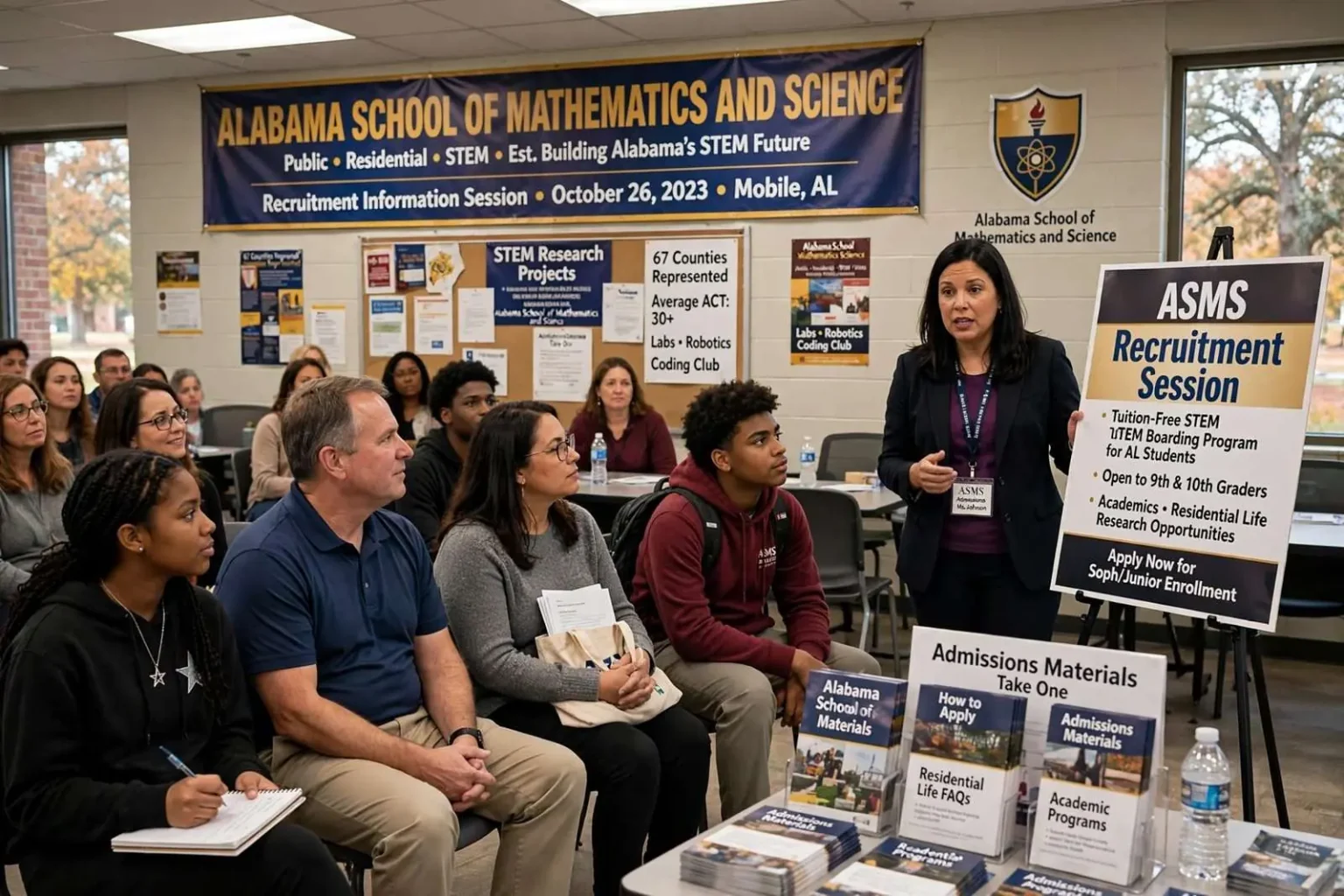
School administrators held an information session on Thursday, Oct. 26, at the ASMS campus in Mobile, welcoming prospective students and their families to explore what the school has to offer. Sessions like this one walk families through academics, residential life, the application timeline, and the practical questions that come with the idea of a teenager leaving home for a boarding school two years before graduation.
ASMS is Alabama’s only fully public and fully residential high school, serving sophomores, juniors, and seniors with a focus on science, technology, engineering, and mathematics. The school sits in the historic Spring Hill area of Mobile, and its campus combines classrooms and laboratories with dormitory life, giving students from small towns and big cities alike a shared residential experience.
The state covers tuition for all enrolled students, and children from all 67 Alabama counties have attended the school. That footprint is a point of pride for administrators, who describe the school as a resource for the whole state rather than for Mobile alone — a place where a student from a school that cannot offer calculus or research labs can find those opportunities.
A Different Kind of Public School
The model differs from a standard high school in almost every dimension. Students live on campus, take an advanced curriculum concentrated in STEM fields, and are surrounded by classmates who chose to be there. The residential structure allows the school to run labs, research projects, study sessions, and enrichment activities on schedules a day school cannot match.
Administrators say the school provides academic, leadership, laboratory, and research opportunities that students would not typically find at their home schools. Coursework goes well beyond state graduation requirements, and the faculty — many with advanced degrees in their fields — teach at a depth that prepares graduates for selective colleges and universities across the country.
The school boasts an average ACT score of 30 among its students, well above state and national averages. For context, the national average ACT composite has typically hovered around 20, meaning the ASMS student body scores roughly ten points higher on average — a gap that reflects both the selectivity of admissions and the intensity of the academic environment.
Admission is competitive but designed to find motivated students rather than only those with perfect records. Administrators have historically emphasized that students from rural districts, home-school backgrounds, and under-resourced schools are encouraged to apply, because the school’s mission is to serve the state’s talented students wherever they live.
Why the School Reaches Out Early
The information session targeted 9th- and 10th-graders because timing is everything in the admissions cycle. Students apply during the middle and later years of high school and enroll as sophomores or juniors, so families who wait until a student is already deep into 10th grade may find the window narrowing. Early outreach gives families time to plan, visit, and prepare an application.
For parents, the tuition-free structure is often the most surprising fact. Families accustomed to assuming that boarding school means five-figure tuition learn that ASMS, as a public school of the state, charges no tuition for Alabama residents — removing the largest barrier that keeps qualified students from considering the school.
What Students Find on Campus
Life at ASMS extends well past the classroom. Students participate in clubs, athletics, leadership organizations, and service projects, and the residential setting means those activities happen within a community where classmates are also lab partners and roommates. Administrators describe the environment as one that teaches independence — managing time, laundry, and deadlines — two years before most students face college life.
The school’s research opportunities are among its strongest draws. Students have worked on projects in the sciences and mathematics that would be unfamiliar at most high schools, presenting their work and entering competitions that can shape college admissions and scholarship outcomes. For a student interested in engineering, medicine, computer science, or research science, the exposure can be formative.
Graduates go on to colleges and universities inside and outside Alabama, often with scholarship support, and the school maintains a record of alumni who have entered STEM careers across the state and nation. Administrators point to that record when talking with skeptical families who wonder whether two years away from a hometown school is worth it.
How Families Can Learn More
Families interested in the program can visit the school’s website for additional details about admissions and upcoming events. The site lays out application requirements, deadlines, and visit opportunities, and the admissions staff can answer questions about the timeline for sophomores and juniors considering a transfer.
Information sessions in Mobile are one of several ways the school connects with families across the state. Prospective students and parents can also arrange campus visits, meet current students, and sit in on the kind of academic and residential programming that defines daily life at the school.
Counselors in school systems across Alabama are another channel. Because students from all 67 counties have attended, many districts have alumni on staff or students currently enrolled who can speak to the transition from a home school to residential STEM school, and the school encourages families to reach out early in a student’s high school career.
For a motivated 9th- or 10th-grader interested in science, mathematics, or technology, the school represents an option that did not exist in most Alabama communities a generation ago: a public, free, statewide program that treats a teenager’s talent as something worth investing in — wherever that teenager happens to live.
The session on Oct. 26 was part of that early-outreach strategy. Rather than waiting for applications to arrive, administrators bring the school’s story directly to families, explaining the residential model, the academics, and the application process in person. Questions at such sessions range from dorm life and phone policies to course selection, athletics, and how a student returns home for breaks.
The Case for a STEM-Focused High School
Alabama’s push to grow its technology and advanced manufacturing workforce has put a premium on students who graduate high school already steeped in science and mathematics. Employers in aerospace, biotechnology, shipbuilding, and automotive manufacturing — all present in the state — look for exactly the preparation that a focused STEM curriculum provides, and the school’s graduates step into that pipeline early.
Educators have long observed that talent is evenly distributed across a state even when opportunity is not. A bright student in a small Black Belt town may have no access to calculus, physics labs, or computer science courses that suburban schools take for granted. The residential model closes that gap by bringing the student to the resources rather than waiting for the resources to arrive.
The school’s residential structure also serves students whose home environments make it hard to focus on demanding academics. For some, the campus offers the first place where being serious about science is the norm rather than the exception — a peer group that pushes in the same direction.
Preparing for the Application
Students considering ASMS can strengthen their candidacy well before applying. Counselors recommend taking the most challenging courses available at the home school, building strong relationships with teachers who will write recommendations, and demonstrating genuine interest in mathematics and science through clubs, competitions, or independent projects.
The application itself typically asks for transcripts, test scores, teacher recommendations, and student essays, giving admissions staff a picture of both academic readiness and motivation. Administrators stress that the process is designed to identify students who will thrive in the school’s demanding, close-knit environment — not simply those with the highest numbers.
For families weighing the decision, administrators suggest treating the choice as a two-year commitment with a clear payoff: an advanced education, college preparation, and independence, all at no tuition cost to Alabama families. The information sessions are the place to ask the hard questions, and the school’s staff make themselves available to answer them.
As the school continues its statewide recruitment, administrators say the goal remains constant: to find Alabama’s promising young scientists and mathematicians wherever they are, and to give them a school built around what they can do.
Prospective families who missed the October session will have further chances to engage with the school through its website and admissions office, which maintain a calendar of visit days and events throughout the year. The school encourages families who cannot travel to Mobile to start online, where virtual resources and staff contacts can answer initial questions before a campus visit is planned.
The message administrators bring to those events is straightforward: Alabama families do not have to choose between a challenging STEM education and affordability. For students willing to leave home a couple of years early, the state has built a school that delivers both, and every session held across Alabama is an invitation to find out whether it is the right fit.