Alabama Voters Can Cast Absentee Ballots for Postponed July 14 Primary Runoff
Secretary of State John Merrill outlines absentee voting options and deadlines for Alabama's coronavirus-postponed July 14 primary runoff election.
Alabama voters will head back to the polls this summer for a primary runoff that looks very different from the one originally scheduled, and Secretary of State John H. Merrill wants them to know they do not have to risk their health to take part. With the state’s primary runoff election pushed from March 31 to July 14 because of the coronavirus outbreak, Merrill is reminding voters they can avoid the polls entirely by voting absentee. “Alabamians who are concerned about contracting or spreading an illness have the opportunity to avoid the polls on Election Day by casting an absentee ballot,” Merrill said in announcing the guidance for the rescheduled runoff.
The runoff was originally set for March 31, but as the COVID-19 pandemic spread across Alabama and the rest of the country, state officials determined that holding an in-person election at that time posed too great a risk to voters, poll workers, and the broader public. The delay moved the contest to Tuesday, July 14, giving campaigns additional months to reach voters and giving election officials time to prepare for an election that would unfold amid a public health emergency. The rescheduled runoff means Alabama’s primary season stretches deep into the summer, an unusual arrangement for a state that typically settles its party nominations in the spring.
For many voters, the most consequential change is the expanded ability to vote from home. Absentee voting, long available in Alabama only for voters who met specific statutory qualifications, became far more accessible because of emergency authority granted to the Secretary of State’s Office. That authority is the reason a voter worried about exposure to the virus can now request and cast a ballot without leaving their residence.
How to Apply for an Absentee Ballot
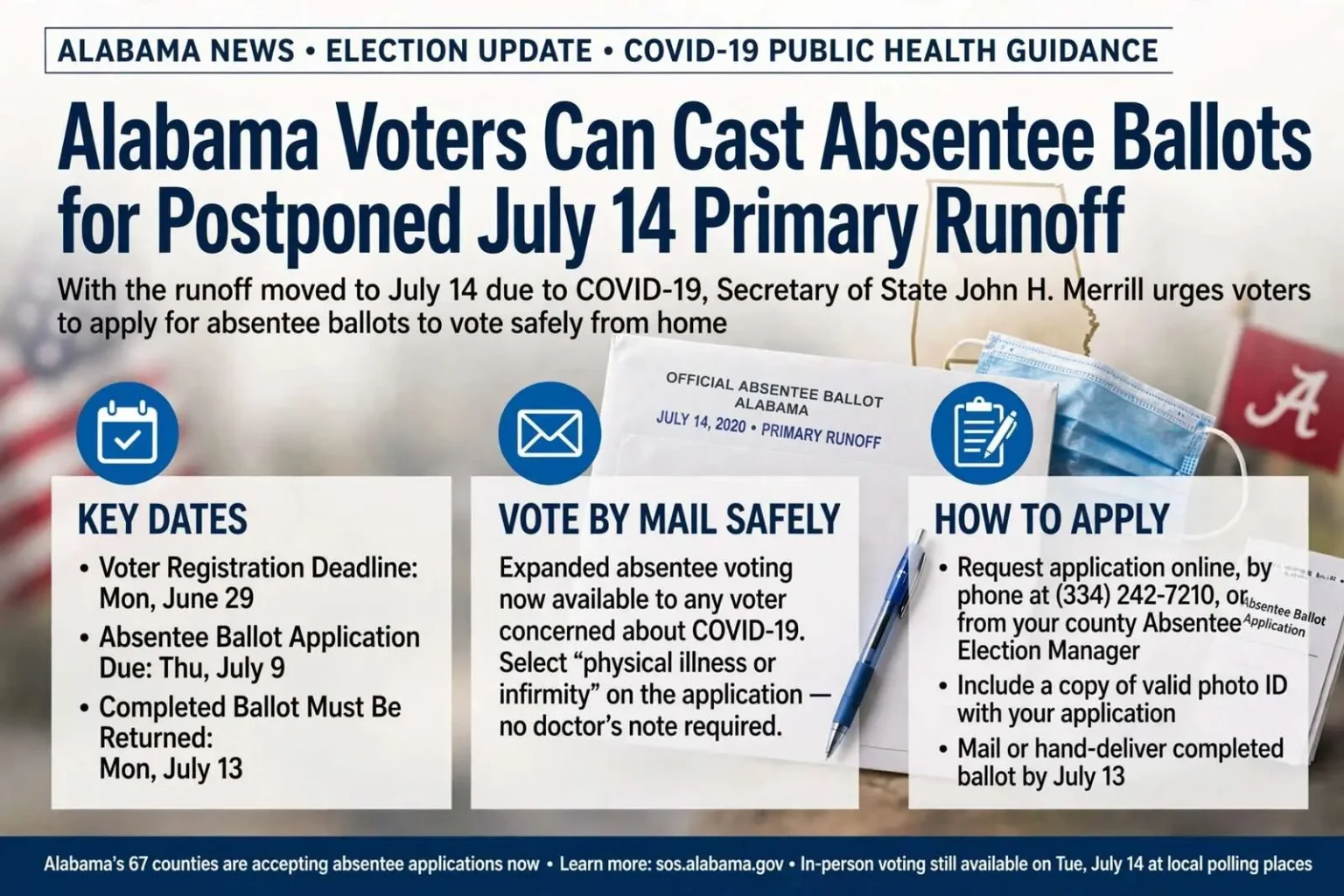
Getting an absentee ballot starts with an application, and Merrill’s office has made the process available through several channels. Absentee ballot applications are available online, through local Absentee Election Manager offices, or by calling the Secretary of State’s Office at (334) 242-7210. Each of Alabama’s 67 counties has an Absentee Election Manager, typically based at the county courthouse, who handles applications, issues ballots, and receives completed ballots from voters in that county. Voters who prefer to apply in person can visit their county’s Absentee Election Manager, while those who would rather not make a trip can download an application from the Secretary of State’s website or request one by phone.
Because state law allows the Secretary of State to issue absentee voting guidance during declared states of emergency, Merrill is encouraging voters worried about COVID-19 to check the box on the application citing a physical illness or infirmity that prevents attendance at the polls — an option that requires voter identification. Under normal circumstances, an Alabama voter who wanted to vote absentee had to state a qualifying reason, such as being out of the county on election day, being a member of the armed forces, working a shift that prevented voting, or having a physical illness or infirmity. The emergency guidance effectively opens the absentee option to any voter who is concerned about being around others at the polls, without requiring them to document a specific medical condition.
Under normal circumstances, Alabama law limits who may vote by mail. The state’s Constitution and the statutes that govern elections have historically treated absentee voting as an exception to the rule that voters appear in person at their assigned precinct, and the qualifying reasons were interpreted narrowly. The emergency guidance issued for this runoff takes a different approach: it effectively opens the absentee option to any voter who is concerned about being around others at the polls, without requiring them to document a specific medical condition or obtain a doctor’s note. Election officials across the state have reported strong interest in the absentee option since the runoff was rescheduled, and county offices have been preparing for a volume of mail-in ballots far beyond what a typical Alabama primary runoff produces.
Voters who use the illness or infirmity box still need to verify their identity. That generally means submitting a copy of acceptable photo identification with the application — an Alabama driver’s license or non-driver ID, a U.S. passport, a student or employee ID from an Alabama college or a state employer, a military ID, a tribal ID, or another approved form. Voters who have difficulty meeting the identification requirement can contact the Secretary of State’s Office for assistance in resolving it before the application deadlines pass. A copy of the identification must accompany the absentee application, and election officials recommend making the copy at the time the application is filled out so the paperwork can be mailed together in a single envelope without delay.
Key Deadlines for the July 14 Runoff
The calendar for the rescheduled runoff includes several dates that voters should mark now. The voter registration deadline is Monday, June 29. Anyone who is not registered by that date cannot participate in the July 14 runoff, so voters who have recently moved within Alabama or who have never registered should take care of it well before the deadline. Registration can be completed through the county Board of Registrars or online through the state’s registration portal.
The absentee ballot application deadline is Thursday, July 9. Applications must be received by the voter’s Absentee Election Manager by that date, and election officials advise against waiting until the final day, since any application that arrives incomplete or with an identification problem may leave too little time to fix it before ballots must be returned.
Completed ballots come back to the Absentee Election Manager by close of business Monday, July 13, which is the deadline to return a completed ballot to the Absentee Election Manager. The last day to postmark an absentee ballot is also Monday, July 13. In practical terms, voters who mail their ballots should do so early enough to ensure the envelope is postmarked by July 13 and reaches the election manager’s office by the close-of-business deadline the following day. A ballot that is postmarked in time but arrives late will not count, so officials recommend hand-delivery to the Absentee Election Manager’s office for anyone cutting it close.
Military and overseas voters covered by the Uniformed and Overseas Citizens Absentee Voting Act have until Tuesday, July 14 — election day itself — to postmark their ballots. The federal law, commonly known as UOCAVA, guarantees service members, their eligible family members, and overseas civilians a means of participating in elections even when they are far from their home county. The extra day for UOCAVA voters reflects the realities of military mail and international delivery, which can add days or weeks to transit times.
What the Runoff Will Decide
A primary runoff is held when no candidate in a primary race receives a majority of the vote, sending the top two finishers to a head-to-head contest. The winner of the runoff becomes the party’s nominee for the general election in November. Because Alabama is a state where party nominations frequently determine the eventual officeholder, runoffs in statewide and legislative races often draw intense interest, and the delay of this one pushed campaign activity into early summer.
The rescheduled date also affects the logistics of election administration across the state’s 67 counties. Absentee Election Managers, probate judges, and county commissions have had to plan for a runoff conducted during an ongoing pandemic — recruiting poll workers who may be at higher risk, arranging polling places that allow for social distancing, and processing an expected surge in absentee applications. The Secretary of State’s emergency guidance is designed to relieve some of that pressure by letting voters who are concerned about the virus vote by mail rather than crowding precincts.
What Voters Should Do Now
Local election officials and the Secretary of State’s Office offer a consistent set of recommendations for the weeks ahead. First, confirm your registration status before the June 29 deadline. Second, if you intend to vote absentee, request an application as early as possible through the online portal, your county Absentee Election Manager, or the Secretary of State’s Office at (334) 242-7210. Third, when filling out the application, voters concerned about COVID-19 should check the box citing physical illness or infirmity under the emergency guidance, and include the required copy of photo identification. Fourth, return the completed ballot promptly — by mail with enough time for a July 13 postmark, or in person to the Absentee Election Manager by close of business on July 13.
Voters who prefer to vote in person can still do so on Tuesday, July 14 at their assigned polling place, and the same registration deadline of June 29 applies regardless of how they plan to cast their ballot. For voters who are unsure which races appear on their runoff ballot or where their polling place is, the Secretary of State’s Office maintains online lookup tools, and county Absentee Election Managers can answer questions about the absentee process. With the runoff now set for mid-July, the safest course for any voter concerned about the coronavirus is to plan ahead: register early if needed, apply for an absentee ballot early, and return it in time to be counted.