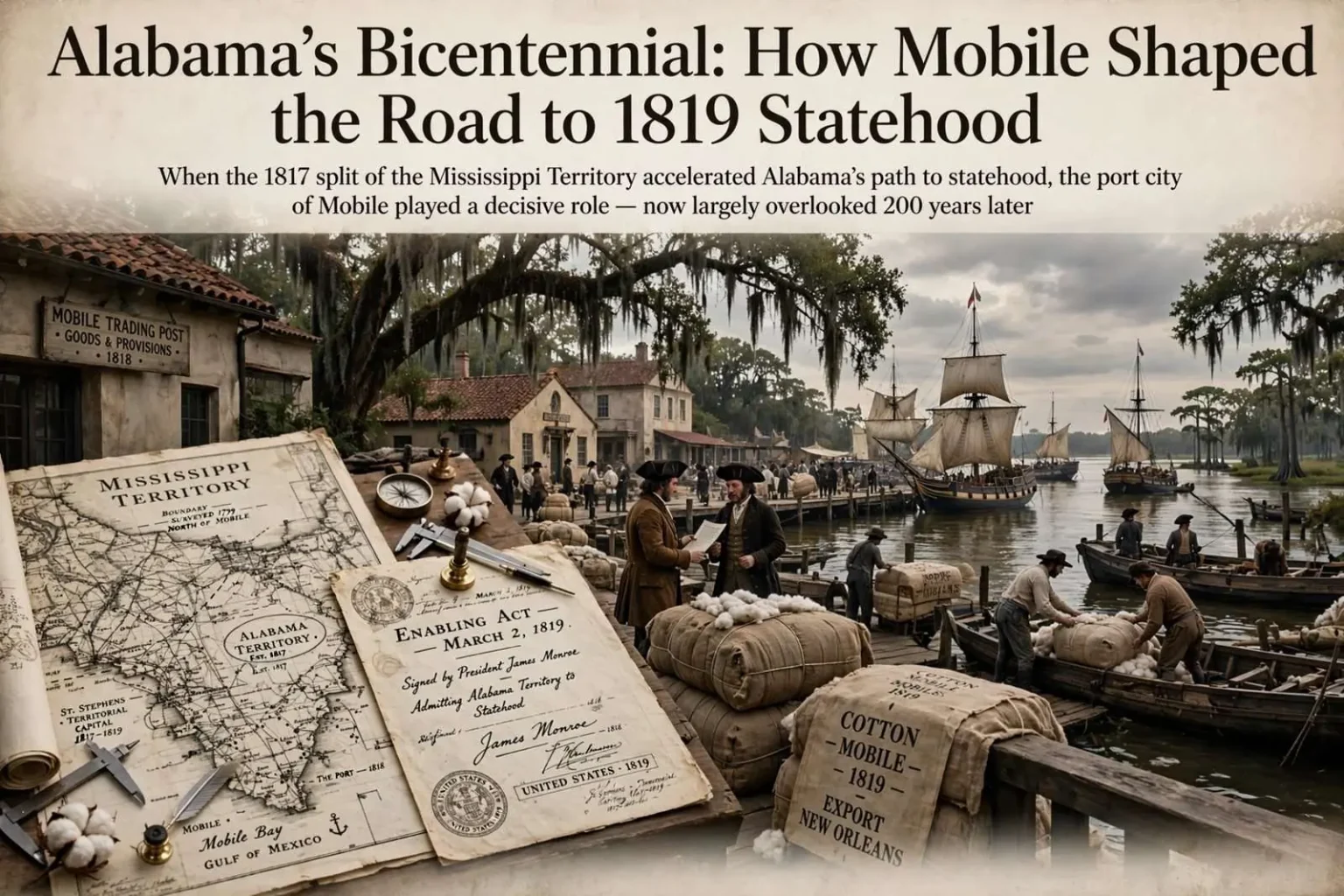
Alabama marked the 200th anniversary of statehood in 2019, a milestone that traces directly back to decisions made in Mobile and along the Gulf Coast more than two centuries ago. On March 2, 1819, President James Monroe signed the Enabling Act that Congress had approved the previous December, formally setting Alabama on the path to becoming the nation’s 22nd state. Word of that action traveled slowly in an era before railroads or telegraph lines, arriving by horseback and boat, so there was little in the way of celebration when it happened.
Local historians say that quiet reception two centuries ago has an echo today, since Mobile’s role in the story of Alabama statehood is often overlooked even as other parts of the state marked the bicentennial with fanfare. The land that became Alabama started out as the eastern half of the Mississippi Territory, a vast expanse created by Congress in 1798 that stretched west of Georgia, south of Tennessee and north of the 32nd parallel.
Surveyors working under Andrew Ellicott pinned down the exact boundary within a year or two of the territory’s creation, running the line just north of Mobile near Plant Barry on the Mobile River. At the time, the Mississippi Territory was physically larger than any state in the Union, yet its far-flung settlements had almost no way to communicate with one another. Settlements along the Mississippi River, such as Natchez, had little in common with the cotton country to the north or the mostly undeveloped eastern half of the territory that would eventually become Alabama.
That eastern portion remained largely Native American land, and Mobile stood as the only settlement of any real size, still under Spanish control until 1813. President Thomas Jefferson appointed an English-born judge named Harry Toulmin, who had previously served the federal government on the Kentucky frontier, to organize a basic government from St. Stephens on the Tombigbee River. Toulmin’s task was not easy. Settlers arriving from Georgia and from Spanish territory to the south were, by many accounts, a diverse and often unruly population, and establishing any semblance of law and order took years.
Development across the territory’s eastern half was slow so long as Native American tribes held the land, which they used largely for hunting and small-scale farming as they had for generations. Settlers, however, wanted the same land for growing cotton, a crop for which the soil was especially well suited. That fundamental conflict between two very different uses of the land escalated in the early 19th century, first with the Creek Nation and later with other tribes in the region, culminating in the Creek War of 1813-1814.
The war was brutal, and its end forced Native Americans to surrender the bulk of their territory, opening millions of acres to settlement. What followed was a land rush so intense that it became known as “Alabama Fever,” a wave of migration that continued for years afterward, lasting until late 1819. That surge of settlement upended the balance of power within the Mississippi Territory. The eastern half, fueled by the aftermath of the Creek War, began growing far faster than the western half centered on the Mississippi River, and it threatened to dominate territorial politics altogether.
Congress had set clear rules for statehood: a territory needed a population of at least 60,000 and a state constitution acceptable to federal lawmakers. By 1816, the eastern portion had cleared that population threshold, and its leadership, many of whom had roots in Georgia, was in a position to draft a constitution that Congress would accept. There was also a political motive at play beyond population growth.
Southern states supported splitting the territory in two because doing so would add four more senators from slaveholding states, at a time when the question of slavery’s expansion was becoming as important to national politics as the settling of the frontier itself. Mobile had been formally part of the Mississippi Territory since 1813, and the once-sleepy colonial trading outpost was beginning to feel the earliest effects of the cotton boom taking hold across the region. The old economy built around trade with Native Americans faded as those communities were displaced, replaced by a far more lucrative cotton trade.
Events unfolding well north of the city reshaped Mobile almost overnight, ushering in a new era of wealth, newcomers and the boom-and-bust cycles that would define the cotton economy for generations. Change accelerated after 1816. Leaders across both halves of the Mississippi Territory eventually agreed the territory should be divided, and Congress approved the split in early 1817. Mississippi achieved statehood that same year, with Alabama following in 1819.
There was even discussion at the time of naming the new state after Mobile, its largest town, since Natchez sat on the far western edge of the old territory and was similarly remote from the new state’s eastern lands. In the end, the name “Alabama” was chosen instead, though Mobile’s position at the southern tip of the new state mirrored Natchez’s isolation from the rest of Mississippi. Choosing a capital proved complicated because two very different centers of growth had emerged by 1817. One was the cotton plantation country along the Alabama River and its tributaries.
The other was the fertile Tennessee Valley, anchored by the fast-growing town of Huntsville, founded in 1804. Huntsville and the Tennessee Valley looked northward, relying on the Tennessee River for trade with New Orleans and beyond, while the southern part of the new state looked to the Port of Mobile. The geography of the era made overland travel between the two regions nearly impossible, and the rivalry between north Alabama and south Alabama for political influence that took root in those early years has persisted, in one form or another, ever since.
The cotton boom that reshaped Alabama’s economy also drove a dramatic expansion of slavery across the new state. White settlers arriving mostly from neighboring Southern states brought enslaved people to clear land and cultivate cotton, some marched overland from coastal states and others sold through Mobile’s slave market. Few of those sold in Mobile remained in the city itself, since the market existed to funnel labor to the cotton fields further north, but the trade itself became a significant source of local profit alongside the export of raw cotton.
By 1860, nearly half of Alabama’s population consisted of enslaved people, concentrated heavily on the plantations of the Black Belt north of Mobile. Statehood also marked a turning point in Mobile’s own identity. As American settlers flooded into the city and took over its economic and political institutions, Mobile’s Creole heritage, shaped by more than a century of French and Spanish colonial rule, gave way to a new identity built around cotton and American commerce.
The city grew rapidly in the years after 1819, but it did so as an Alabama city, its colonial roots increasingly overshadowed by the state’s new economy and politics. Historians note that the Mobile and Alabama of today are, in many ways, direct products of the events between 1817 and 1819. The rivalry between north and south Alabama, the legacy of the cotton economy, and the long shadow of slavery in the Black Belt all trace back to decisions made in that brief window when the Mississippi Territory split in two.
As the state’s bicentennial commemorations continue to be observed around Alabama, local historians say Mobile’s foundational role in that story deserves more recognition than it typically receives.
From Territory to Statehood
When Congress divided the Mississippi Territory in 1817, the eastern half became the Alabama Territory, with its capital at St. Stephens. Delegates met in Huntsville in July 1819 to write the state’s first constitution, and Monroe signed the resolution admitting Alabama to the Union on Dec. 14, 1819. Cahawba, at the meeting of the Alabama and Cahaba rivers, became the state’s first permanent capital.