
ALDOT Announces Perch Creek Bridge Replacement on Dauphin Island Parkway
ALDOT will demolish and replace the SR-163 bridge over Perch Creek on Dauphin Island Parkway. The $5.1M project begins January 7 with I-10 detour.
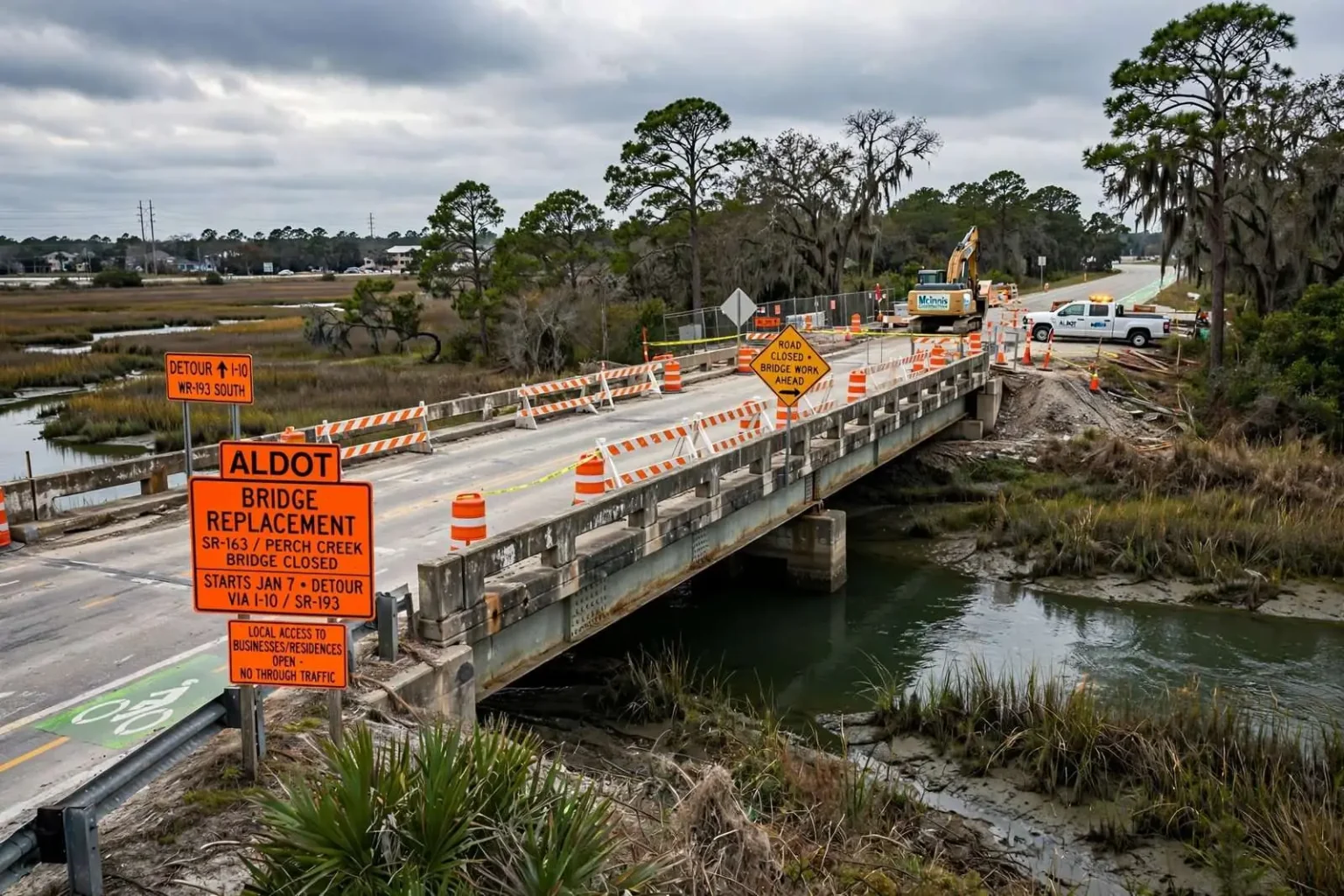
Major bridge replacement coming to Dauphin Island Parkway
The Alabama Department of Transportation is set to begin a major bridge replacement project along Dauphin Island Parkway early next year. Starting January 7, ALDOT will demolish the existing SR-163 bridge over Perch Creek and construct a new structure in its place, launching one of the more visible road projects planned for the southern part of Mobile County. The work targets a crossing that thousands of drivers use every day on the corridor that carries residents, commuters and island-bound travelers between south Mobile and the communities along the way.
The $5.1 million project, partially funded by the city of Mobile, was awarded to McInnis Construction. The shared funding arrangement reflects the parkway’s role as both a state route and a city street that neighborhoods along Perch Creek rely on daily. Contracts of this size typically cover demolition, structure construction, paving and finishing work, with the state administering the project and the city’s contribution underwriting a portion of the cost for a route that serves Mobile residents directly.
Detours during construction
Through traffic will be detoured onto Interstate 10 and State Route 193 while work is underway. The detour plan routes drivers around the closed crossing using the region’s existing highway network, sending through travelers up to the interstate and back down the state route that serves the area south of the creek. For commuters accustomed to rolling straight down the parkway, the detour adds miles and minutes, and transportation officials typically urge drivers to plan extra time or find alternate routes during projects of this duration.
Local traffic will still have access to businesses and residences at each end of the bridge, but the crossing itself will remain closed throughout the replacement and preliminary paving work. That distinction — open at the ends, closed in the middle — is standard for full bridge replacements, and it means customers can still reach shops, restaurants and homes on either side of the creek even though they cannot cross from one side to the other. Signs at the closure points direct drivers to the detour, and access for emergency vehicles is coordinated through the project’s maintenance-of-traffic plan.
What the project includes
The scope of work includes complete demolition of the existing bridge, construction of a new bridge, paving operations, and striping to restore the existing lane configuration and buffered bike lanes in both directions. The buffered bike lanes are a notable feature of the modern corridor: painted buffers separate cyclists from vehicle lanes on the parkway, a design treatment that has become standard in contemporary road projects aimed at making busy arterials safer for all users. Rebuilding them as part of the project ensures the new bridge matches the corridor’s current configuration rather than dropping a dated design into a modernized road.
Full replacement rather than repair is the option ALDOT chose for the aging crossing over Perch Creek. Bridges carry rated lifespans and load limits, and when a structure reaches the point where rehabilitation no longer offers a durable return, agencies typically opt for removal and construction of a new bridge built to current standards for strength, hydraulic capacity and safety features such as guardrails and approaches. A new structure also resets the maintenance clock, sparing the route the repeated lane closures that patching an aging bridge would require.
Timeline for the work
The bridge replacement and most of the asphalt work, which will allow the road to reopen, is expected to be completed by early fall 2021. That timeline means the crossing will be out of service through the winter, spring and summer months — a stretch that includes the region’s heaviest travel seasons for the corridor, which serves as one of the main routes toward Dauphin Island and the beach communities to the south. Drivers heading toward the island during that period will need to follow the I-10 and SR-193 detour or use other routes around the closure.
Remaining work items should be finalized under traffic by spring 2022. The sequencing is common on bridge projects: once the new structure is ready, the road reopens over it while crews finish striping, punch-list items and incidental work in lanes that are open to traffic. Finishing under traffic keeps the inconvenience shorter for the public, though it requires crews to work within a live roadway, with lane closures and careful traffic control during the final phase.
An incentive/disincentive clause in the contract is designed to expedite completion. Such clauses pay the contractor a bonus for each day ahead of schedule and assess a penalty for each day beyond the deadline, aligning the builder’s financial interest with the public’s interest in a short closure. On a corridor as heavily used as Dauphin Island Parkway, the daily cost of a prolonged closure is real — in detour time, fuel and lost convenience for businesses at each end of the bridge — which is why transportation agencies increasingly build these provisions into bridge replacement contracts.
Why the corridor matters
Dauphin Island Parkway, designated SR-163 along this stretch, is one of the principal arteries of southern Mobile County. It threads through established neighborhoods south of the city before continuing toward the communities that anchor the road to the coast, and it carries a steady mix of commuter, school and commercial traffic along with the recreational and fishing traffic that funnels toward the island and its famous public beaches. A closure anywhere along the corridor is felt across the southern part of the county, which is why the Perch Creek crossing replacement has drawn attention from residents and businesses nearby.
Perch Creek itself winds through the low ground south of Mobile, part of the network of creeks and bayous that drain the area toward Mobile Bay. Bridges over tidal-influenced creeks face particular stresses: saturated soils, moving water and the corrosion that comes with a coastal salt environment all shorten a structure’s service life. Those conditions are a routine fact of infrastructure along the Gulf Coast, where transportation agencies budget continually for replacing crossings that the climate and the water work against.
The broader program of work
The project fits into a broader pattern of bridge investment across Mobile County, where the state and city have worked through a backlog of aging structures in recent years. Alabama has thousands of bridges in its inventory, and a significant share has passed the fifty-year mark that engineers use as a planning benchmark, making replacements like the SR-163 crossing a recurring feature of the state’s transportation program rather than an exception. Federal aid and local contributions, as with this project’s city funding share, spread the cost across the partners who benefit from the route.
For the neighborhoods flanking the parkway, the coming months will mean adjusted routines: a longer drive to reach the other side of the creek, delivery routes shifted to the detour, and construction activity at the crossing itself. The payoff, when the new bridge opens in the fall and the finishing work wraps up by the following spring, is a crossing built to modern standards with the same lane configuration and buffered bike lanes the corridor’s users know — and a route whose most vulnerable link is renewed for decades to come.
Getting around during the closure
Residents and commuters who depend on the parkway have a set of practical options during the construction window. The official detour through Interstate 10 and State Route 193 will carry most through traffic, and drivers making regular trips across the creek — commuters, students, shoppers heading to businesses on either side — will settle into the alternate pattern quickly. Local trips that would have crossed the bridge become longer loop drives, and households near the closure can expect the neighborhood streets around the work zone to carry somewhat more traffic as drivers look for shortcuts, which is a familiar pattern wherever a main road closes.
Businesses at each end of the bridge remain open and reachable throughout the project, and project signage will direct customers to the local access points. Retailers and restaurants along a closed section typically feel the impact of a long closure through reduced drive-by traffic, which is why agencies publicize access arrangements prominently during such projects. The distinction that matters is the one the project plan preserves: the bridge is closed, but the neighborhoods and businesses on both sides stay connected to the rest of the road network at their end of the parkway.
What a new bridge delivers
The new structure over Perch Creek will bring the crossing up to current design standards in ways that go beyond simply replacing what was there. Modern bridge construction in coastal Alabama accounts for the hydraulic demands of the creek, the soil conditions of the low-lying approach areas and the durability requirements of a salt-adjacent environment, and the finished structure is engineered for a service life measured in many decades. Approaches, guardrails and joints built to today’s standards also improve the everyday experience of the drivers, cyclists and pedestrians who use the corridor.
The restoration of the buffered bike lanes in both directions maintains the corridor’s multimodal character. Buffered lanes give cyclists a painted cushion between their travel path and moving cars, a design that has become common on urban and suburban arterials where retrofitting protected lanes is impractical. Preserving that configuration through the new bridge means cyclists who use the parkway — including riders connecting to the broader south Mobile network — keep the continuity they had before construction began.
ALDOT’s role in projects like this
The Alabama Department of Transportation administers projects like this one across the state, from small bridge replacements to major interstate work, and the SR-163 project follows the department’s standard delivery model: design, bid, award to a contractor and oversight through construction. McInnis Construction, the awarded contractor, will execute the demolition and construction under ALDOT’s inspection, with the department responsible for ensuring the work meets plan specifications before the road reopens over the new structure. The incentive/disincentive clause is one of the tools ALDOT uses to keep that delivery on schedule.
The city of Mobile’s partial funding of the project reflects the partnership arrangement that governs many routes within city limits. State routes that pass through municipalities carry both state and city traffic, and cost-sharing lets the partners match responsibility to benefit. For the neighborhoods along Dauphin Island Parkway, the practical result is the same regardless of whose funds are used: the crossing gets replaced, the road reopens by early fall 2021, and the remaining finishing work wraps up under traffic by spring 2022, leaving the corridor with a new bridge and its familiar lane and bike lane configuration intact.


