ALDOT Pushes Back on Byrne’s Funding Criticism as Manzie Seeks Relief for Bridge-Impacted Neighborhoods
ALDOT is defending its pursuit of federal money for the Mobile River Bridge project after criticism from U.S. Rep. Bradley Byrne, as Mobile City Councilman Levon Manzie asks Gov. Kay Ivey for help for neighborhoods facing construction impacts.
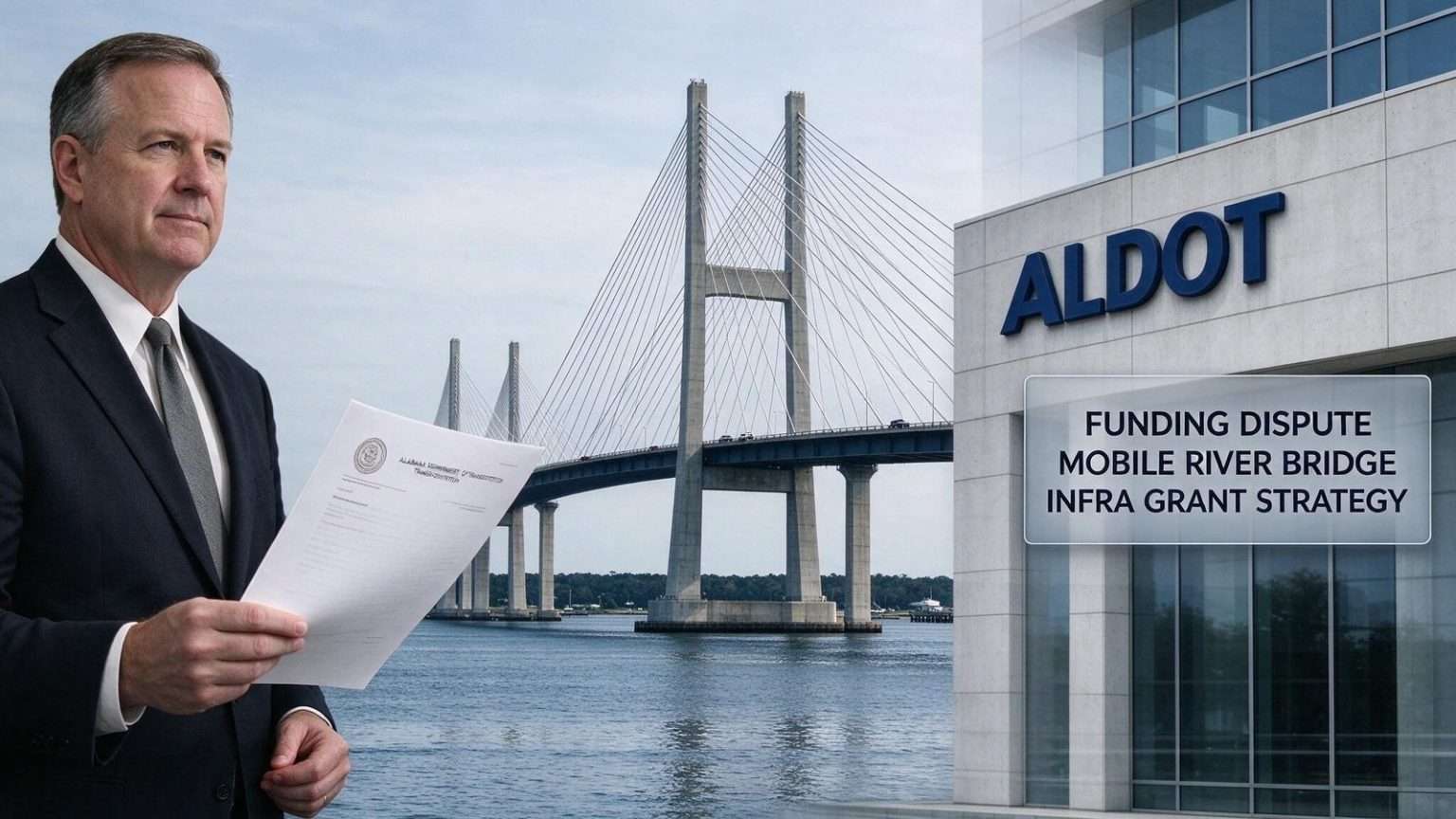
State transportation officials are defending how they have pursued federal money for the Interstate 10 Mobile River Bridge and Bayway project, after U.S. Rep. Bradley Byrne publicly criticized the agency’s funding strategy for the roughly $2 billion span. The dispute — playing out through written statements and media appearances rather than a hearing room — has exposed the hard arithmetic behind a project that everyone in south Alabama agrees is necessary and no one has yet figured out how to pay for.
In a written statement, Alabama Department of Transportation spokeswoman Allison Gregg said the agency regrets any confusion over its position and insisted ALDOT remains willing to accept federal dollars from any source, including federal funding, to help pay for the bridge and its approaches. The statement was notable for its patience: state agencies rarely respond to congressional criticism in writing, and the fact that ALDOT did reflected how sensitive the funding question has become as the project moves from study to engineering to the search for actual money.
Byrne had criticized ALDOT in recent media appearances for declining to tap a cost-sharing program that channels a share of federal oil and gas revenue back to Gulf Coast states. That program, the Gulf of Mexico Energy Security Act, was established in 2006 and has funneled money to Alabama and other Gulf states with offshore energy production. Byrne’s argument was simple: Alabama’s coastal communities bear the burdens of offshore energy production, and revenue shares designed for exactly that reason should help fund the region’s most urgent infrastructure need. Byrne’s office did not respond to a request for comment on the dispute.
What ALDOT says it is doing instead
In a follow-up interview, Gregg said ALDOT has instead focused on other federal funding streams it considers a better fit for offsetting what she called a “huge chunk of change.” Chief among them is the Infrastructure for Rebuilding America program, known as INFRA, a U.S. Department of Transportation discretionary grant program that awards roughly $250 million nationally each cycle. Discretionary grants of this kind are the modern gateway to major-project funding: states compete nationally, applications are scored on merit criteria, and winners receive federal money that would otherwise never reach their state.
ALDOT applied for INFRA funding in 2018 but was not selected. Gregg said the agency has reapplied this year and is optimistic about its chances, though there is no firm timetable for when winners will be announced. She said the federal government is expected to reveal grant recipients by the end of the summer — a deadline that matters, because each year without a federal award pushes the financing burden further onto tolls, state funds or a combination that local officials dread.
The disagreement over GOESA — the Gulf revenue-sharing law — reflects a genuine constraint rather than stubbornness, according to transportation planners familiar with the program’s rules. Funds distributed under the act flow through state and local accounts with prescribed uses, and harnessing them for a project of this size would require legislative action and offsets elsewhere. That may be exactly what Byrne is proposing, but for an agency assembling a funding package on a deadline, the INFRA route is the one that does not require rewriting statute.
The stakes are amplified by the project’s price tag. At roughly $2 billion for the bridge, its approaches and the Bayway reconstruction, the Mobile River Bridge would rank among the largest single infrastructure undertakings Alabama has ever contemplated — a scale that makes every federal stream matter and explains why an argument over one of them has produced statements from both a congressman’s office and the state’s transportation department.
The project’s engineering scope also shapes the funding debate. The plan calls for a new bridge crossing the Mobile River north of the existing Bankhead and Wallace tunnels — a route chosen in part to spare the downtown grid — plus the rebuilding of the aging Bayway across Mobile Bay, whose elevated spans date to the 1920s. Each element carries its own price and its own federal eligibility, and ALDOT’s applications have had to make the case for the whole as a single corridor rather than a collection of separable repairs.
Manzie’s letter and the neighborhoods underneath
Byrne has not been the only elected official pressing ALDOT and the state on how the bridge project is funded and how it will affect nearby communities. Mobile City Councilman Levon Manzie sent a letter to Gov. Kay Ivey asking her to consider additional funding for neighborhoods most affected by construction, including the historic Africatown/Plateau area and the Down the Bay community — two of the city’s most storied Black neighborhoods, both of which already carry the imprint of earlier highway projects.
In the letter, Manzie floated the idea of a community benefits agreement that would compensate residents of what he described as “incredibly historic and vulnerable” neighborhoods near the bridge corridor. Community benefits agreements — negotiated packages of mitigation, investment and guarantees between project sponsors and affected communities — have become a tool in major infrastructure projects around the country, and Manzie argued that Mobile’s situation fits the model exactly: a state project of enormous scale, passing beside neighborhoods of historic importance and limited political leverage.
He said the concept drew a positive response when he raised it at a recent community meeting on the project, and that he believes it could help offset the disruption both areas are expected to face. For residents who have watched the city’s waterfront plans approach their streets for years, the promise of compensation — rather than mere accommodation — marks a shift in how the project’s costs are discussed.
In a phone interview, Manzie said the two neighborhoods would be affected differently. Down the Bay sits closer to the construction footprint and would bear the brunt of building activity, he said, while Plateau is more likely to see an increase in cut-through traffic from drivers trying to avoid new tolls on the bridge. Both outcomes, he said, could diminish quality of life for longtime residents, and he wants ALDOT and the state to treat the two communities “equally and with respect” as planning moves forward.
The councilman’s letter to Ivey also situated the neighborhoods’ concerns in the context of the city’s history. Down the Bay — the community chronicled in the works of Mobile-born writer Eugene Walter and home to generations of working families — was bisected by earlier highway construction, and Africatown’s Plateau section has spent decades contending with industrial encroachment on land its founders settled after emancipation. To residents of both, a new corridor of construction and traffic is a familiar proposition, which is why Manzie’s request for compensation rather than consultation carries such local force.
The toll question that will not go away
Tolls have been a persistent point of contention around the project, with proposed one-way charges in the $3 to $6 range — a spread that has generated years of public argument about who the bridge is really for. For commuters who cross the Bayway daily, even the low end adds up to a meaningful monthly cost, and for residents of communities near the free alternatives, the toll threatens to push bypass traffic onto streets never designed for it.
Gregg noted that motorists looking to avoid paying a toll will still have free options. The Bankhead Tunnel will not be tolled, she said, and drivers can also use the Causeway to reach the tunnel or cross the river via the Cochrane-Africatown Bridge, the same span used today. The acknowledgment matters to the neighborhoods Manzie represents: the free routes run through or beside the very communities he is trying to protect, which is why traffic volume on them has become a proxy for the project’s fairness.
The bridge and Bayway project has been one of the most closely watched infrastructure fights in south Alabama in recent years, with local leaders, business groups and residents all weighing in on financing, tolling and the project’s footprint through Mobile’s waterfront neighborhoods. Business interests see the I-10 crossing as the region’s economic bottleneck — a route where congestion already costs commuters and freight haulers measurable time — while neighborhood advocates see a project whose benefits flow to through-traffic and whose burdens land locally.
ALDOT’s public comments come as the agency continues to assemble a funding package for a project whose price tag has made it one of the largest single infrastructure undertakings in state history. Whether the INFRA application succeeds this year will say much about the project’s timeline; whether Byrne’s GOMESA argument and Manzie’s benefits agreement gain traction will say much about its politics. The bridge, in one form or another, appears likely to be built. The argument that will determine the next few years is over who pays, who is protected, and how much of the story south Alabama’s own officials will get to write.