
ALDOT Says $40 Million Still Needed to Complete US-98 Safety Project After Fatal Crashes on Moffett Road
ALDOT says $40 million is needed to complete the US-98 safety extension project after four people were killed in crashes on Moffett Road in one week.
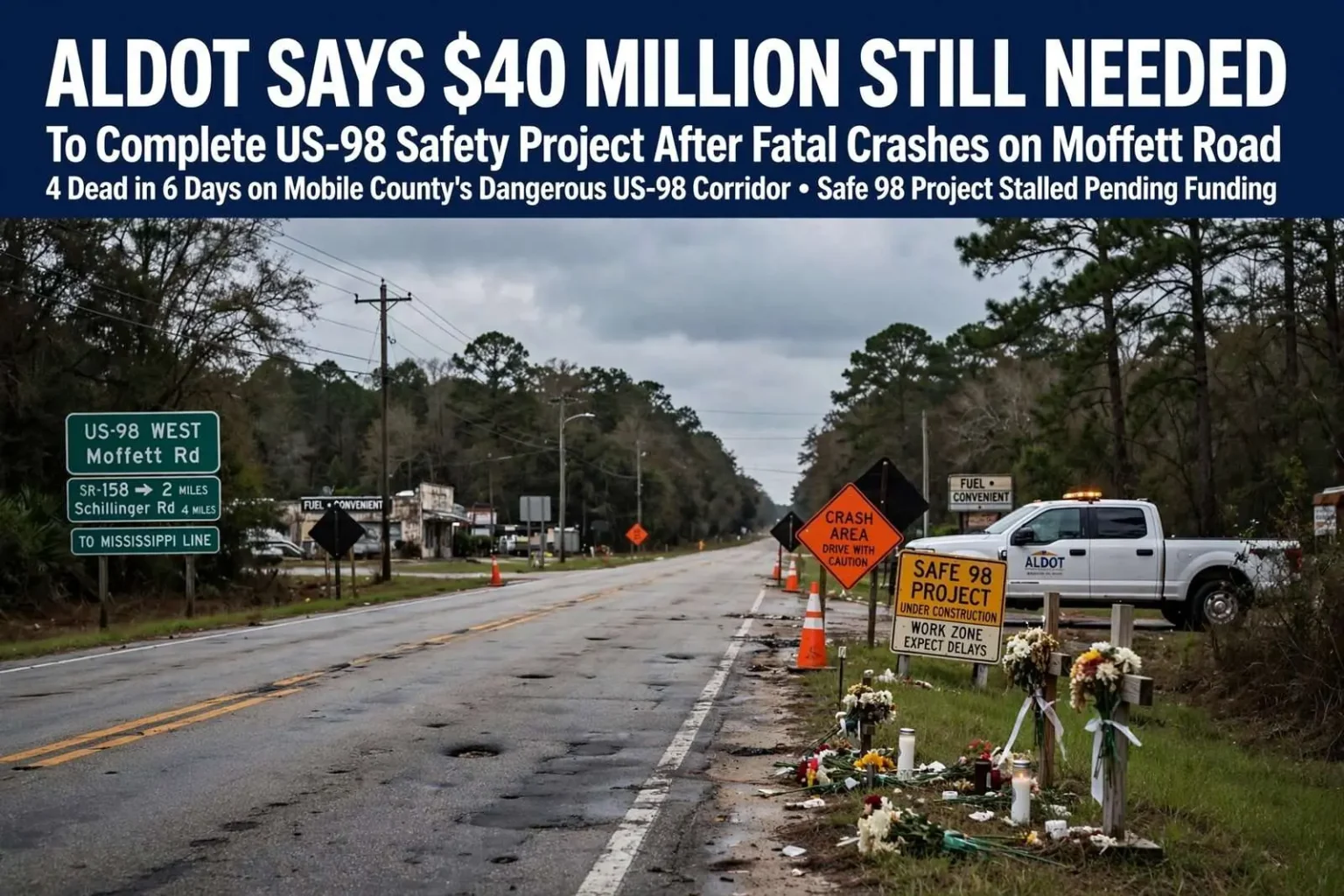
The Alabama Department of Transportation says approximately $40 million in funding is still needed to complete a critical safety improvement project along US-98 after four people were killed in three separate crashes on Moffett Road within a single week. The stretch of Highway 98, known locally as Moffett Road as it runs northwest out of Mobile toward the Mississippi line, has ranked among Mobile County’s most persistent danger zones for years, a corridor where heavy traffic, commercial driveways and a decades-old two-lane design keep colliding.
In a statement, ALDOT extended sympathies to the families of the victims and emphasized that highway safety remains the department’s highest priority. The agency confirmed that while significant progress has been made on the Safe 98/SR-158 extension project, the remaining two-lane connection from the Mississippi state line to Schillinger Road requires substantial additional funding. That missing link is the piece of the puzzle that keeps through traffic on the old Moffett Road alignment, where the week’s fatal crashes occurred.
A week of fatal crashes
The urgency of the project was underscored by a series of fatal collisions in a span of six days. On April 14, a woman and her one-year-old son died when a UPS truck crossed into their lane near Wolf Ridge Road. The next day, April 15, a man lost his life after his car collided with an SUV near Big Creek Lake on Highway 98. On April 19, a woman was killed when her vehicle struck a tree near Helen Street. Three crashes, four deaths, all on the same corridor, all within a single week.
Crashes of that frequency on one road are not random. Safety engineers look at corridors like US-98 and see the compounding factors: a roadway built for far less traffic than it now carries, a steady stream of turn movements in and out of businesses and side streets, limited shoulders and almost no median separation. When a truck crosses the centerline or a car leaves the roadway, the absence of the safety features built into modern highways leaves drivers with no margin for error.
What Safe 98 was built to fix
The Safe 98/SR-158 extension project represents the region’s long-running attempt to give northwest Mobile County a modern highway alternative. The SR-158 extension, completed in recent years, created a limited-access route parallel to Moffett Road between US-45 and US-98, diverting through traffic away from the old corridor’s driveways and curves. The unfinished business is the connection west of there: the remaining two-lane segment of US-98 from Schillinger Road out to the Mississippi state line, which still carries local traffic and freight on a roadway never designed for the volumes it sees today.
ALDOT stated it is committed to exploring all options to secure the funding needed to complete the much-needed safety project, which aims to improve one of Mobile County’s most dangerous corridors. The roughly $40 million gap is the distance between the project’s design and its construction, and it comes at a time when transportation agencies across the state are stretching funds across a long list of competing needs.
The corridor’s role in the region
US-98’s importance to northwest Mobile County is easy to underestimate from the numbers alone. The highway is the main commercial artery for the communities between Schillinger Road and the Mississippi line, fronted by grocery stores, fuel stations, churches, schools and small businesses that depend on visibility from passing traffic. It is also a commute route for residents working in Mobile’s urban core, and a freight connection for the rural areas on both sides of the state line.
That mix explains why improvements have lagged. Widening a working commercial corridor requires right-of-way purchases from dozens of frontage properties, utility relocations and careful staging of construction so businesses can stay open — complications that make the per-mile cost far higher than a rural widening project. The SR-158 extension gave planners a way to relieve the corridor without touching every driveway along it, but the westernmost connection still runs through the developed and semi-rural landscape where the fatal crashes occurred.
Why this stretch is so dangerous
Moffett Road’s dangers are well documented to the people who drive it daily. The roadway functions simultaneously as a commuter route for northwest Mobile County, a commercial strip lined with businesses and driveways, and a rural highway carrying traffic to and from the Mississippi state line. Those roles conflict. A driver turning left into a business from a two-lane highway at 55 miles per hour forces everyone behind to brake or swerve; a curve that was tolerable at older traffic volumes becomes a hazard when thousands of vehicles a day traverse it.
The corridor’s geography adds to the risk. Sections near Big Creek Lake and the Mobile county line wind through rural terrain with trees and ditches close to the roadway, leaving little recovery space when a vehicle runs off the pavement. The crash near Helen Street — a car leaving the road and striking a tree — is the kind of outcome that modern design features such as clear zones, wider shoulders and median barriers are specifically built to prevent. Until the highway is rebuilt to those standards, the corridor keeps producing them.
The funding challenge
The $40 million still needed is not unusual in scale, but it is significant in a state where transportation funding has long lagged behind needs. Alabama’s gas tax increase, adopted in 2019 and phased in over three years, was projected to add hundreds of millions of dollars annually for road and bridge work, but those revenues are spread across a statewide program list that includes projects announced years ago. Getting the US-98 connection to the top of that list requires the same ingredients as any major project: local advocacy, congressional attention when federal discretionary grants are available, and a state priority call from ALDOT’s leadership.
The crashes of that single week have already done what statistics alone could not: they have put a face and a timeline on the corridor’s problems. Residents along Moffett Road have watched the SR-158 extension open to the north and wondered aloud when their own stretch would follow. ALDOT’s statement, while stopping short of a funding commitment, acknowledges the department understands both the need and the arithmetic — approximately $40 million stands between the corridor and its fix.
The human cost of waiting
Behind the funding figures are the families of the four people killed in April. A woman and her one-year-old son died together in a head-on crash near Wolf Ridge Road when a UPS truck crossed into their lane — the kind of collision that a divided, modern highway makes geometrically impossible. A man died near Big Creek Lake when his car collided with an SUV. A woman died near Helen Street when her vehicle left the road and struck a tree. Each crash involved a different set of circumstances, but all three shared the same stage: a two-lane stretch of Highway 98 that safety officials have identified for replacement.
Traffic engineers describe corridors like this one as having a “systemic” risk — the danger is not one bad intersection or one blind curve, but the accumulated hazard of an entire roadway design from another era. That is why the fix being pursued is comprehensive reconstruction rather than spot improvements. Widening US-98 to modern standards from Schillinger Road to the state line, with turn lanes, medians and proper shoulders, addresses the whole pattern of crashes rather than their individual symptoms.
What residents can expect next
In the near term, drivers on Moffett Road should expect the status quo: the two-lane roadway remains open, and the Safe 98/SR-158 extension continues to serve as the region’s modern bypass for traffic willing to route around the old corridor. Law enforcement presence along US-98 often increases after high-profile crashes, particularly around speed and lane discipline, but enforcement manages the symptom while the engineering fix remains unfunded.
The longer-term path runs through ALDOT’s project programming process. The agency’s commitment to explore all options for the remaining $40 million means the project will compete for state construction funds, federal highway formula dollars and potentially federal discretionary safety grants. Community support matters in that competition: documented crash histories, local government resolutions and organized advocacy from northwest Mobile County all strengthen the case when funding decisions are made in Montgomery.
Until the money is found, the corridor’s danger is a known quantity. The week that claimed four lives on Moffett Road turned a long-standing engineering concern into a public accounting, and it established the number that will define the debate going forward: approximately $40 million, the cost of completing the Safe 98 vision and removing one of Mobile County’s most dangerous corridors from the list.


