ALDOT to Temporarily Close SR-81 Bridge in Notasulga Starting Monday
ALDOT will temporarily close the SR-81 bridge over the railroad in Notasulga on weekdays for about two weeks starting Aug. 17, with a signed detour in place during repairs.
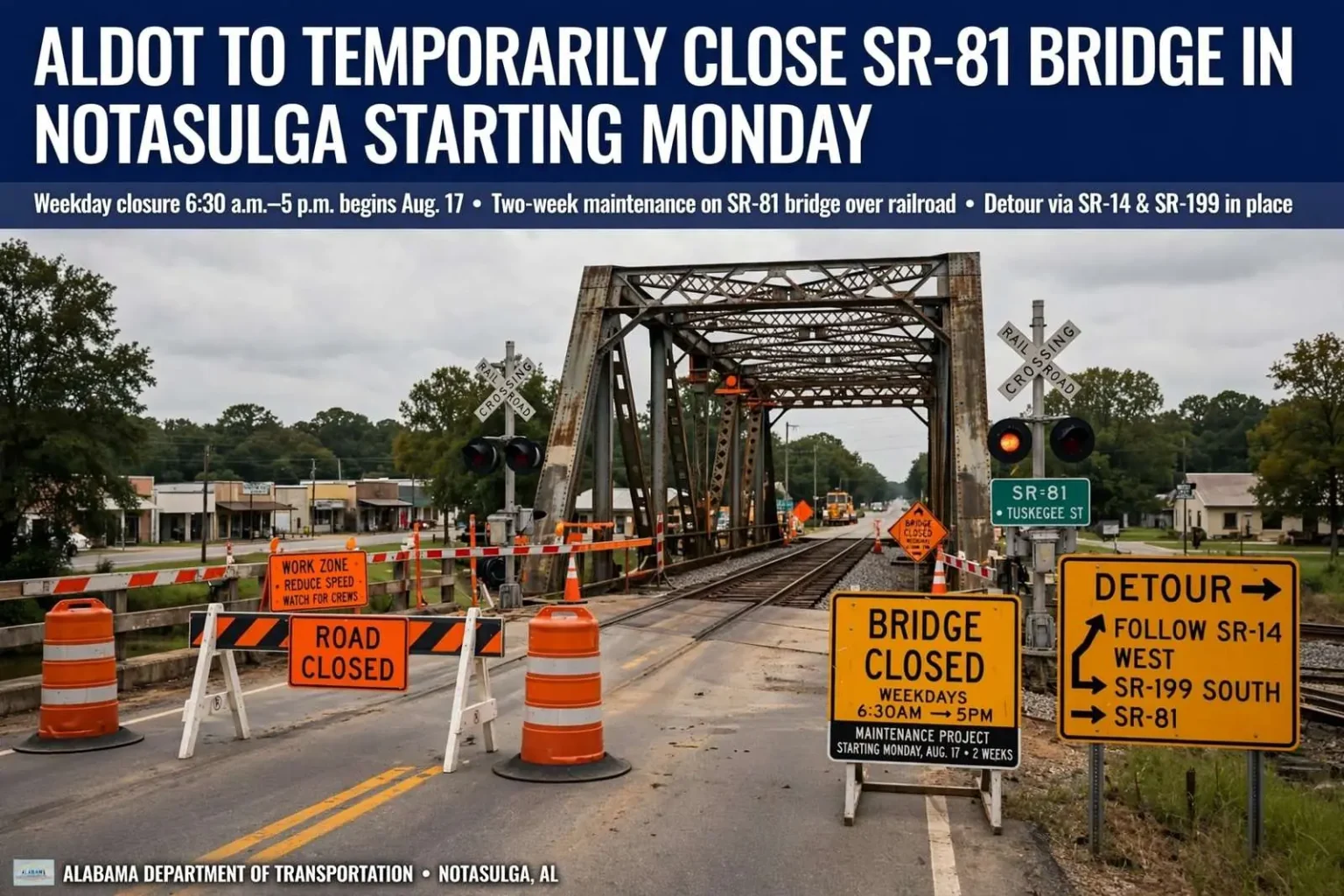
The Alabama Department of Transportation will temporarily close the bridge on SR-81 (Tuskegee Street) over the railroad in Notasulga beginning Monday, Aug. 17, as crews carry out maintenance repairs on the structure. According to ALDOT, the bridge will be closed on weekdays from approximately 6:30 a.m. to 5 p.m. while repair work is underway, and the department expects the project to take roughly two weeks to complete.
The restricted schedule means the crossing will not be shut down around the clock. Once crews wrap up each day’s work, the bridge is expected to reopen to traffic in the evening and remain accessible overnight and on weekends. That arrangement is designed to keep a vital link in and out of town available to commuters, school traffic and residents while still giving repair crews an unblocked work zone during daylight hours. Drivers should be aware, however, that schedules on projects like this can shift, and ALDOT has advised motorists to watch for updated signage in case conditions change as the work progresses.
Detour Route in Place
A signed detour will guide motorists around the closure for the duration of the project. Drivers traveling south on SR-81 will be directed to take SR-14 West to SR-199 South, then back to SR-81. Motorists traveling north on SR-81 will follow the reverse route, taking SR-199 North to SR-14 East before returning to SR-81.
The routing adds only a modest amount of distance, but officials caution that it will funnel traffic onto two-lane roads that are not accustomed to carrying the bridge’s full volume. Motorists who normally cross the structure without a second thought will need to allow extra minutes for the loop, particularly during the morning and midday hours when the closure is in effect. Local drivers familiar with the area may already know alternate ways around town, but ALDOT is asking all motorists to follow the posted detour so that traffic moves predictably through the work zone perimeter.
ALDOT is urging drivers who regularly use the SR-81 bridge to plan ahead for the closure and to build extra time into their commutes while the detour is in effect. The agency also reminded motorists to be mindful of workers and equipment operating in the work zone throughout the repair period, noting that crews will be working close to the roadway on a structure that funnels traffic directly over an active rail line.
Bridge maintenance projects of this kind are a routine part of ALDOT’s program, but they are easy to underestimate. A bridge that carries traffic over a railroad is subject to constant vibration, weather exposure and impact from heavy vehicles, and components such as joints, bearings, decks and railings gradually wear even when the structure remains fundamentally sound. Scheduled repairs catch that wear before it becomes a hazard, and transportation officials consistently frame short-term closures of this sort as the price of avoiding far longer shutdowns if a deteriorating structure has to be emergency-closed.
Why the Closure Matters
The SR-81 bridge over the railroad is a key crossing for traffic moving through Notasulga, a small town along the Tuskegee Street corridor. The route functions as one of the primary connectors between Notasulga and the surrounding area, linking the town with Tuskegee to the south and tying into the regional network of state routes that carries drivers toward Auburn and other points in east Alabama. For a community of Notasulga’s size, the loss of that crossing — even for a few hours a day — is felt quickly by anyone who commutes, runs errands between towns, or moves goods along the corridor.
Notasulga sits in northern Macon County, near the border with Lee County, and its road network reflects its position between larger population centers. SR-14 runs through the area as an east-west route, providing the western leg of the posted detour, while SR-199 offers a southern connection back toward the Tuskegee area. The bridge over the railroad sits where the town’s main street crosses the rail line that has long shaped the community’s layout, with the roadway narrowing at the structure and offering few practical alternatives for large vehicles. When a crossing like that closes, there is no simple side street to absorb the traffic — the whole corridor has to shift onto the state-route loop.
The timing of the closure, limited to weekday daylight hours, is intended to blunt that impact. By reopening the bridge each evening and leaving it open on weekends, ALDOT allows evening commutes, weekend travel and church and school-related traffic to use the crossing normally. Crews get a full work window when traffic volumes are more manageable and visibility is good, which shortens the overall duration of the project. Transportation planners generally prefer this kind of intermittent closure for smaller structures because it avoids the emergency detours and long-term closures that result when deferred maintenance forces an unplanned shutdown.
Routine Work, Real Consequences
Bridge maintenance projects like this one are a routine but necessary part of keeping Alabama’s transportation infrastructure safe for daily use, and temporary closures are typically scheduled to limit long-term disruption while still allowing crews adequate time to complete repairs safely. Across the state, ALDOT maintains thousands of bridges, many of them crossings over rail lines, creeks and other roadways that were built decades ago and require ongoing attention to remain in service.
For residents of Notasulga, the practical effect of the project will be measured in minutes added to familiar trips. Drivers heading from town toward Tuskegee, or returning from Auburn-side errands along SR-14, will need to run the detour loop instead of rolling straight across the bridge. Motorists are encouraged to think through their regular routes before the closure begins and to consider shifting discretionary trips outside the weekday closure window, when the bridge remains open.
Because the closure is limited to weekday daytime hours, the bridge is expected to reopen to traffic each evening and remain accessible overnight and on weekends, though drivers should watch for updated signage in case conditions change as the work progresses. Weather, equipment availability and the condition discovered once crews open up the structure can all affect the pace of the work, and ALDOT has indicated the two-week estimate is the department’s current planning figure rather than a guarantee.
Staying Informed During the Project
ALDOT encouraged residents and commuters to stay informed about the status of the closure and any related traffic conditions by using the ALGOTraffic app, which provides real-time updates on road conditions, closures and incidents across the state’s highway system. The app and its companion website list active work zones, posted detours and estimated timelines, giving drivers a way to check the status of the SR-81 bridge before they leave home rather than discovering a closed crossing at the end of Tuskegee Street.
Staying current matters on projects like this because conditions at a work zone can change from one day to the next. A repair that turns out to be more involved than expected can extend a closure window, and crews occasionally need to adjust hours to accommodate weather or equipment issues. The posted signs along SR-14, SR-199 and the local approach roads will reflect the official routing, but the ALGOTraffic platform is the department’s channel for broader updates about the project’s progress.
Local officials and residents alike tend to spread word of closures quickly in a town the size of Notasulga, but drivers passing through from outside the area are the ones most likely to be caught off guard. The detour signage is designed for them — motorists who do not know the area cannot be expected to improvise a route, and unmarked shortcuts through residential streets can create problems of their own. ALDOT’s request that all drivers follow the signed loop is aimed at keeping heavy vehicles, in particular, on roads built to handle them.
Safety in the Work Zone
Throughout the two-week project, the stretch of SR-81 around the bridge will be an active work zone during weekday hours, with equipment, materials and workers positioned near the roadway. ALDOT’s reminder that motorists should be mindful of workers and equipment is a standard message, but it carries particular weight at a bridge crossing, where sight lines are constrained and traffic is funneled into a narrow approach. Drivers using the detour should also stay alert on SR-14 and SR-199, which will carry more local traffic than usual while the bridge is closed each day.
Work zone safety practices that apply on any ALDOT project apply here: obey posted signs, reduce speed near crews and equipment, avoid distractions, and be prepared for flaggers or temporary lane controls on the approach roads. The department’s message to the traveling public is consistent — the inconvenience of a two-week closure with a signed detour is far preferable to the consequences of a bridge failure, and patient driving through the work zone protects both the crews making the repairs and the drivers passing through them.
For the businesses and residents along Tuskegee Street, the project brings a temporary burst of activity and disruption. Access to local property will be maintained as practical, but drivers should expect changes to parking and traffic patterns near the bridge while crews are on site. Anyone with questions about the project or the detour can direct them to ALDOT, and the department’s public information channels will carry updates if the schedule changes.
What Drivers Should Do Now
The department’s advice to drivers who use the bridge regularly boils down to a few practical steps. First, plan for the closure before it begins: identify which trips can shift to evenings or weekends, and which must run through the detour. Second, allow extra time — the loop via SR-14 and SR-199 is not long, but it will slow the trip, particularly at peak hours and when other drivers are unfamiliar with the routing. Third, keep an eye on ALGOTraffic for updates, since the project schedule could be adjusted as the work unfolds.
Commercial drivers and anyone hauling trailers or equipment should pay particular attention to the posted route. The detour keeps heavy vehicles on state routes rather than local streets, and following it exactly is the safest option for both the driver and the town’s residential roads. Motorists walking or cycling near the bridge should also exercise caution during work hours, since the approaches will see maneuvering trucks and crews moving between the structure and their equipment.
A Two-Week Inconvenience for a Long-Term Benefit
Once the repairs are finished and the final signs come down, the SR-81 bridge will return to its everyday role with renewed maintenance work behind it. Projects like this rarely draw much attention when they go smoothly, but they are the reason a crossing that carries school buses, commuters and freight over an active rail line can continue doing so without incident. The two weeks of weekday closures are the visible cost; the invisible benefit is added service life on a structure that would otherwise only degrade further.
For Notasulga, the episode is also a reminder of how much a single crossing can matter to a small town’s daily rhythm. The bridge on Tuskegee Street is one of those pieces of infrastructure that residents use without thinking until it is unavailable, and the detour loop through SR-14 and SR-199 will make its value obvious each time a driver rounds the longer route. ALDOT’s planning — daylight-only closures, a signed detour, a two-week target and real-time updates through ALGOTraffic — is designed to keep that inconvenience as small as the work allows.
Drivers with questions or concerns during the project can reach out to ALDOT through its public information channels, and the department will issue updates if the closure schedule or detour routing changes. In the meantime, motorists in and around Notasulga should assume the bridge is closed each weekday from about 6:30 a.m. to 5 p.m. through the roughly two-week repair window beginning Monday, Aug. 17, plan their trips accordingly, follow the posted detour, and give the crews working over the rail line the space and caution they need to finish the job safely.