ALDOT Weighs Roundabout for Busy Bayou La Batre Intersection, Asks Public for Input
ALDOT wants public feedback on replacing the SR-188/CR-19 T-intersection near Bayou La Batre with a roundabout, with construction possible in spring 2022.
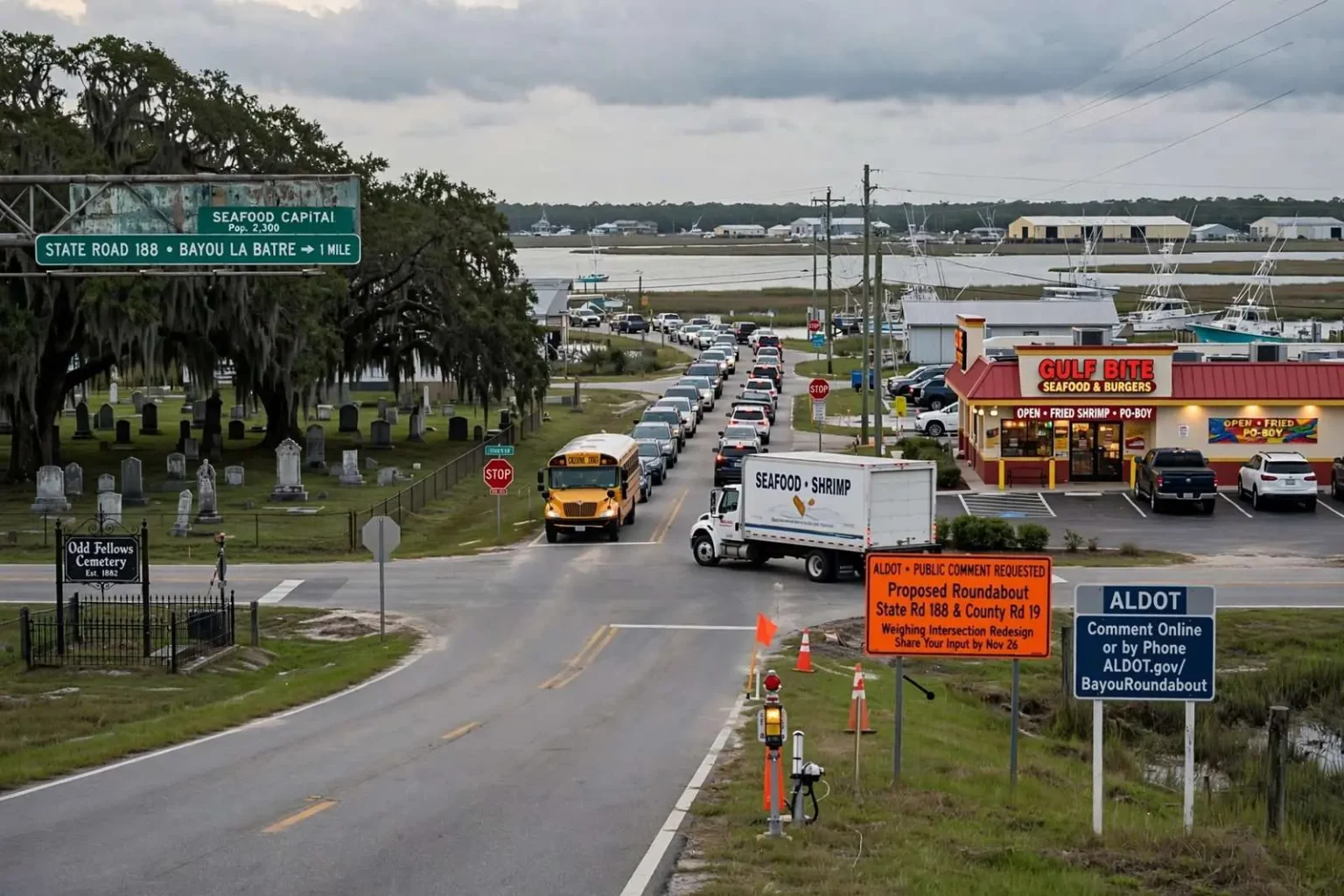
A frequently congested intersection south of Bayou La Batre could get a major redesign. The Alabama Department of Transportation is collecting public feedback on a proposal to replace the T-intersection where State Road 188 meets County Road 19 — the crossing near Odd Fellows Cemetery and a popular fast-food restaurant — with a roundabout.
The intersection serves as a gateway to Bayou La Batre, the small seafood town on Alabama’s Gulf Coast whose shrimp fleets and processing houses give the stretch of State Road 188 a traffic character unlike most rural corridors in Mobile County. Commercial trucks, commuter traffic, and visitors heading for the waterfront all funnel through the crossing, and at peak hours the T-intersection’s stop-controlled flow produces backups that residents know well.
Signs posted around the intersection point drivers to ALDOT’s comment process. Area residents have voiced mixed reactions as word of the study spreads. “Have a lot of gridlock here, especially in the afternoon,” said area resident C L Jordan, who noted that school buses sometimes back up at the crossing and that he has witnessed several near misses.
Jordan’s description captures the intersection’s dual problems: capacity and safety. Afternoon gridlock stems from the volume of traffic returning from the bayou at the end of the workday, while school bus movements add slow, wide vehicles to a junction already operating at its limit. Near misses, in turn, reflect the risks inherent in T-intersections, where drivers on the main road may not anticipate vehicles entering from the side, and where sight lines can be complicated by turning trucks.
Why a Roundabout Is on the Table
Roundabouts keep traffic moving continuously and typically reduce severe crash types at intersections, which is why transportation planners increasingly favor them for high-volume rural junctions like this gateway to Alabama’s seafood capital.
The engineering logic is straightforward. A traditional signalized or stop-controlled intersection requires drivers to stop entirely, stacking vehicles in queues and creating conflict points where paths cross at full speed. A roundabout replaces that with continuous, low-speed circular flow: entering drivers yield, merge at reduced speeds, and exit without ever coming to a full stop when gaps allow. Because vehicles move through the circle at lower speeds and in the same direction, the crashes that do occur tend to be sideswipes rather than high-energy angle collisions.
National safety data has consistently shown that converting conventional intersections to roundabouts reduces fatal and injury crashes substantially, and the Federal Highway Administration has promoted them as one of the proven safety countermeasures available to state departments of transportation. ALDOT has installed roundabouts elsewhere in Alabama in recent years, and each project has brought the same local debate now playing out south of Bayou La Batre: unfamiliar geometry versus a better long-term safety record.
The learning curve is real. Drivers encountering a roundabout for the first time must adjust to yielding on entry and navigating counter-clockwise flow, and large vehicles — a significant presence on a corridor serving the seafood industry — need the truck aprons that modern roundabout designs include for their turning paths. Those adjustments typically settle within weeks of opening, transportation officials say, but the transition period is often the roughest stretch in a project’s life.
Neighbors Split on the Idea
Others who work nearby worry a circular intersection could make matters worse rather than better, arguing that current traffic already flows in and out smoothly. For those residents and workers, the daily experience of the intersection is better than the study suggests: most hours of the day, vehicles move through without significant delay, and the queue problems are confined to predictable peak windows.
That split reflects a familiar dynamic in transportation projects. The people who experience an intersection at its worst — the afternoon commuter, the parent waiting behind a line of school buses — are often the strongest supporters of change, while those who pass through at off-peak hours see little reason to alter what works for them. Business owners add another consideration: construction disrupts access to their front doors, and any redesign that changes how customers enter and exit the adjacent businesses carries economic risk alongside its safety promise.
The intersection’s landmarks make the stakes tangible. Odd Fellows Cemetery sits near the crossing, one of the region’s historic burial grounds, and the popular fast-food restaurant that anchors one corner generates steady turning traffic of its own. Any redesign must accommodate both, along with the trucks, school buses, and tourists that share the junction during shrimp season and the summer beach rush along the Gulf Coast routes.
State Road 188 itself is the area’s lifeline. The route connects Bayou La Batre and Coden to the rest of Mobile County, carrying residents, seafood workers, and freight between the waterfront communities and the population centers to the north. Any change to its principal junction with County Road 19 affects nearly everyone who lives or works south of the bayou — which is why ALDOT’s decision to collect public input before committing to a design matters to the community.
Timeline and How to Weigh In
ALDOT’s public comment period was scheduled to close Nov. 26, with input accepted online, by email, mail, voice message or in person. The multiple channels reflect the department’s effort to reach all of the corridor’s users — including commercial fishermen, older residents, and shift workers who may not engage through a website.
Public comments serve a practical function in projects like this one. They document local concerns that must be addressed in the project’s development, they sometimes surface information — crash patterns, traffic anomalies, drainage problems — that formal studies miss, and they give the department a record showing the community was heard. Residents with specific experiences at the intersection, whether near misses or daily delays, have the strongest material to submit.
If the project advances, the department anticipated that main construction would begin in spring 2022 and finish by that summer. That compressed timeline suggests ALDOT expects the work to be a focused reconstruction of the junction rather than a multi-year corridor overhaul — a key consideration for the businesses and residents who would live with construction traffic in the interim. A build window of months, completed before the height of the next summer season, would limit the disruption to a single tourist and seafood season.
For Bayou La Batre, the proposal represents the kind of infrastructure attention small Gulf Coast communities rarely attract. The town has weathered hurricanes, the Deepwater Horizon oil spill’s effects on its fishing economy, and the long-term pressures facing the domestic seafood industry, and its infrastructure has often been at the center of recovery efforts. A safety-focused upgrade to its main junction would be an investment in the community’s daily life — one that residents now have the opportunity to shape before the design is set.
The decision now rests with the comment period’s outcome and the department’s engineering review. Whether the T-intersection at State Road 188 and County Road 19 becomes a roundabout or stays as it is, the study has already accomplished one thing: it has forced a public accounting of how the gateway to Alabama’s seafood capital works, who it fails at rush hour, and what the community is willing to change.
Learning From Other Alabama Roundabouts
Alabama drivers have seen a steady increase in roundabout construction over the past decade, giving the state a growing track record with the design. Communities that initially resisted their roundabout projects have often converted into supporters once the intersections opened and the expected queues failed to materialize. Traffic engineers point to that pattern when making the case to skeptical residents: the fear of the unfamiliar tends to fade faster than the safety benefits accrue.
Local experience also shows what roundabouts cannot fix. If the afternoon backup at State Road 188 and County Road 19 is driven by sheer volume exceeding the junction’s capacity, a roundabout helps by keeping flow continuous, but it is not a cure for every congestion source. The department’s study presumably accounts for projected traffic growth along the corridor, including the residential development pressure that Mobile County’s southern communities have experienced, to ensure the design chosen today still functions decades from now.
The Bigger Picture for the Corridor
The Bayou La Batre study also fits into a larger pattern of safety investment on Alabama’s rural coastal routes. State roads serving waterfront communities combine ordinary commuter traffic with heavy commercial vehicles, seasonal tourism, and slow-moving fishing industry equipment — a mix that produces crash patterns unlike those on urban arterial roads. Junctions like the State Road 188 crossing are where those patterns concentrate, and they are where targeted improvements deliver the most measurable safety gains.
Residents weighing their comments have until Nov. 26 to make their views known through any of the channels ALDOT has opened. Whatever the department decides, the intersection’s story is worth following for anyone who drives the southern end of Mobile County: the outcome will determine whether the afternoon gridlock that C L Jordan described — the school bus queues, the near misses, the daily bottleneck at the gateway to the seafood capital — remains a fact of life, or becomes the next Alabama junction redesigned for a safer, smoother flow.