ALEA, Mobile County Sheriff’s Office Searching for Missing Semmes Teen
ALEA and the Mobile County Sheriff's Office are searching for 15-year-old Jennah Phillips, last seen Aug. 4 in Semmes, and are asking for public help.
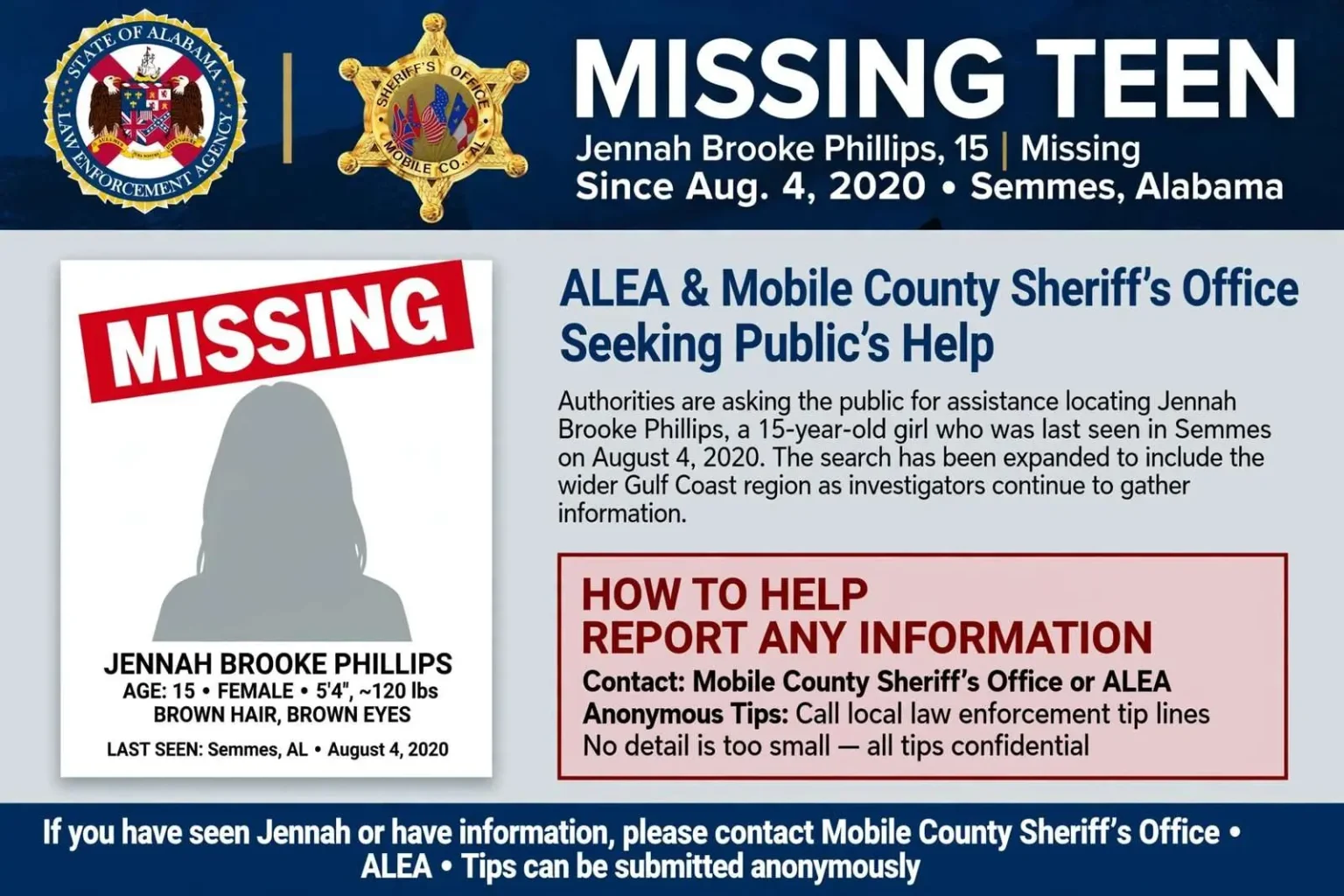
SEMMES, Ala. — The Alabama Law Enforcement Agency and the Mobile County Sheriff’s Office are asking for the public’s help in locating a 15-year-old girl who went missing from Semmes. Jennah Brooke Phillips, 15, was last seen on August 4, 2020, according to authorities, and the search for her continued as the sheriff’s office shared her photo on social media Wednesday.
The sheriff’s office posted the girl’s photograph and description to its social media accounts Wednesday, urging anyone with information to come forward. The post represents the next stage of a missing-child investigation — moving from the immediate search of the area where she was last seen to a wider public appeal, enlisting the eyes of the entire Gulf Coast region in the effort to find her.
In cases involving missing teenagers, those first days and weeks are critical. Investigators work to establish a timeline — where the teen was last seen, who they were with, what they were doing — while also monitoring social media, phone records and the places a young person might go. Every tip from the public, even one that seems minor, can provide the thread that unravels the case.
How to Help
Anyone who has seen Jennah or knows her whereabouts is asked to contact the Mobile County Sheriff’s Office or ALEA immediately. Tips can also be submitted anonymously through local law enforcement tip lines, an option that allows people who may be hesitant to get involved — or who fear retaliation for providing information — to share what they know without revealing their identity.
Law enforcement officials stress that no detail is too small in a missing-person case. A sighting, a social media message, a rumor heard at school or around town — each piece of information is checked against what investigators already know. Anonymous tips, in particular, have historically been responsible for locating missing children, because they often reach the people closest to a young person’s daily life: classmates, neighbors and extended family friends.
The Mobile County Sheriff’s Office handles missing-person investigations across the county’s unincorporated areas and smaller municipalities, working alongside municipal police departments and state agencies. ALEA, the state’s umbrella law enforcement agency, can extend the search across jurisdictional lines — an important capability when a missing teenager may have traveled beyond county borders.
The Search From Semmes Outward
Semmes is a growing community in western Mobile County, roughly 20 miles northwest of downtown Mobile. Once a quiet rural crossroads centered on its schools and nurseries, the city has expanded rapidly in recent years, absorbing new subdivisions and families drawn by its schools and its relative affordability compared to closer-in Mobile neighborhoods.
The town’s population has expanded rapidly in recent years, and local officials have said the pace of growth makes community awareness especially important when a young person goes missing. A fast-growing community means new residents who may not know their neighbors, expanding school enrollments where teenagers arrive from elsewhere each year, and a geography that stretches farther each year along its main corridors.
That growth also multiplies the number of eyes available for a search. Semmes’ residents, church communities and school networks have historically mobilized quickly when a local child is missing, sharing official posts, organizing searches and keeping the case visible — a civic reflex that law enforcement counts on in the critical early stages.
Semmes and Its Rapid Rise
Semmes’ transformation from rural community to fast-growing city happened within a single generation. Incorporated as a town in 1996 and later reclassified as a city, it grew around landmarks such as its long-standing schools and the nursery industry that once made the area a horticultural center for the Gulf Coast. New rooftops followed new roads, and the city’s population climbed steadily as Mobile’s suburbs pushed westward along Moffett Road — U.S. Highway 98 — toward the Mississippi line.
Growth of that pace cuts both ways in a missing-person case. Residents who have lived in Semmes for decades know the back roads and the families who have lived along them for generations; newcomers bring fresh eyes but may not recognize when something in their own neighborhood is out of place. Public appeals like Wednesday’s are how the two groups are joined into a single search network.
The case has drawn attention across western Mobile County, where school communities, churches and neighborhood groups circulate law enforcement posts rapidly. Officials in fast-growing suburbs have repeatedly emphasized that same point: the more residents who see and remember an official description, the shorter the distance between a tip and an answer.
How Missing-Child Investigations Work
When a juvenile is reported missing, the first hours follow a familiar protocol. Deputies take the report, gather a recent photograph and a physical description, and begin checking the places the teen is known to frequent — friends’ homes, parks, businesses along main roads. Deputies also work to determine whether the disappearance might be voluntary, which is common with teenagers, or whether the circumstances suggest danger.
Either way, the case stays active until the child is found. Missing-person reports involving juveniles do not expire or wait out a waiting period, contrary to a persistent myth; deputies begin working the case as soon as it is filed. The longer a teen remains missing, the more the search widens — from the immediate neighborhood to the region, and in some cases across state lines through coordination with ALEA and national missing-child organizations.
Investigators also review what technology can tell them. Phone and social media activity, surveillance video from homes and businesses along likely routes, and transactions can each place a missing teen at a specific time and location. In suburban areas like Semmes, where doorbell cameras and business cameras now line the main corridors, that digital trail often develops faster than it once did — but it still depends on people coming forward with what they saw and when.
Social media has changed the dynamics of these cases. A sheriff’s office post can reach tens of thousands of people within hours, and shares multiply that reach across the Gulf Coast and beyond. Investigators monitor the comments and direct messages that follow, filtering leads and following up on anything credible. The Wednesday post asking the public for help is a deliberate escalation — a sign that investigators want the widest possible audience for Jennah’s photo.
What Families and Neighbors Can Do
For families in the area, the case is a reminder of the practical steps that help when a child goes missing — or better, that reduce the risk beforehand. Knowing where children spend their afternoons, who their close friends are and how to reach those friends’ parents gives families and investigators a starting map. Keeping recent photographs on hand matters more than most parents realize; investigators need clear, current images to circulate.
Neighbors and community members have their part as well. Reading the descriptions in law enforcement posts carefully — what the person was last wearing, where and when they were last seen — makes the difference between a passing glance and a genuine identification. Anyone who thinks they recognize someone from a missing-person post should report it even if they are unsure; investigators would far rather check a false lead than miss a true one.
Residents can also share official posts rather than screenshots or edited versions, ensuring that accurate descriptions and correct contact numbers travel with the photo. Misinformation, even well-intentioned, can send searchers in the wrong direction.
Above all, authorities repeat the same guidance in every case like this: report what you know right away rather than waiting to be certain. A detail that seems insignificant — a car parked where it never does, a teenager walking along a highway shoulder, a face that looked familiar in a store — is exactly what investigators need, and the faster it reaches them, the faster it can be checked.
Mobile County’s Broader Effort
The search for Jennah Brooke Phillips is part of a larger, ongoing challenge across south Alabama, where rapid suburban growth in western Mobile County has created communities larger than the infrastructure that once served them. The Mobile County Sheriff’s Office, which patrols the unincorporated areas and contracts with smaller municipalities, balances that growth with finite resources — making public cooperation a genuine force multiplier rather than a courtesy.
ALEA’s involvement gives the search statewide reach. The agency can coordinate alerts across state lines, tap into regional intelligence networks and connect the local investigation with databases used by agencies across the Southeast. For a 15-year-old who may have traveled, that reach can be decisive.
For now, the message from both agencies is simple and urgent: if you have seen Jennah or know where she might be, call the Mobile County Sheriff’s Office or ALEA immediately — or submit an anonymous tip through a local tip line. In missing-child cases, the next call sometimes comes from a stranger who recognized a face. Both agencies are counting on that possibility.