ALEA Urges Drivers to Slow Down as Alabama Students Head Back to School
ALEA is asking Alabama motorists to slow down and stay alert as school buses return to the roads and students head back to class statewide.
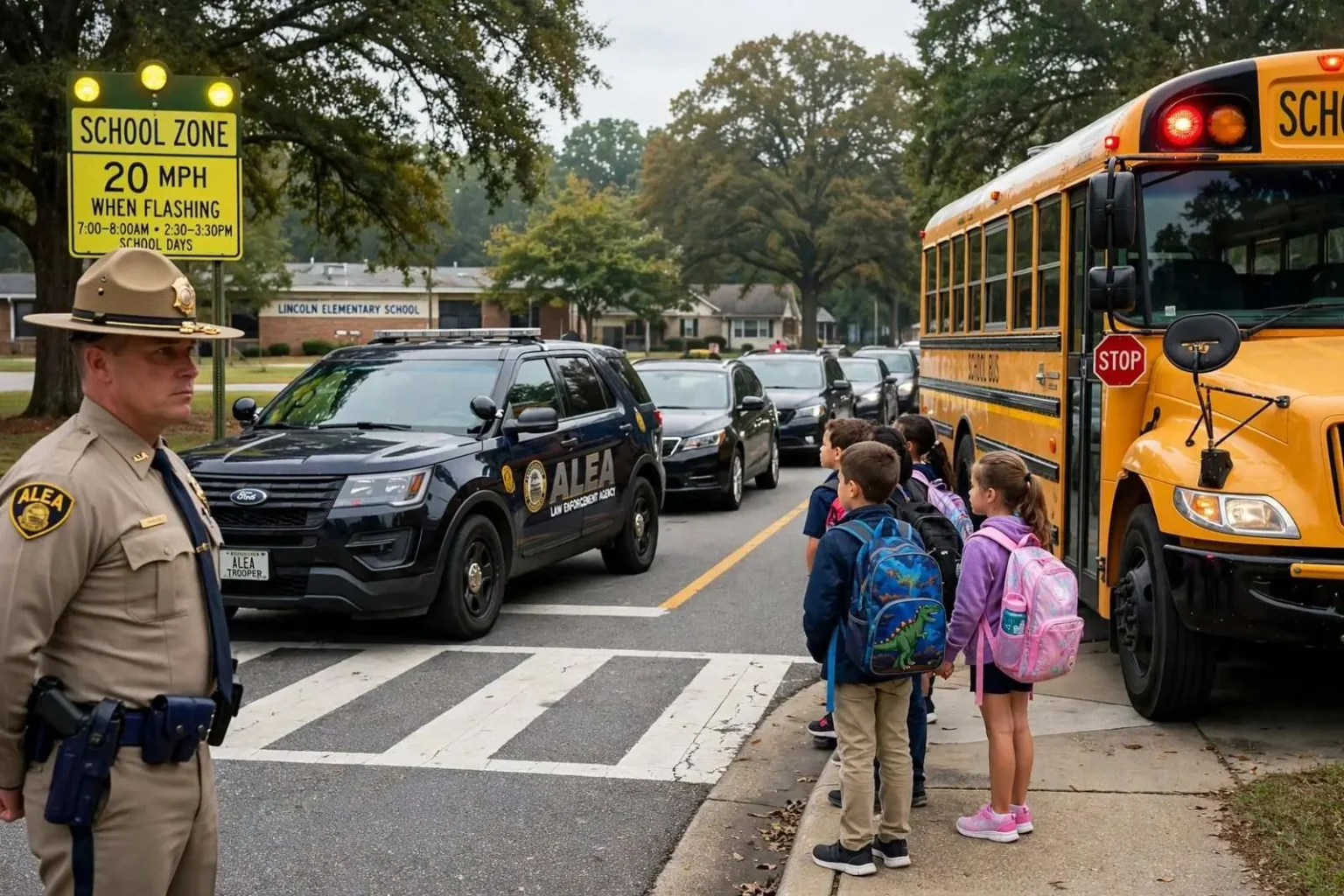
With backpacks packed and school buses back on Alabama roadways, the Alabama Law Enforcement Agency (ALEA) is reminding motorists that the return of the school year also means a return to increased traffic, more pedestrians near roadways, and school buses making frequent stops.
ALEA Secretary Hal Taylor said the back-to-school period brings both excitement and concern for parents. “As a parent, I understand the excitement and the concern that come with sending our children back to school each year,” Taylor said. “We all want to know they will arrive safely and make it back home at the end of the day. With school buses back on the roads and more young drivers and pedestrians traveling each morning and afternoon, I ask everyone to be patient, put the phone down and slow down. Those few extra minutes behind the wheel are a small price to pay when it comes to protecting Alabama’s children.”
ALEA Department of Public Safety Director Colonel Jonathan Archer echoed that message, noting that troopers will be visible in and around school zones and along heavily traveled routes during morning and afternoon hours. “We know it takes time for everyone to readjust to school-year traffic, but that makes it even more important to leave a little earlier, slow down and stay focused behind the wheel,” Archer said.
The agency’s reminder lands at the moment when road conditions across the state change most abruptly. Over a summer, commuters adjust to a rhythm that excludes school traffic; in a single week, drivers confront congested drop-off lines, buses stopping every few blocks in residential neighborhoods, and teenage drivers making their first solo runs to high school parking lots. Crash data from traffic safety officials across the country consistently show that the hours surrounding school arrival and dismissal are among the most dangerous of the day for young pedestrians.
What Drivers Are Asked to Do
For drivers, ALEA is asking motorists to obey posted speed limits, especially in school zones, put phones away, allow extra travel time during drop-off and dismissal, and watch for children near crosswalks and bus stops. Drivers should never pass a vehicle stopped for pedestrians in a crosswalk and should always wear a seat belt and ensure children are properly restrained.
School zone speed limits deserve particular attention in the opening weeks of a school year. The reduced limits are in force only during posted hours, but enforcement is heaviest when the zones are newly active and drivers are still adjusting, and a speeding violation in an active school zone carries penalties that grow sharply with speed. Officials urge drivers to treat the flashing beacons and marked crossings near elementary schools as full stops in patience, not mere suggestions, since young children are the least predictable pedestrians on the roadway.
Motorists are also reminded to stop when a school bus activates its flashing red lights and extends its stop arm, and never to pass a stopped bus when prohibited by law. Alabama law requires drivers approaching a stopped school bus from either direction on an undivided road to halt until the lights stop flashing and the arm is withdrawn. Only traffic on the opposite side of a highway divided by a physical barrier or unpaved median may continue past a loading or unloading bus, and even then drivers should watch for children who may cross unexpectedly.
Illegal passing of stopped school buses remains one of the most persistent violations troopers encounter during the school year, and it is among the most dangerous. A school bus loads and unloads at the roadside, often in darkness during the early-morning months of the school year, and children stepping off the bus may need to cross the road they just exited. Law enforcement agencies across Alabama conduct periodic school bus enforcement details each fall, positioning officers along known bus routes and citing drivers who run extended stop arms.
Distraction is the other recurring theme in the agency’s back-to-school messaging. A driver glancing at a phone covers remarkable distance at residential speeds — a few seconds of inattention in a school zone can span the width of a crosswalk. Alabama’s texting-while-driving prohibition makes typing or reading messages behind the wheel a violation in its own right, and troopers stationed near school zones are watching for it alongside speeding and restraint violations.
Advice for Students and Parents
Students are asked to arrive at bus stops early, wait in a safe location away from the roadway, and never walk behind a bus. Children who wait on the shoulder rather than at the curb give drivers more time to see them, and those who arrive late tend to run, which is precisely the movement drivers least expect and respond to slowest.
Parents are encouraged to walk younger children to the bus stop when possible and to teach the basic habits that safety officials repeat every year: look both ways before stepping into the road, make eye contact with the bus driver before crossing, stay out of the bus’s blind spots, and wait until the bus comes to a complete stop before approaching. Children crossing after dismissal should walk several steps ahead of the bus so the driver can see them in the mirror before they enter the roadway.
For families who drive students to school rather than relying on buses, the drop-off line imposes its own discipline. Officials ask parents to use designated drop-off zones rather than stopping in traffic lanes or across crosswalks, to remain with the vehicle, and to have children exit on the side nearest the sidewalk. Double-parking to save a minute in line forces children into live traffic lanes and is among the most common causes of near-misses at crowded schools.
Teen drivers face their own adjustment each August. Newly licensed students are simultaneously learning to manage a car and navigating congested campus parking lots, and safety officials urge parents to set clear rules about passengers, phones and radio volume during the first weeks of school. Alabama’s graduated driver license system already restricts the youngest drivers on night driving and passenger limits, and back-to-school season is the period when those limits matter most in practice.
Restraint use completes the checklist. Adults must buckle up, and children too small for seat belts belong in car seats or booster seats appropriate to their age, weight and height. Troopers note that properly installed child restraints dramatically reduce the risk of serious injury, and that parents can often have installations checked by certified technicians through local law enforcement agencies and hospital-based child passenger safety programs.
Why the Message Comes From the Top
The prominence of Taylor and Archer in the campaign reflects how ALEA approaches seasonal safety messaging. The agency, which consolidated Alabama’s major law enforcement functions under a single cabinet-level department, rotates public awareness campaigns through the calendar — holiday travel, boating season, severe weather and school re-entry each get their own push, with troopers deploying visible enforcement to match.
That visibility is deliberate. Safety officials have long observed that drivers respond to enforcement presence even more than to the threat of a ticket, and a marked unit sitting near a school crossing in the first weeks of class slows an entire street. Troopers will emphasize school zones and bus routes through the opening weeks of the school year, then settle into routine patrol as traffic patterns stabilize.
The stakes are not abstract. National traffic safety research consistently ranks the afternoon dismissal period among the highest-risk windows for child pedestrian injuries, and the first weeks of a school year bring a surge of incidents as drivers and students alike relearn routines. A child darting between parked cars, a bus stopping unexpectedly on a two-lane road, a driver running an extended stop arm — each scenario ends differently when the surrounding traffic is moving slowly and paying attention.
Local school systems across south Alabama, from Mobile County — the largest district in the state — to the suburban systems of Baldwin County and the river-region districts to the north, supplement the state’s message with their own reminders, crossing guards, and staggered bell schedules designed to spread out traffic. But the geometry is fixed: thousands of students converge on campuses twice a day, most of them within walking distance of moving traffic.
ALEA’s guidance, in the end, compresses into a handful of habits. Slow down in and around school zones. Put the phone out of reach. Stop for buses with red lights flashing, and for cars yielding to pedestrians. Give children the extra second at the crosswalk, even when they seem to take forever. Leave early enough that patience costs nothing.
As Taylor put it in asking for that patience, the few extra minutes behind the wheel are a small price when the alternative is measured in children’s lives. Troopers will be watching; the agency’s request is that drivers watch too, so the opening weeks of the school year pass the way every school year should — with all of Alabama’s students arriving, learning, and coming home safely.