Alexander Shunnarah Firm Pays $276,526 to End Alabama Media Group’s Unpaid-Ad Lawsuit
Alabama Media Group sued attorney Alexander Shunnarah for nearly $300,000 in unpaid ad bills; the debt was wired days later and the case dismissed.
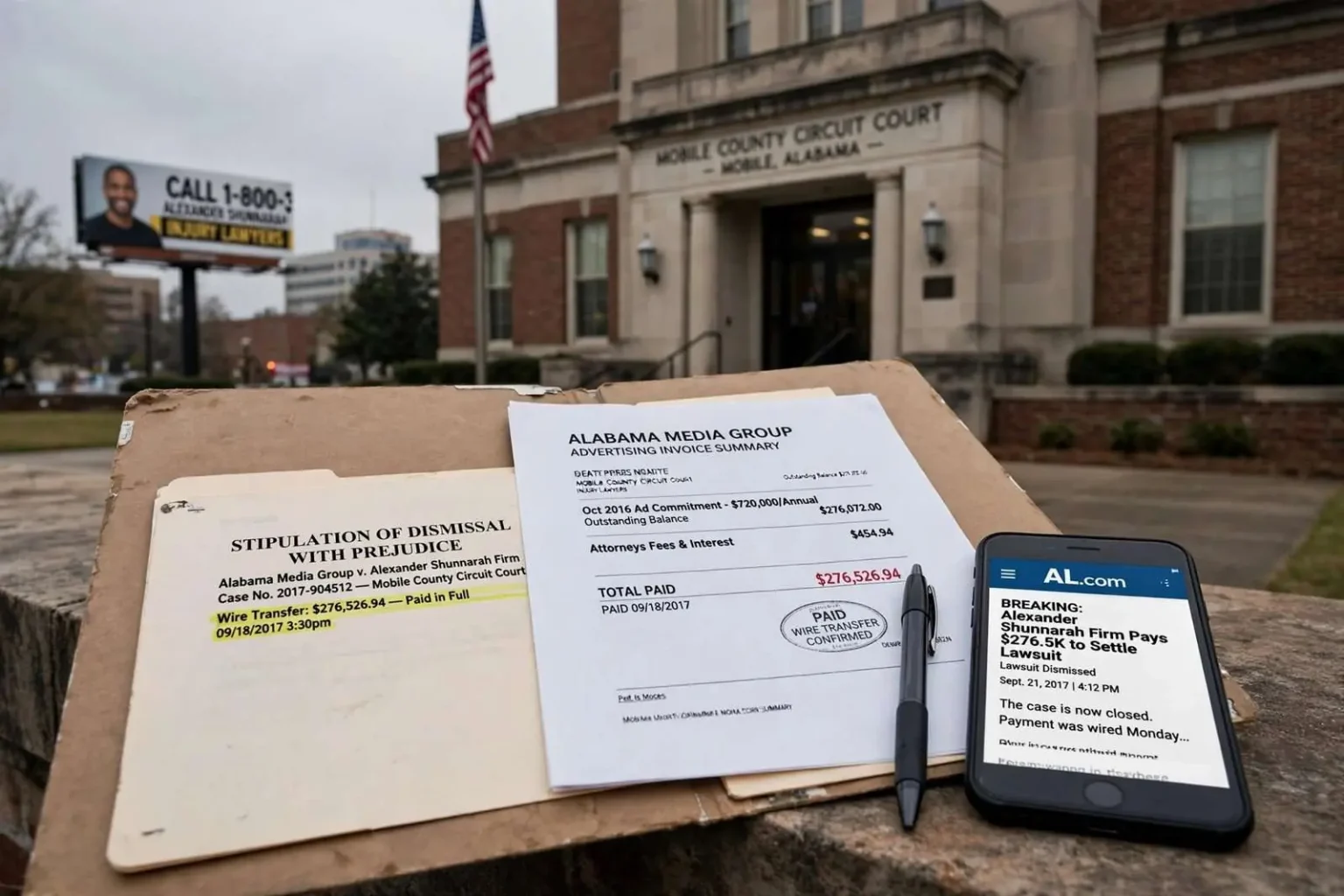
A lawsuit that pitted one of the state’s most visible personal-injury brands against the parent company of AL.com ended almost as soon as it made headlines — with a six-figure wire transfer. Alabama Media Group filed suit in Mobile County Circuit Court on Sept. 14, 2017, seeking $276,072 it said Birmingham-based attorney Alexander Shunnarah owed for advertising run on the company’s website, plus $55,000 in attorneys’ fees and interest. Within a week, the debt was paid and a stipulation dismissing the case was circulating for signatures, closing out a dispute that had briefly made one of the Gulf Coast’s most familiar advertisers the defendant in a very public invoice fight.
Court filings showed the balance had once topped $345,000 before Shunnarah’s firm paid just over $69,000, and detailed the scale of the relationship: an October 2016 commitment to place $720,000 in advertising over a year, and a separate 2014 contract calling for at least $14,900 a month — up to $183,960 annually. The numbers made clear that the suit was not about a small unpaid bill but about one of the largest recurring advertising relationships in Alabama digital media. AL.com, the state’s dominant news site, had structured a multi-year, multi-contract arrangement with the firm across its network.
Alabama Media Group, the Advance Publications affiliate that operates AL.com and the state’s largest newsroom, publishes in Huntsville, Birmingham, Montgomery and Mobile, and its ad sales operation sells everything from sponsored content to display placements across the site and its apps. A $720,000 annual commitment from a single advertiser ranks among the deals that anchor a regional digital publishing budget, which explains why the company turned to litigation rather thancollections letters when the invoices went unpaid.
Debt Paid Before the Story Even Ran
The matter moved quickly. James T. Laura Jr., managing partner of Alexander Shunnarah & Associates, told reporters on Sept. 21 that the debt had been paid in full at 3:30 p.m. the previous Monday — a wire transfer of $276,526.94 from Alexander Shunnarah Gulf Coast LLP — and that a joint stipulation dismissing the case with prejudice was awaiting signature from AMG’s attorney, Joshua Friedman. The timing detail became the story’s sharpest irony: the wire had landed before AL.com’s first report on the lawsuit was published.
Laura noted the transfer predated publication of the initial report, though the outlet had contacted Shunnarah’s Mobile office a full day before deadline to seek comment; no response came until Sept. 21. In litigation terms, the sequence meant the story’s central fact — a six-figure unpaid balance — was already resolved by the time readers saw it, and the firm’s decision to go silent during the reporting window left the initial story without its eventual defense. The payment settled the account; the public impression took longer to catch up.
Friedman could not sign immediately because of a religious holiday but was expected to finalize the dismissal the next day. He declined to comment on the suit itself. A dismissal with prejudice carries a specific legal weight: it is not a pause or a dismissal without prejudice that could be refiled, but a permanent end to the claims, entered at the parties’ joint request. Once the judge signed the stipulation, the file closed with no finding of fault, no trial and no public adjudication of either side’s version of the dispute.
What the Filings Revealed
For observers of Alabama’s legal advertising market, the court filings offered a rare documented look inside the economics of the state’s most aggressive personal-injury marketing operation. Advertising commitments of $720,000 a year and standing monthly minimums of $14,900 from 2014 establish, in sworn filings, the scale at which one firm buys media from the state’s largest news operation. Personal-injury advertising in Alabama is famously competitive, with firms spending millions annually across billboards, broadcast and digital placements, and the AMG contracts showed exactly how that spending distributes across channels.
The suit itself was a straightforward breach-of-contract action, the kind commercial dockets in Mobile County Circuit Court handle routinely. What distinguished it was the parties: a plaintiff whose name is synonymous with Alabama news and a defendant whose face is arguably the most recognizable in the state’s outdoor advertising. Cases between familiar brands draw attention that the identical contract dispute between two anonymous companies never would, and the speed of the resolution reflected both sides’ incentive to make the headlines disappear.
The $55,000 in attorneys’ fees AMG sought alongside the balance was a standard feature of contract pleadings, where prevailing parties can request fees when the underlying agreement provides for them. Whether the final $276,526.94 wire covered any portion of the fees and interest, or only the principal balance, was not detailed publicly — the wire figure slightly exceeded the principal the suit sought, and the joint stipulation ended the question without a contested accounting.
A Familiar Face in Gulf Coast Advertising
Shunnarah is known across Alabama and the broader Southeast for billboard saturation so dense that two of his smiling likenesses can sit nearly across the street from each other, alongside heavy spending on broadcast and digital ads. The firm’s marketing strategy has made its founder a pop-culture reference point across state lines — commuters can travel from Birmingham to the Florida line and count his billboards the whole way — and the strategy extends through television commercials, radio spots and the digital placements at issue in the AMG contract. Law firm marketing analysts frequently cite the operation as one of the most recognizable examples of saturation advertising in the personal-injury sector.
The Mobile office whose silence during the reporting window became part of the story is one of the firm’s Gulf Coast outposts in a network that stretches from Birmingham through Montgomery, Dothan and the Panhandle. Alexander Shunnarah Gulf Coast LLP — the entity behind the wire transfer — is one of the corporate identities through which the firm’s regional operations transact, a structure common among multi-office injury practices that manage advertising, staffing and liability across state lines.
The episode served as a reminder of how much money flows through that machine — and what happens when the invoices stop getting paid. Digital media companies depend on a handful of large advertising relationships, and when one of them falters, the arithmetic turns public fast: a $720,000 annual commitment is a budget line, not a rounding error, for a regional news operation. AMG’s willingness to file suit rather than quietly renegotiate signaled how it valued the account.
How the Case Closed
With the wire transfer confirmed and the stipulation signed, the Mobile County Circuit Court file closed without a hearing, a motion practice or a judgment. Contract cases that end this way leave behind only the filings, which is why the pleadings’ details — the October 2016 commitment, the 2014 monthly minimums, the prior $69,000 payment — became the public record of the dispute. Neither party issued a broader statement, and the litigation never reached the discovery stage that might have surfaced the reasons the invoices went unpaid.
The speed of the resolution drew attention in media and marketing circles precisely because such disputes often linger. A defendant who pays within a week of being sued, before the first story even publishes, signals a calculation that the account matters more than the grievance — that the advertising relationship, or at least the reputational cost of the fight, was worth more than the $276,000. For a firm whose entire business is built on public visibility, the calculation was legible to everyone watching.
For Alabama consumers, the episode passed without any change in what they see: the billboards still line the interstates, AL.com still carries the state’s largest newsroom, and the advertising relationship that generated the lawsuit continued as background noise in the state’s daily media diet. The court file, the wire transfer receipt and a handful of filings remain the only public accounting of how a six-figure ad bill became a headline — and how quickly money, when it finally moved, made the headline go away.
The Larger World of Alabama Injury Advertising
The case offers a window into an advertising economy that most residents encounter daily without thinking about its mechanics. Alabama’s personal-injury bar spends heavily enough to sustain billboard companies, broadcast stations and digital publishers across the state, and the competition for the state’s accident cases drives creative decisions — phone numbers chosen for memorability, taglines tested in focus groups, and placements bought by the corridor rather than the market. Shunnarah’s operation built its brand identity on being unmissable, and the AMG contracts documented the digital side of that same strategy: if the audience reads the news on AL.com, the firm buys the news site.
For the publishers, such relationships come with a delicate boundary between advertising and editorial. News operations that accept large commitments from local litigators must manage the relationship without letting the advertiser’s weight touch coverage, and a payment dispute that ends up in court tests that boundary in public. AMG’s decision to sue, report and accept payment within the same news cycle illustrated how quickly the commercial and editorial sides of the business can collide when a familiar advertiser’s account goes unpaid.
The final accounting is simple: a $276,526.94 wire from Alexander Shunnarah Gulf Coast LLP, a stipulation of dismissal with prejudice awaiting one signature, and a dispute that rose and fell within a single news week. The filings remain in the Mobile County Circuit Court record for anyone who wants the dollar figures, and the episode stands as both a curiosity and a case study — proof of how much a single firm’s advertising is worth, how fast a public brand moves to protect itself, and how completely a wire transfer can end a story that seemed, for exactly one day, to be just getting started.