All Alabama Constitutional Amendments on the 2018 Ballot Passed — Here’s What Each One Does
Alabama voters approved every 2018 constitutional amendment, from Ten Commandments displays to changes in filling vacant legislative seats.
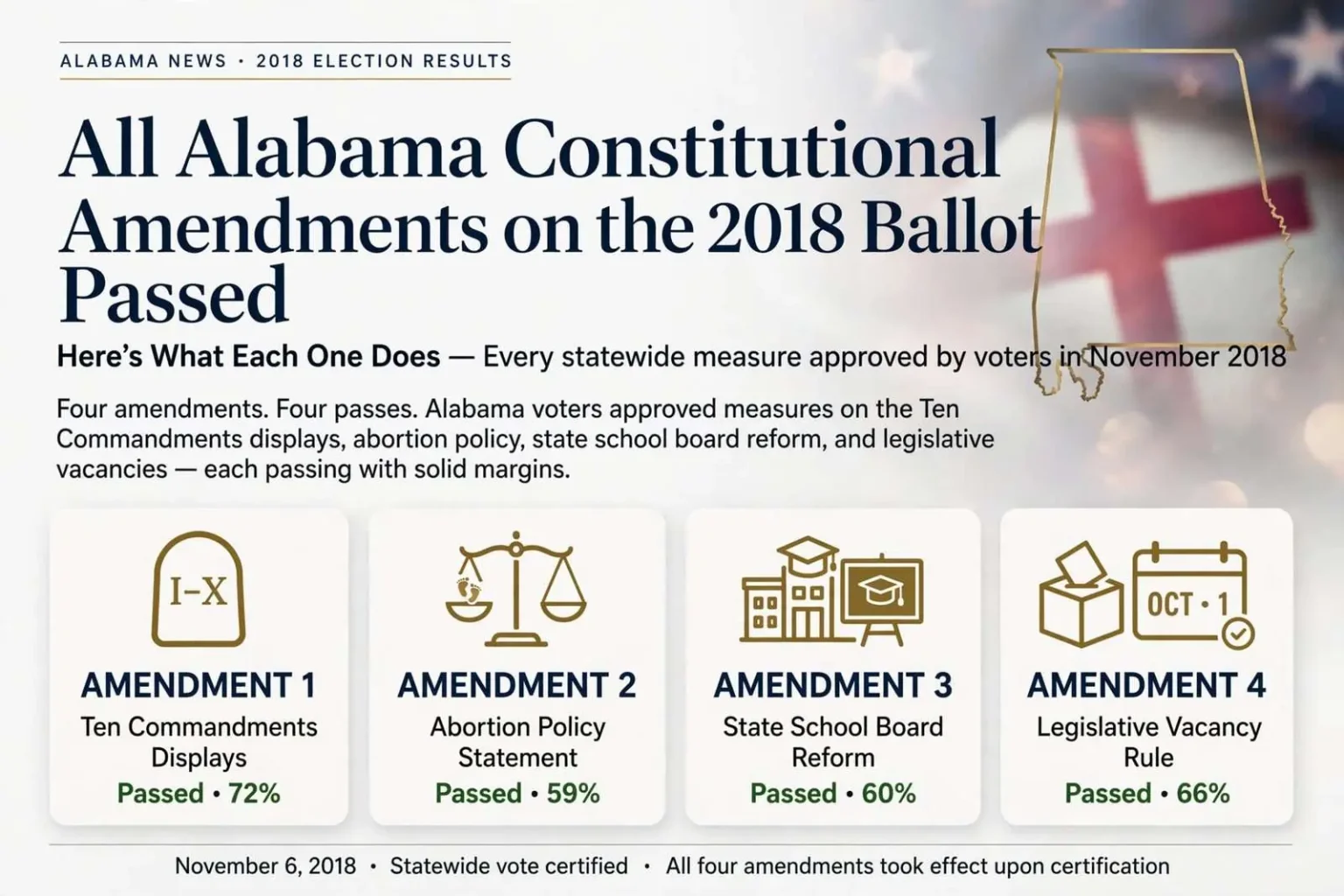
Every statewide constitutional amendment Alabama voters faced in November 2018 won approval, most by solid margins. Several carry lasting consequences for how state government works. The results capped a ballot that asked Alabamians to weigh in on everything from religion in public buildings to the mechanics of filling legislative vacancies, and the clean sweep for the amendments reflected a slate that polled well across party lines even in a year of otherwise contested politics.
Alabama’s practice of amending its constitution through statewide votes is nearly unique in its frequency. The state’s 1901 constitution, among the longest constitutions in the world, has been amended hundreds of times, and Alabama voters routinely face ballots listing local amendments, statewide amendments and bond issues. The 2018 statewide questions drew unusual attention, however, because several touched on topics — religion, abortion policy and education governance — that move voters more than the technical amendments that fill most ballots.
Amendments that reach the statewide ballot in Alabama pass through the Legislature, where each proposed change must win approval in both chambers before it goes to the voters. Supporters then campaign for passage, and the votes on controversial amendments often serve as unofficial referendums on the underlying issues themselves.
Amendment 1: Ten Commandments displays
Amendment 1 passed with 72 percent of the vote. It allows the display of the Ten Commandments on public property, including schools, so long as the display meets constitutional requirements — such as being presented alongside historical or educational materials. The measure bars the use of public funds to defend the amendment’s constitutionality in court.
The wording was designed to thread a legal needle. Federal courts have long drawn lines between displays that convey a religious message and those presented in a historical or educational context, and the amendment’s supporters wrote those standards into the text, aiming to authorize displays that could survive legal scrutiny rather than inviting litigation the state would lose.
The issue carried particular weight in Alabama’s recent political history. The state had been at the center of a national controversy years earlier over a Ten Commandments monument in the state judicial building, a fight that ended with the monument’s removal and cemented the Ten Commandments as a recurring theme in Alabama politics. Amendment 1 gave voters a chance to write their preference directly into the state constitution, within the limits the federal courts had set.
The funding restriction drew attention from government watchers. By barring public money from defending the amendment in court, the amendment’s drafters sought to prevent the situation, seen in other states, where local governments spend taxpayer dollars on litigation over religious displays. Any legal defense would have to be carried by private parties or outside organizations rather than public coffers.
The 72 percent support marked one of the widest margins on the 2018 ballot, reflecting how little organized opposition the measure faced. Polling in the years since has consistently shown majorities of Alabamians favoring such displays, and the amendment’s passage drew little of the litigation some observers had predicted.
Amendment 2 passed with 59 percent. A yes vote established a statement of state policy recognizing the sanctity of unborn life and the rights of unborn children, and declaring that Alabama’s constitution includes no right to abortion and does not require taxpayer-funded abortion. It did not outlaw abortion or change any law immediately, but it was written with an eye toward a potential shift in federal precedent such as a reversal of Roe v. Wade.
The amendment’s structure made it a statement of principle with future implications. By declaring that the state constitution recognized the rights of unborn children, Alabama joined a handful of states that had placed such language in their founding documents, creating a foundation that future legislatures could build on if the federal legal landscape changed.
Supporters described the amendment as a values statement that cost nothing on its own, while opponents — including medical and civil liberties organizations — warned that it laid groundwork for future restrictions and could complicate care in cases where physicians had to weigh the life of the mother. The 59 percent result showed a divide narrower than Amendment 1 enjoyed, and the campaign drew more outside money and attention than any other measure on the ballot.
The reference to taxpayer funding addressed a separate argument that had circulated in state politics for years. Federal law already governed the use of public money for abortion, but the amendment’s language ensured that the state constitution itself could not be read to require such funding, closing off one line of potential litigation.
Amendment 3: State school board
Amendment 3 passed with about 60 percent. It removed the State Superintendent of Education’s automatic seat on the state school board — though a superintendent could still serve if nominated and confirmed — allowed board members to keep serving past age 70, and fixed the board’s membership at the number of congressional districts in place as of January 2018.
The change untangled several threads in the board’s structure at once. The automatic seat had made the superintendent both the board’s chief executive and a voting member of the body that supervises the superintendent’s own department, a conflict that reformers had criticized for years. Under the amendment, that person could join the board only through the same nomination-and-confirmation process applied to other members.
The age limit provision answered a practical problem in education governance. Board members who reached 70 had faced mandatory departure regardless of their standing, and the amendment let voters keep experienced members in office if they chose. Education policy advocates had argued that the state needed continuity on the board more than it needed a retirement rule.
Fixing the board’s size at the number of congressional districts tied education governance to a benchmark rather than a moving target, preventing future redistricting fights from automatically changing the board’s composition. The state school board, which oversees the state department of education and elects a superintendent in that structure, had seen its membership questions entangled with census-driven district changes for years.
The amendment emerged from a longer debate over Alabama’s education governance, which had drawn criticism after years of turnover in the state’s top education post. Reformers hoped the structural changes would stabilize the board and clarify accountability between the board and the superintendent it oversees.
Amendment 4, sponsored by outgoing Mobile County State Sen. Rusty Glover, passed with 66 percent. Under the change, a legislative seat that becomes vacant after October 1 in the third year of a four-year term is no longer filled by special election; instead, it stays open until the next general election, meaning a district could go as long as 14 months without representation.
Glover, who was completing his service in the Senate when the amendment went to the ballot, carried the measure through the Legislature as a cost-saving and practicality measure. Special elections to fill legislative vacancies run up significant expenses for county and state governments, and in the final year of a term they often seat a winner for only a few weeks before the regular election replaces them.
The trade-off was representation. Under the old system, districts sent someone to Montgomery quickly after a vacancy, even late in a term. The amendment accepted months without a sitting legislator in exchange for avoiding elections whose winners would serve briefly and whose campaigns would cost taxpayers hundreds of thousands of dollars statewide in a given year.
The October 1 cutoff in the third year of the term was designed to draw the line narrowly. Vacancies occurring earlier still trigger special elections under the amendment, preserving speedy representation where a substantial part of the term remains. Only vacancies in the final stretch — when the next general election is close enough to serve as the filling mechanism — fall under the new rule.
Local governments and party organizations took note of the change, since it alters the planning that follows a legislative resignation or death. Under the amendment, the seat simply waits for the calendar, and the district’s constituents are served, where service is possible at all, by neighboring legislators and by the agencies that handle constituent work between elections.
What the results mean
Taken together, the four amendments showed the range of what Alabama’s ballot-measure process handles: statements of values, structural reforms to government bodies and procedural changes to elections. Each passed with a comfortable majority, and none came as close to defeat as some amendment fights of previous years had.
The amendments took effect upon certification of the election results, though several required follow-up action by the Legislature to implement. The Ten Commandments language and the abortion-policy statement operate as declarations within the constitution itself, while the school board and vacancy changes altered statutes of governance that legislators and election officials would apply going forward.
For voters, the 2018 slate was also a reminder of how much of Alabama’s governance is settled at the ballot box rather than in the Legislature or the courts. Constitutional amendments that would require new conventions or major rewrites in other states arrive in Alabama as individual questions, passed or failed one at a time. The 2018 results added four more amendments to a document that has grown for more than a century, and the margin on each one measured where the state’s voters stood on the issues involved.