Alligator mating season is here: what south Alabama residents should know
Alligator mating season runs April through May in Alabama. Here's how breeding works, why gators matter to wetlands, and ADCNR safety tips for residents.
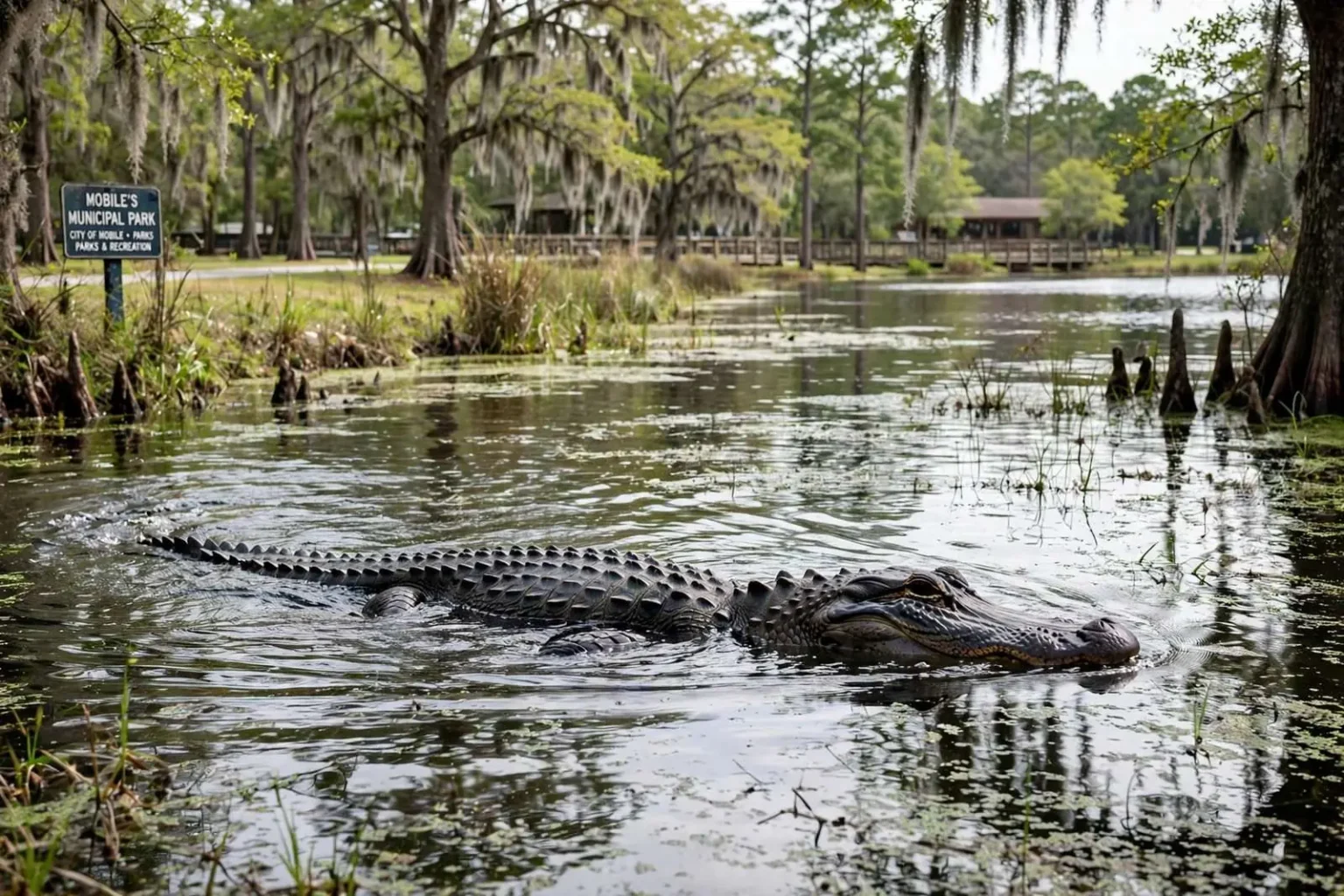
MOBILE, Ala. — A large alligator recently filmed swimming across the lake at Mobile’s Municipal Park is a sure sign of the time of year: alligator mating season, which runs from April through May in Alabama according to the Alabama Department of Conservation and Natural Resources (ADCNR). The sighting, captured on video and shared widely, gave south Alabamians a vivid reminder that one of the state’s most ancient predators becomes especially active as spring warms the water.
Mobile’s Municipal Park — the lakes and paths around what is now part of the city’s park system along Museum Drive — has long been a place where residents walking dogs or fishing from the banks might glimpse wildlife. But a large gator cruising openly across a lake in daylight is a spectacle that reliably stops foot traffic, and it arrives each year right on schedule with the breeding season.
How the Season Works
Alligator courtship and breeding take place in open water. During the spring, adult alligators become more visible and more mobile, with males traveling between water bodies in search of mates — behavior that explains sightings like the one at Municipal Park, where a gator may simply be passing through on its seasonal rounds.
Afterward, females build nests from plants and mud, often on elevated ground near the water’s edge, and lay between 30 and 70 eggs. The decomposing vegetation in the nest generates heat that incubates the eggs, and the temperature of the nest during development influences the sex of the hatchlings. The eggs hatch after about nine weeks, typically in late summer, and the young stay with their mother for roughly 18 months, protected in her territory during the most vulnerable stretch of their lives.
Even with a mother’s protection, the survival odds for young alligators are steep — hatchlings face predators ranging from wading birds to raccoons, larger fish and other alligators. That natural attrition is one reason a single female’s nest of dozens of eggs typically produces only a handful of adults.
Growth and Habits
Alligators grow quickly early in life, adding about a foot of length each year for their first four years. Growth slows after that, but the animals keep growing throughout their lives, which is how the largest adults in south Alabama’s rivers, swamps and lakes reach lengths that astonish casual observers.
Adult gators are ambush hunters that feed mostly at night, seizing prey in powerful jaws before drowning it and swallowing it whole. Their diet is broad and opportunistic — fish, turtles, snakes, small mammals and birds, along with carrion when the chance arises. During the warm months, including mating season, an adult alligator eats around 20 pounds of food every week, fueling the increased activity that the breeding season demands.
That appetite makes the warm half of the year the season of greatest overlap between alligators and people. Gators bask on banks to regulate their body temperature, cruise lake surfaces in daylight and roam overland between water bodies, sometimes turning up in retention ponds, golf course lakes and drainage canals in residential areas.
Living Alongside Gators
Coexistence with alligators is part of everyday life in south Alabama, and because the animals are naturally shy around people, bites are rare. The Mobile-Tensaw Delta north of the city, the rivers that feed Mobile Bay, and the countless lakes, swamps and marshes across the lower part of the state hold a healthy alligator population, and most residents will live their entire lives alongside the species without a single dangerous encounter.
That balance was once at risk: unregulated harvest across the South in the early 1900s pushed the species toward extinction, according to the ADCNR, before conservation measures allowed populations to recover. The American alligator became one of the country’s most celebrated conservation success stories, protected by federal and state law and managed through carefully regulated seasons, until populations rebounded to the point that limited hunting could resume in Alabama under state-run programs.
As a top predator in the state’s wetlands, the alligator helps keep other animal populations in balance. Its role in the food web — preying on fish, turtles and mammals, and shaping the behavior of species below it — is part of why the Delta and its tributaries support such rich biodiversity. Biologists describe healthy alligator populations as an indicator of healthy wetland systems.
But as development spreads into gator habitat, encounters between people and alligators become more likely. New subdivisions in Mobile, Baldwin and surrounding counties frequently include stormwater ponds and retention lakes that function, from an alligator’s perspective, as ideal habitat, and connecting drainageways allow gators to colonize them from nearby rivers and swamps.
Safety Tips for Spring and Summer
The ADCNR notes that alligators favor permanent water — freshwater swamps, marshes, rivers, lakes and streams that don’t dry up in summer — the same places people flock as weather warms. Residents are encouraged to follow the department’s safety guidance when outdoors this spring and summer.
The core of that guidance is consistent from year to year. Never feed an alligator — feeding destroys the animal’s natural wariness of people and is illegal in Alabama. Keep pets on a leash and away from the water’s edge, since a swimming dog can resemble prey. Swim only in designated areas during daylight hours, and never allow children to play unsupervised near the edge of a lake, river or swamp in gator country. Be especially cautious at dusk and after dark, when alligators do most of their feeding.
Anglers and boaters should dispose of fish scraps in garbage receptacles rather than in the water, because scraps in the same spot teach alligators to associate that location with food. The department’s outdoor specialists also caution against grabbing or harassing alligators of any size — even a two-foot gator can inflict a painful bite, and handling wildlife is against the law.
Reporting a Nuisance Alligator
Not every visible alligator is a nuisance. An animal sunning itself on a bank or swimming across a lake is behaving normally, and in most cases the right response is simply to give it space. A nuisance alligator is one that has lost its fear of people, approaches humans or pets, or has taken up residence somewhere it presents a genuine danger, such as a swimming pool or a pond heavily used by families.
To report a nuisance alligator, contact your regional wildlife office through the ADCNR’s website. Trained personnel can assess the situation and, when warranted, remove the animal, relocating or legally harvesting it rather than leaving an accustomed-to-people gator in place. Wildlife biologists stress that the vast majority of reports end without removal — the animal moves on, or residents adjust their own behavior around it.
For south Alabama, the gator at Municipal Park is less a warning than a seasonal marker: spring has arrived, the water is warm, and the state’s oldest large predator is going about its ancient routine. A little awareness and a few precautions let people share the season with it safely.
Alligators in Alabama’s Landscape
The American alligator’s range in Alabama covers the southern part of the state, where the Mobile-Tensaw Delta forms one of the most extensive wetland systems in the country. The Delta’s braided rivers, bayous, swamps and marshes north of Mobile Bay support alligators, black bears, bald eagles and hundreds of species of fish, birds and amphibians, making it a natural center of the species’ population in the state.
Alligators also inhabit the rivers and floodplain swamps of the Tombigbee, Alabama, Tensaw, Escambia and Perdido river systems, along with coastal lakes and marshes in Baldwin and Mobile counties. In these systems the species has no natural predators as an adult, and its numbers are limited mainly by habitat, food supply and, in recent decades, carefully regulated hunting during the state’s annual alligator season.
That hunting season — administered by the ADCNR with permits drawn by lottery in designated zones — reflects the recovery described in the department’s conservation history. Managed harvest is one of the tools wildlife agencies use to keep alligator populations balanced with habitat and public tolerance, and it has become a distinctive part of south Alabama’s outdoor culture each August.
The Ecology of a Top Predator
Biologists sometimes describe the alligator as an ecosystem engineer, a species whose presence shapes habitat for everything else. In drought years, alligators dig and maintain “gator holes” — deep depressions in marshes that hold water when surrounding wetlands dry up, providing refuges for fish, turtles and birds and concentrating wildlife in ways that sustain the system through hard seasons.
Nesting colonies of wading birds often choose islands in alligator lakes to build their rookeries, precisely because the gator swimming below deters raccoons and other nest predators. The relationship is mutually beneficial: the birds get protection, and the alligator picks off chicks that fall from nests. Observations like these have reshaped the popular image of the alligator from menace to keystone species in southeastern wetlands.
The recovery of the species also carries a cautionary note for residents. A healthy alligator population in a growing region means more animals in more places, and the state’s urbanizing stretches — along the Eastern Shore, the western Mobile County suburbs and the corridors around the Delta — now sit closer to working alligator habitat than at any time since the species neared extinction a century ago.
Spring Sightings and What They Mean
A daylight crossing like the one filmed at Municipal Park typically signals movement, not aggression. Alligators travel overland and across open water most often during the breeding season, and a large animal moving between lakes will simply take the straightest line, indifferent to the walking paths and fishing piers in its way. The appropriate response from park visitors is the one the video showed: watch from a distance, let the animal pass and keep pets clear of the shoreline.
The ADCNR’s wildlife sections handle alligator questions and reports year-round, and regional biologists can advise residents on whether a particular animal warrants concern. Most springtime sightings, biologists note, require nothing more than patience — the gator’s seasonal travels usually end with it settled into quieter water well away from people.
For now, the large visitor at Municipal Park stands as the season’s most visible ambassador: mating season is underway across south Alabama, nests will be built in the coming weeks, hatchlings will emerge by late summer, and the state’s wetlands will once again demonstrate why the alligator’s recovery is counted among the great achievements of American wildlife conservation.