Alligator spotted traveling the west end of Dauphin Island
Sea turtle nest survey volunteers spotted an alligator on Dauphin Island's west end. Experts say the gator is just passing through and poses no threat.
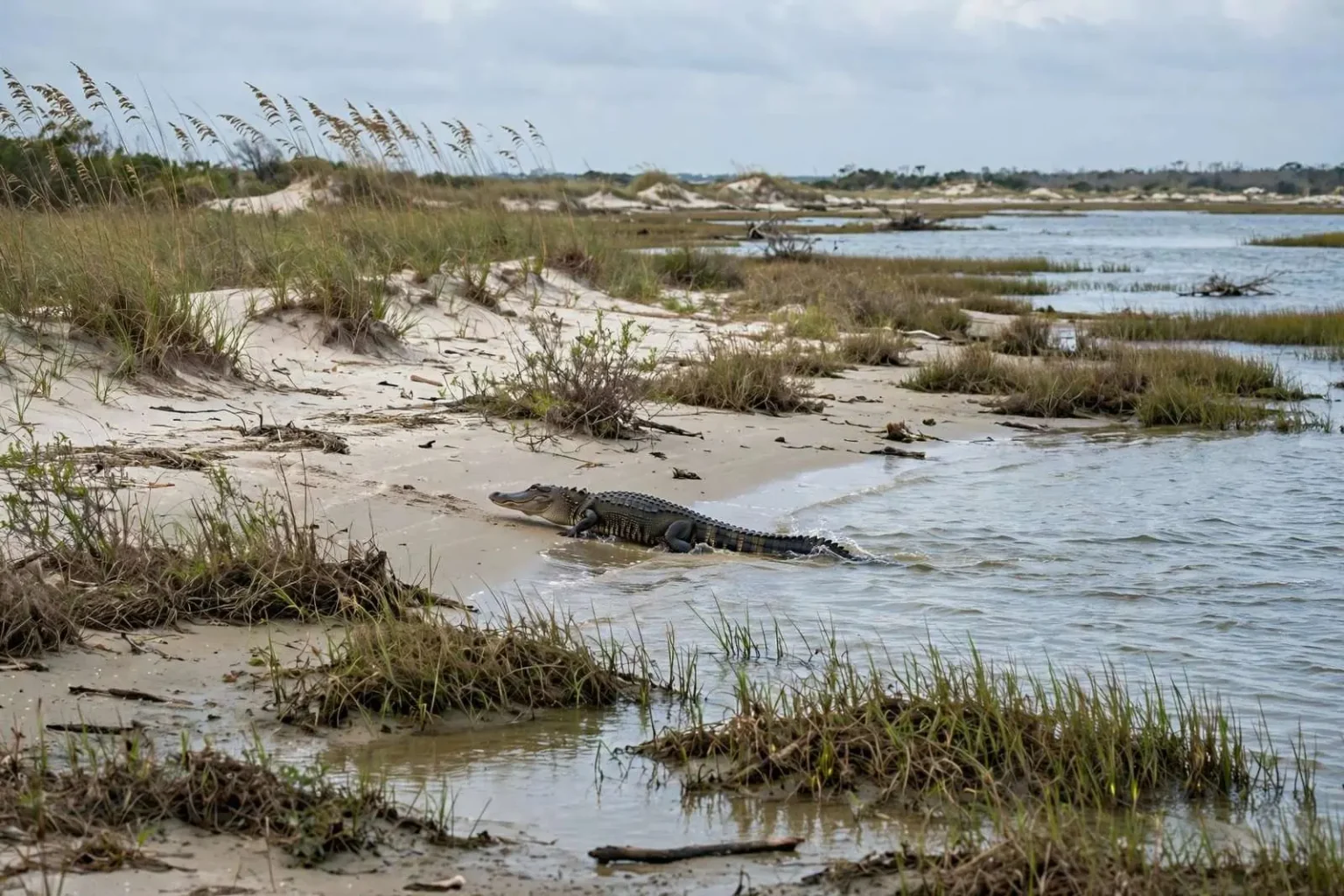
DAUPHIN ISLAND, Ala. — Volunteers scouting Dauphin Island’s beaches for sea turtle nests over the weekend found themselves looking at something considerably larger: an alligator on the island’s far west end. The gator was seen Saturday and Sunday, turning an ordinary early-season patrol into one of the more memorable wildlife sightings the barrier island’s volunteers have logged in recent years.
As volunteers Kathryn Twilley and her husband Michael approached, the alligator slipped straight into the water, vanishing into the surf-line habitat where the island’s west end meets the sound. The sighting was photographed and reported to the island’s sea turtle program, whose staff quickly moved to put the animal’s presence in perspective for a community where news of an alligator on the beach travels fast.
‘Not a Threat,’ Experts Say
Stephanie Serra with Share the Beach Dauphin Island said the alligator is not a threat to residents or tourists on the island. In a message, she explained that the animal is simply passing through the area, a traveler rather than a resident, and that its appearance on the west end is consistent with how alligators move through the coastal landscape of southwest Alabama.
Alligators typically move when they have lost their territory to another male or are searching for females, according to Serra. Both motivations are seasonal and behavioral, not aggressive: a displaced male looks for new water and new standing, and breeding-season movement puts animals on the march in ways that occasionally carry them across beaches, roads, and other terrain people do not associate with the species. The west end of Dauphin Island, with its dunes, tidal pools, and connection to the sound, offers exactly the kind of corridor a moving alligator uses.
Serra’s reassurance rests on that context. An alligator in transit is an animal with somewhere else to be, and the one seen this weekend did precisely what a passing alligator does when approached by people: it left. Wildlife officials advise anyone who encounters an alligator to give it distance, keep pets leashed and away, and let the animal move on, which is what the Twilleys’ sighting suggested the animal intended to do all along.
The West End: Wild by Design
The section of the island where the gator was spotted is accessible only by boat or ATV, a fact that shapes both its ecology and its role in sightings like this one. The far west end of Dauphin Island is the island’s wildest stretch, an undeveloped landscape of dunes and marsh that shifts with every storm and stands as one of the least altered shorelines on Alabama’s coast. Because no road reaches it, the area functions as a refuge for the birds, turtles, and other wildlife that use the island, and human visits are limited to those willing and equipped to make the trip.
That inaccessibility is why the alligator drew attention rather than a shrug. Alligators are common throughout the estuaries, bayous, and marshes of Mobile County — in the Mobile-Tensaw Delta to the north, in the ponds and ditches of the mainland shore, and in the brackish waters around the bay. An alligator swimming the sound or hauled out on a wild beach is not an intrusion into strange territory; it is the species using habitat it has always had. What made the sighting newsworthy was the location on a barrier island famed for its beaches, and the presence of witnesses who happened to be there documenting sea turtle habitat.
The Volunteers Who Found It
The sighting came courtesy of the people who walk the island’s beaches each week on behalf of its most famous seasonal visitors. Share the Beach volunteers patrol Alabama’s coastline each summer monitoring sea turtle nests, and their weekend surveys occasionally turn up other wildlife along the barrier island’s undeveloped west end. The program is the state’s flagship sea turtle conservation effort, organizing trained volunteers who walk designated sections of beach at dawn during nesting season, mark and monitor nests, and shepherd hatchlings safely to the water.
Volunteers like Kathryn Twilley and her husband Michael are the program’s eyes on the sand. Survey work is methodical: volunteers look for the telltale crawl marks left by nesting sea turtles, log what they find, and report it to the program’s leadership so nests can be marked and protected through the months it takes for eggs to incubate. Along the way, they record the island’s other wildlife — birds, dolphins offshore, and, this weekend, a passing alligator — building the kind of continuous observational record that professional researchers alone could never cover.
The timing matters. Turtle season on the Alabama coast builds through the late spring and summer, and early-season surveys establish the baseline that the rest of the monitoring depends on. The west end surveys are among the program’s most rugged assignments, requiring boat or ATV access and a willingness to work the island’s remotest strand, which is precisely why the volunteers who cover it are the ones who see what the island’s wild end holds.
Alligators on the Alabama Coast
Wildlife biologists who study the Gulf Coast describe the American alligator as a conservation success story that has become a routine part of the coastal landscape. Once hunted to perilous lows, the species recovered under protections that began decades ago and now thrives across the southeastern United States, including the rivers, marshes, and estuarine margins of south Alabama. Managed hunts, nuisance-alligator protocols, and habitat protection give the state a working framework for living alongside an animal that sits at the top of its food chain.
Alligators tolerate saltwater for short periods, which is how individuals end up in sounds and along barrier islands, but they are fundamentally freshwater animals that need access to marsh and pond habitat. An alligator on Dauphin Island’s west end is almost certainly one in motion — between waters, as Serra described — rather than one establishing residence on the beach itself. The island’s interior ponds and the marshes at its ends can hold alligators, and sightings in those settings occur in most years without incident.
For residents and visitors, the practical guidance remains the same as it ever was: alligators are most active in warm months, they should never be fed — feeding is illegal and creates the bold animals that cause problems — and any alligator that appears in a populated area or behaves without fear of people should be reported to authorities rather than approached or handled.
Living With Wildlife on a Barrier Island
Dauphin Island occupies a distinctive place on Alabama’s coast. The island guards the entrance to Mobile Bay, shelters the port, and holds some of the most ecologically significant habitat in the state — dunes, maritime forest at its eastern end, and the ever-shifting west end where this weekend’s alligator appeared. Its town is small, its beach culture is genuine, and its identity rests on the balance between the people who live and vacation there and the wildlife for which the island is home ground.
That balance is tested regularly in small ways. Sea turtles nest on the island’s beaches and volunteers darken or shield the lights that would disorient hatchlings. Migrating birds descend on the island in spectacular numbers each spring and fall, drawing birders from across the country to the Audubon bird sanctuary at the island’s east end. Coyotes, diamondback terrapins, and now a headline-making alligator all share the sand. Each sighting renews the same civic conversation about how much the island can — and wants to — accommodate the wild creatures that predate any town charter.
What Serra’s message signaled was continuity rather than crisis. The program’s staff treated the alligator as a data point in the island’s natural history, not an emergency: an animal passing through wild habitat, observed by trained volunteers, documented, and left alone. That response is the template wildlife managers prefer, and its quietness is its own measure of success.
What Happens Next
No removal or relocation of the animal has been announced, and none is implied by the program’s assessment. An alligator that is simply moving through, on an uninhabited stretch of an island where it cannot easily reach people, is the kind of wildlife encounter the coast absorbs routinely. If the animal lingers in an area where people gather, state wildlife authorities would become involved under their standard protocols, but the west end’s isolation makes that scenario unlikely.
Volunteers will continue their surveys as turtle season builds, and the alligator, if it is still around, may well be seen again by the same small group of people who see everything the west end has to offer. The sighting serves as an early-season reminder of what the island’s remotest strand is: not an extension of the town’s beaches but a functioning piece of wild Gulf Coast, where a patrol for sea turtle nests can turn up a creature that slipped into the water as people approached and went on with its travels.
For the Twilleys, the encounter joins the log of unexpected finds that come with the volunteer work. For everyone else, the guidance is straightforward: if you find yourself on the island’s west end and cross paths with an alligator, do what the animal expects you to do — keep your distance, keep pets clear, and let it pass. As Serra’s assessment made plain, the gator on the beach this weekend was not a threat to the island’s people; it was another resident of the coast, briefly in view, on its way somewhere else.