Alton Brown Brought ‘Good Eats’ to Dauphin Island Sea Lab for a Night of Seafood and Science
Celebrity chef Alton Brown headlined a seafood and science event at the Dauphin Island Sea Lab Estuarium, raising funds for oil spill recovery.
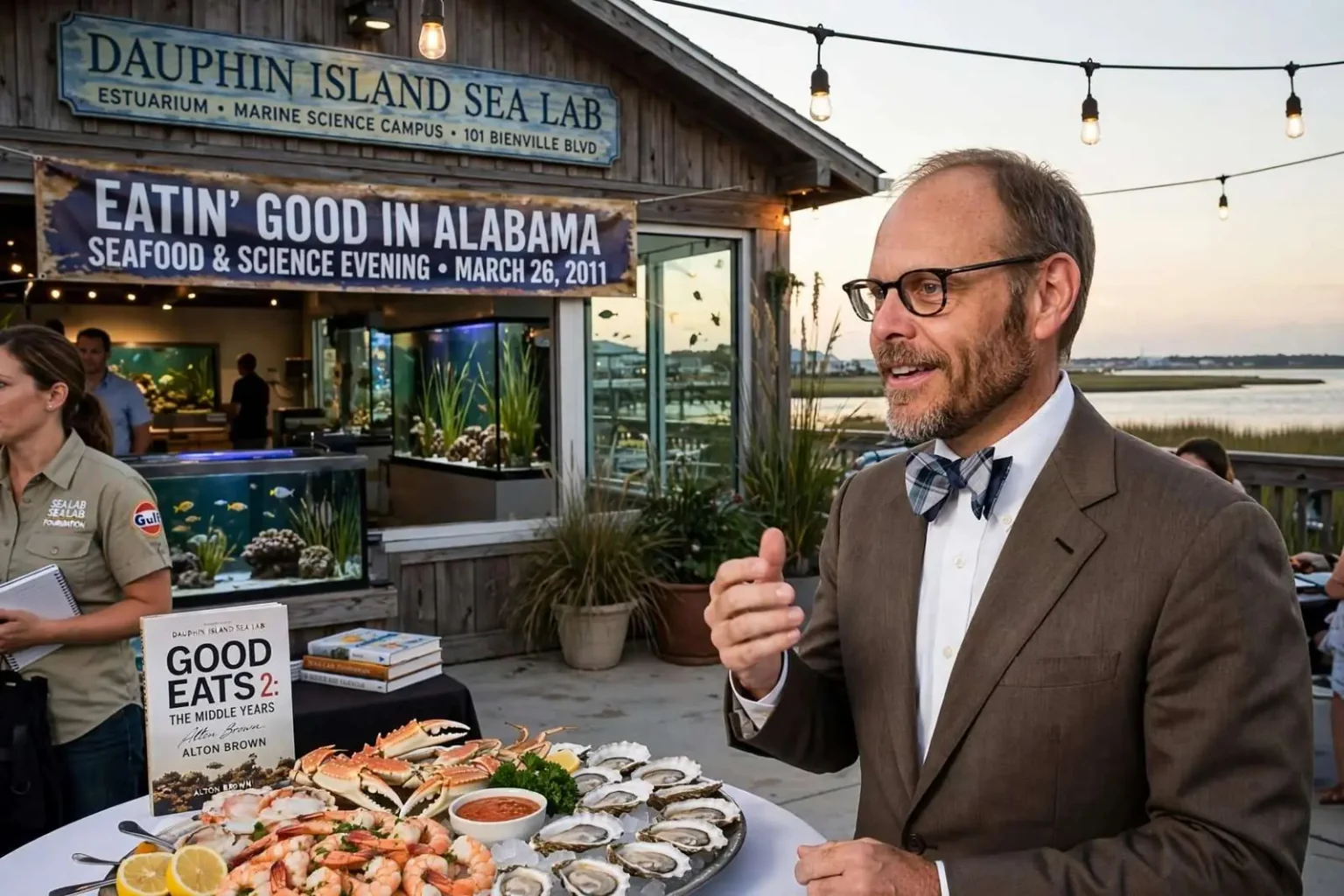
Television personality and culinary scientist Alton Brown headlined an exclusive evening event at the Dauphin Island Sea Lab Estuarium on Saturday, March 26, 2011, blending the worlds of food and marine science in a unique waterfront setting. The appearance brought one of television’s most recognizable food educators to a small barrier island community, where the subject of the evening — Gulf seafood — is both a way of life and, in the spring of 2011, a subject of anxious public debate.
Brown built his reputation by treating cooking as applied science, explaining on his long-running Food Network program “Good Eats” how heat transforms proteins, how emulsions form, and why technique matters as much as ingredients. That scientific bent made the Sea Lab Estuarium, a public aquarium and research facility dedicated to the estuaries of Mobile Bay and the Gulf, an unusually fitting venue. Guests came to hear a cook talk about marine life in the building where marine scientists study it every day.
Seafood, Science and Celebrity
The event, titled “Eatin’ Good in Alabama,” was organized by the West Bay and Gulf Coast Tourism Development Council and offered just 250 guests the chance to hear Brown discuss the vitality of the Gulf’s marine life while enjoying fresh Gulf seafood, live music, and conversation with scientists, community leaders, and local officials from Mobile and Baldwin counties. The deliberately limited guest list gave the evening an intimacy that large food-festival appearances rarely allow, putting ticket holders within conversation distance of a television personality, working researchers and elected officials in a single room.
Each attendee received a signed copy of Brown’s New York Times bestseller Good Eats 2: The Middle Years as a parting gift, along with complimentary seafood and beverages throughout the evening. The book, a companion to the television series, collects the recipes and Food Network-inspired science commentary that made Brown a household name. For fans, a signed copy from an evening spent at an estuarium on Dauphin Island made for a keepsake unlike anything from a standard book signing.
Supporting Gulf Coast Recovery
The gathering carried a charitable purpose as well. A portion of the proceeds was designated to assist families most severely affected by the 2010 BP oil spill and the resulting downturn in the Gulf seafood industry. Additional funds were earmarked for the Dauphin Island Sea Lab Foundation and sustainable tourism initiatives in South Mobile County.
The timing of the charitable focus was no accident. Less than a year had passed since the Deepwater Horizon disaster sent oil toward the Alabama coast, closing fishing grounds, damaging the brand of Gulf seafood in distant markets and straining the livelihoods of commercial fishermen, processors, dock workers and the restaurants and tourism businesses that depend on them. Communities across South Mobile County and coastal Alabama spent 2010 and 2011 working to reassure consumers that Gulf seafood was safe and plentiful, and events like this one doubled as both fundraisers and public endorsements of the industry.
For the Sea Lab, the evening supported an institution with deep roots in Alabama’s marine research community. The Dauphin Island Sea Lab serves as the marine sciences campus for a consortium of state colleges and universities, hosting researchers and students who study everything from oyster reefs and seagrass beds to fisheries and coastal storm impacts. Its Estuarium, the public aquarium side of the campus, draws visitors year-round to see the creatures of Mobile Bay and the northern Gulf up close. The Sea Lab Foundation, which received part of the evening’s proceeds, supports the lab’s education and research mission.
Sustainable tourism, the other beneficiary of the event’s fundraising, had become a watchword for coastal Alabama’s recovery strategy. The idea behind the initiatives is straightforward: encourage visitors who value the environment, the seafood and the small-town character of places like Dauphin Island, spreading economic benefit through the year rather than concentrating it in a narrow beach season. A celebrity event that highlighted both science and seafood fit that strategy precisely.
An Evening on the Waterfront
The event ran from 4:00 p.m. to 7:00 p.m. at the Estuarium, located at 101 Bienville Boulevard on Dauphin Island, giving attendees a chance to mingle with marine researchers in the picturesque waterfront facility as the sun set over the Gulf. The late-afternoon window allowed guests to tour the aquarium’s exhibits before and after hearing Brown speak, and the island setting, reachable only by the Gordon Persons Bridge over the Intracoastal Waterway, made the evening feel like a destination occasion rather than a stop on a promotional tour.
For the West Bay and Gulf Coast Tourism Development Council, which organized the event, the evening represented the kind of partnership promotion that South Mobile County has long pursued. The council works to market the communities along the county’s western shoreline, from Bayou La Batre and Coden down to Dauphin Island, an area whose economy ties directly to the water through commercial fishing, shipbuilding, charter boats and beach tourism. Bringing a national food personality to the island, in support of the seafood industry and marine education, checked every box the council exists to fill.
The gathering also connected two of Alabama’s most recognizable identities: the university research community centered on the Sea Lab and the food culture that has made Gulf seafood a calling card for the state. Brown’s approach to food television — explaining the why behind every technique — aligns naturally with the mission of marine educators who spend their careers explaining how estuaries work and why healthy bays produce healthy fisheries. Guests at the Estuarium got the benefit of both perspectives in one evening, with fresh Gulf seafood on the table and the researchers who study its source standing nearby.
More than a decade later, the event remains a memorable entry in Dauphin Island’s calendar of special occasions, a night when a barrier island town of a few thousand residents hosted one of America’s best-known food personalities, raised money for oil-spill-affected families, and sent every guest home with a signed cookbook and a sunset over the Gulf. It stands as an example of how the Gulf Coast rebuilt its story after the spill: not by downplaying the damage, but by celebrating the science, the seafood and the people whose livelihoods depend on both.
Brown’s visit also arrived at a moment when food television itself was expanding its reach beyond entertainment into advocacy. Personalities who built audiences on cooking shows increasingly lent their names to causes connected to the sources of their ingredients, and Gulf seafood after the spill was a natural cause for a host whose programs had celebrated seafood cookery for years. An appearance that put a nationally known face in front of 250 coastal stakeholders — fishermen, tourism officials, scientists, supporters — delivered a message to the wider market that Alabama’s seafood industry had champions well beyond the Gulf Shore.
Guests who attended described the format as relaxed and conversational rather than a formal lecture. With the Estuarium’s exhibits as a backdrop, the evening blended the atmosphere of a science center reception with that of a seafood social, the kind of pairing possible only in a place like Dauphin Island, where the research campus, the working waterfront and the tourist beach all sit within a short walk of one another on the same barrier island. Live music and complimentary seafood kept the mood celebratory even as the fundraising purpose remained front and center.
The choice of the Estuarium’s address on Bienville Boulevard placed the event on the main artery of the island’s town grid, steps from the historic district named for the French colonial founder of New Orleans, whose colony once stretched across the Gulf Coast. That layered history — French exploration, fishing heritage, hurricane resilience and modern marine science — gives Dauphin Island a character distinct from the high-rise beach towns to its east. An event celebrating sustainability and recovery fit naturally into that setting.
For organizers, the counting of proceeds and their distribution to spill-affected families, the Sea Lab Foundation and tourism initiatives followed in the weeks after the event. Whatever the totals raised, the evening’s broader effect was public: a packed waterfront room, a celebrity endorsement of Gulf seafood, and a reminder that the coast’s recovery depended on visitors, scientists and residents pulling in the same direction.
Seafood itself carried the evening’s theme. Gulf favorites served at such gatherings typically reflect the local catch — shrimp, oysters, crab and finfish pulled from Mobile Bay and the nearby waters of the Gulf — and the spread gave attendees a literal taste of what the event existed to support. In a season when outside perception of Gulf product mattered as much as the catch itself, plates of fresh local seafood served beside a television personality’s assurances about the vitality of Gulf marine life made the industry’s case better than any advertisement could.