Alvin Briggs named new AHSAA executive director
Alvin Briggs, a veteran Alabama high school football coach, has been named the next executive director of the AHSAA, succeeding retiring Steve Savarese.
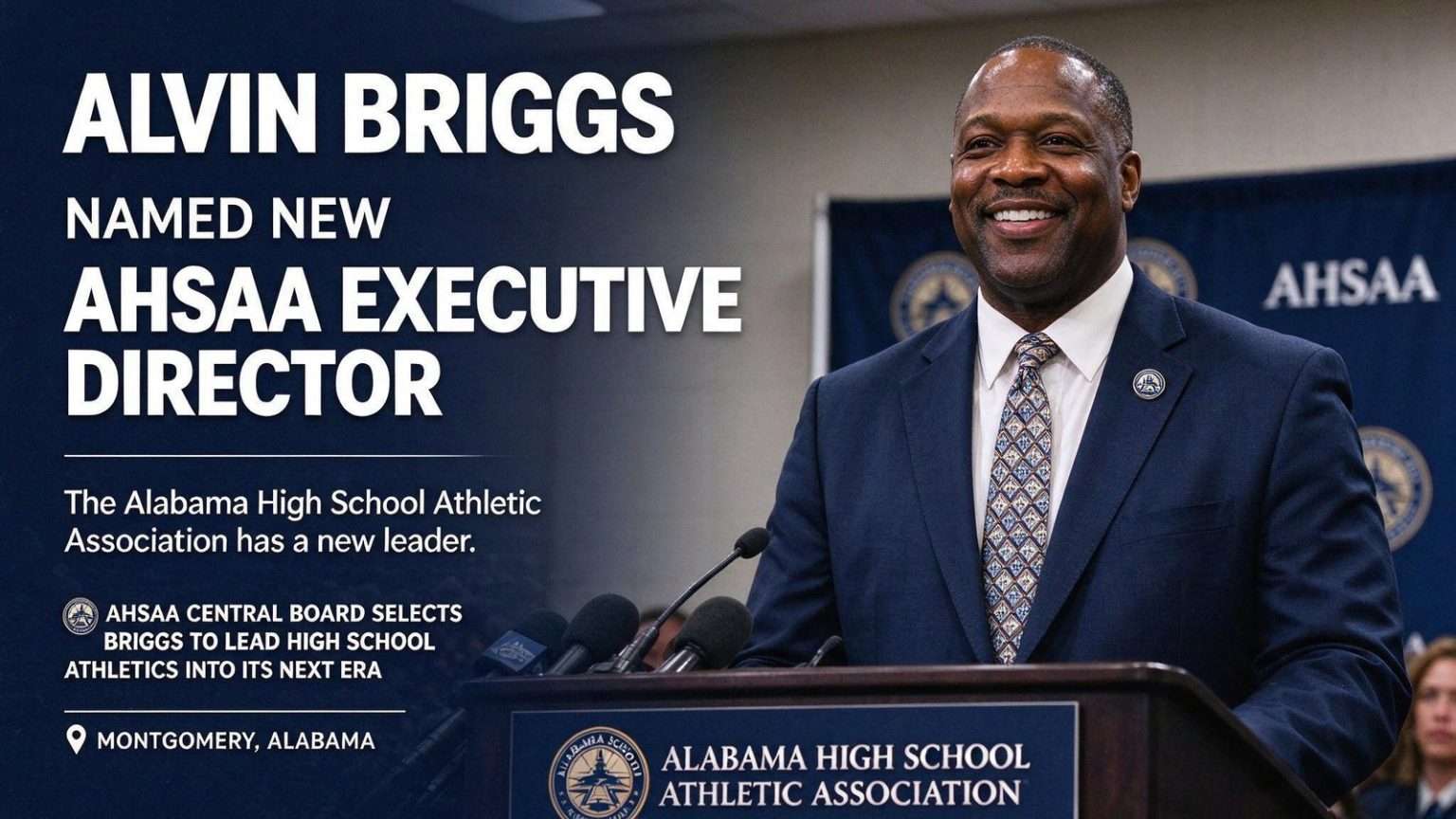
The Alabama High School Athletic Association has a new leader. Alvin Briggs, who has served as the organization’s associate executive director since 2018, was selected Monday by the AHSAA Central Board to replace outgoing executive director Steve Savarese. The decision was announced during a press conference in Montgomery, where association officials introduced Briggs as the choice to guide high school athletics in Alabama into its next era.
Briggs, who led the AHSAA’s Athletic Directors and Coaches Association from 2011 until taking the associate post, was chosen over two other finalists. His promotion from within the organization signals a commitment to continuity at the helm of an association that touches nearly every community in the state, from the largest city systems to the smallest county schools that field teams on Friday nights.
In remarks to the media, he credited Savarese as a mentor and father figure and pledged to keep the association focused on its core mission. For Briggs, the appointment represents the culmination of a career spent at nearly every level of football in Alabama — first as a player, then as a coach, and finally as an administrator shaping the rules and opportunities for the student-athletes who came after him.
A familiar face in Alabama high school sports
‘This association is to serve our member schools through sportsmanship, competition and enhanced student learning,’ Briggs said. ‘With integrity as its foundation, this association consistently governs the rules created by member schools.’
Those words reflect the unusual structure of the AHSAA, a private, nonprofit association whose member schools themselves create and approve the rules that govern interscholastic competition. The Central Board of Control, the body that selected Briggs on Monday, acts as the association’s governing board, overseeing policy, eligibility decisions and the enforcement of the regulations member schools adopt.
Briggs arrived at the association in 2011 to lead the Alabama High School Athletic Directors and Coaches Association work before moving up to associate executive director in 2018. In that role, he was deeply involved in the day-to-day administration of the organization, giving him firsthand knowledge of the issues that matter most to member schools — eligibility, classification, officiating, and the steady growth of championship events across every sport the AHSAA sanctions.
From Greenville to Auburn to the NFL
A four-year starter at Greenville High School, Briggs went on to a standout career as a defensive back at Auburn and was drafted by the Dallas Cowboys, though he spent just one season in the NFL. His path from a small-town high school in south-central Alabama to the professional ranks made him a natural ambassador for the thousands of student-athletes the association serves each year.
Greenville, the Butler County seat along the Interstate 65 corridor, has long taken pride in its football tradition, and Briggs remains one of its most recognizable athletic exports. His return to lead the AHSAA gives the association a leader who understands both the small-school experience and the spotlight of big-time competition.
At Auburn, Briggs played in the Southeastern Conference, the most demanding defensive proving ground in college football at the time. The skills that carried him there — discipline, preparation and competitiveness — would later define his coaching and administrative career as well.
A coaching career across north Alabama
After his playing days ended, Briggs turned to coaching. He later spent 10 seasons as an assistant coach at North Alabama in Florence, helping build the Lions’ program during a stretch when the university was establishing itself as one of the premier programs in Division II football.
From there, Briggs became head coach at his alma mater, Greenville High, for four seasons, returning to the school where his own career began. He then led Florence High for five seasons, giving him head-coaching experience at two very different Alabama high school programs — one in the Black Belt, one in the Shoals.
That blend of college, small-town and city-school coaching shaped the perspective Briggs brought to the AHSAA when he joined the organization in 2011. Colleagues note that administrators who have actually coached in Alabama high schools carry a credibility with athletic directors and coaches that is difficult to replicate, and Briggs spent a decade as one of the association’s most visible liaisons to those groups before his promotion.
The association and its century of service
The AHSAA occupies a unique place in Alabama public life. Unlike governing bodies in many states, it is not a state agency; it is a voluntary association of schools that has overseen interscholastic athletics since its founding more than a century ago. Its mission, as Briggs emphasized in his remarks, centers on sportsmanship, competition and enhanced student learning — the idea that athletics exist to serve the educational mission of member schools rather than to stand apart from it.
The association sanctions championship play across the full range of high school sports, from football and basketball to track, golf, tennis, soccer, volleyball, softball, baseball, cross country, swimming, wrestling, bowling and indoor track. Championship events draw crowds to venues across the state each year, and the Super 7 football championships and state basketball tournaments have become fixtures on Alabama’s sports calendar.
Eligibility and classification are among the association’s most consequential responsibilities. The AHSAA periodically reclassifies its member schools based on enrollment, grouping them into competitive classifications so that schools of similar size compete against one another for state titles. Those decisions shape schedules, travel and playoff paths for schools from the Gulf Coast to the Tennessee Valley, and they routinely generate intense interest from communities whose rivalries span generations.
For Briggs, leading that machinery is the job he prepared for through more than a decade of association work. As director of the Athletic Directors and Coaches Association, he organized the annual summer conferences and coaching schools that bring thousands of coaches to Montgomery each July for rules clinics, safety training and professional development — work that keeps Alabama coaches current on everything from concussion protocols to heat safety.
Savarese’s tenure and a smooth transition
Savarese, who has led the AHSAA since 2006, said he was pleased with the selection. His tenure spanned a period of enormous change in high school athletics: the expansion of championship sports, the growth of the state playoff format, evolving transfer and eligibility rules, and the increasing complexity of managing athletics in a media-saturated era.
The transition also carries symbolic weight. Briggs described Savarese as a mentor and father figure, language that speaks to the close-knit nature of the association’s Montgomery headquarters staff and the personal relationships that underpin its work. For member schools, continuity at the top means the policies and procedures they have built their programs around will not be upended midstream.
Observers of Alabama high school sports noted that promoting the associate executive director into the top job is a pattern the association has trusted before, and the Central Board’s choice of an insider over two external finalists suggests members wanted a leader already fluent in the association’s operations, its relationships with school systems, and the sensitivities of its role as the state’s athletic rule-maker.
The fifth in a line of leaders
Briggs becomes the fifth executive director in the organization’s history, following Cliff Harper, Bubba Scott, Dan Washburn and Savarese. The short list underscores how stable the association’s leadership has been — five executive directors over more than a century of operation — and how much institutional memory now passes to Briggs.
Washburn’s long tenure, which ended when Savarese took over in 2006, coincided with the modern expansion of AHSAA championships and the growth of football playoffs into the multi-round events that define Alabama’s fall weekends. Savarese built on that foundation, and Briggs inherits an organization with established traditions, a professional staff, and a membership that expects both firm governance and responsiveness to school needs.
What it means for schools across the state
For the principals, athletic directors and coaches who deal with the AHSAA day to day, the change at the top will be felt mainly in tone and priorities. Briggs made clear in his introductory remarks that he intends to keep the association’s focus where it has always been: on the member schools and the students they serve.
In communities across Alabama, high school athletics are more than entertainment. They are sources of civic identity, engines for college scholarships, and in many towns the largest regular gathering of residents outside of church. The person who governs the rules for those games holds real influence over the experience of hundreds of thousands of Alabamians each year.
Looking ahead
Briggs takes office at a moment when high school athletics everywhere are balancing tradition with change. Questions about athlete safety, officiating shortages, competitive balance and the growing demands placed on student-athletes all land on the executive director’s desk. His remarks suggested he sees those challenges through the same lens the association has always applied: the rules exist because the member schools create them, and the staff’s job is to administer them fairly and consistently.
The Monday announcement in Montgomery closed one chapter and opened another for an organization that has been part of Alabama life for generations. For Briggs, the son of a small-town program who played his way to Auburn and the NFL and then spent decades coaching and administering in the state, the job is also a homecoming of sorts — a chance to serve the schools that produced him.
‘With integrity as its foundation,’ he said of the association, promising that the principles passed down through leaders like Harper, Scott, Washburn and Savarese will continue to guide the way Alabama crowns its champions and, more importantly, the way it prepares its young people for life beyond the scoreboard.