America’s Amazon Documentary Screens at Saenger Theatre Dec. 3
Ben Raines' America's Amazon documentary on the Mobile-Tensaw Delta screens at the Saenger Theatre Dec. 3, then airs on APT.
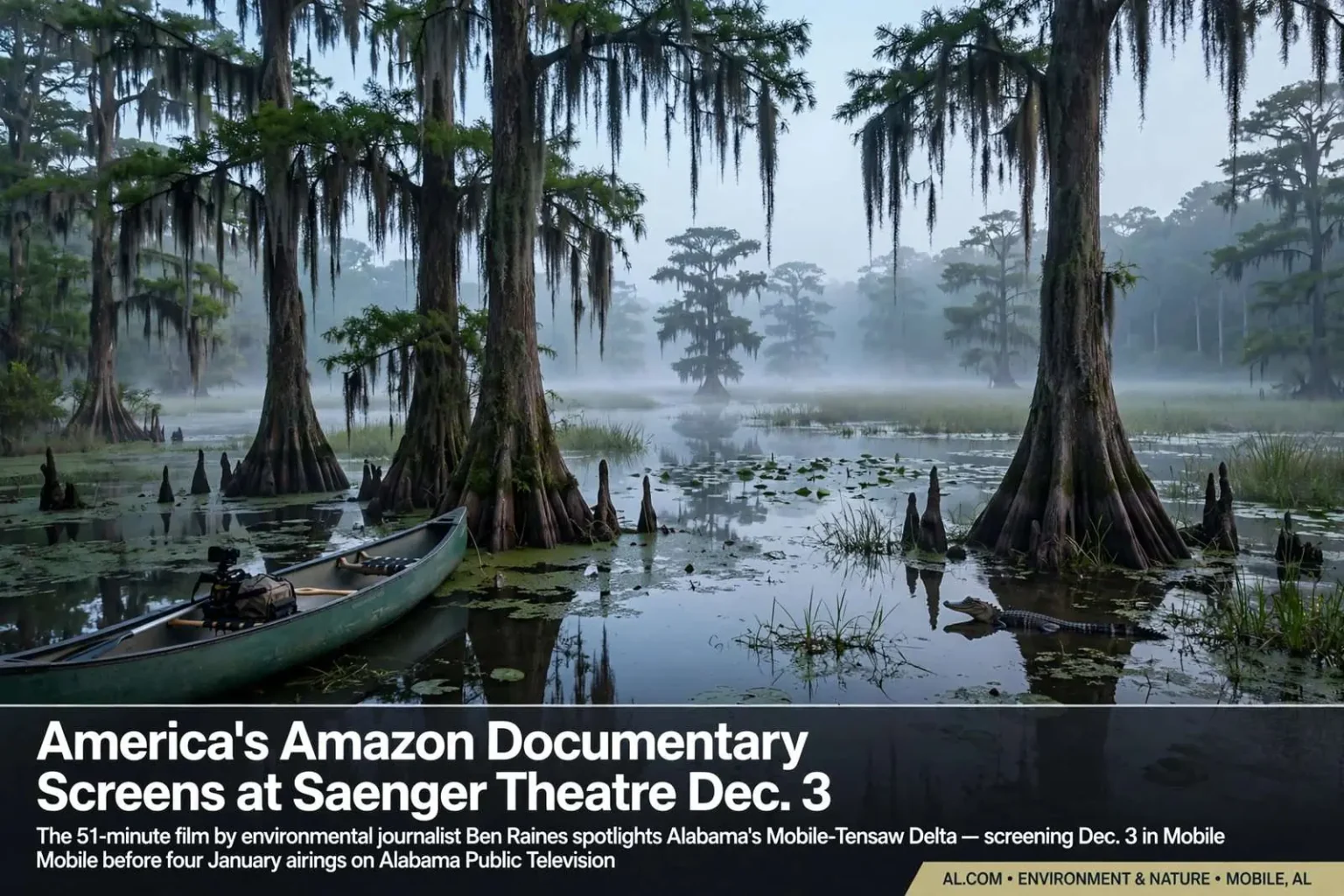
The new documentary “America’s Amazon” — a 51-minute portrait of the 300-square-mile Mobile-Tensaw Delta written and co-produced by veteran environmental journalist Ben Raines — screens at Mobile’s Saenger Theatre on Dec. 3, before airing four times on Alabama Public Television in January. For a state that rarely sees its wildest places on screen, the film’s arrival is an event: a full hour of television devoted to the swamp system that sits a half-hour’s drive from downtown Mobile and most Alabamians have never paddled.
The film drew positive notices at its public premiere at the Fairhope Film Festival on Nov. 8, and its subject is vast: a quarter-million acres of rivers, swamps and bayous stretching from the Causeway north past Grove Hill, covering some of the most biodiverse terrain in North America. The delta is where the Alabama and Tombigbee rivers meet and spread out before funnels through the Mobile Delta into Mobile Bay, a landscape of braided channels, cypress-tupelo swamps and bottomland hardwood forests that scientists have compared to wilderness far better known, from the Everglades to the Amazon.
Breathtaking footage, hard questions
Raines spent 13 years covering the environment for the Mobile Press-Register before becoming executive director of the Weeks Bay Foundation, and the film draws heavily on stories from that decade-plus of reporting. The imagery ranges from overhead shots of meandering creeks to fog-banked stream banks, alligators, manatees on their seasonal journeys from Florida, and recently hatched pelicans. The access reflects years of work: Raines has spent more time in the delta’s backwaters than almost any journalist in Alabama, and the film’s camera crews followed wildlife into corners of the swamp that few visitors ever reach.
There are rarities as well: an endangered Red Hills Salamander coaxed from its burrow by a biologist, and the Rusty Gravedigger, a crawfish species presumed extinct until Raines himself dug one from a bayou near a Daphne sewage treatment plant. The film also revisits his discovery of a 15,000-year-old underwater forest miles offshore in the Gulf, and a hollow cypress more than 27 feet in diameter spared by loggers only because it was worthless as timber. Baldwin County developer Pat Ogburn even guides a boat through the trees to a secluded “hidden lake.”
Each of those stories carries the same underlying point: the delta and the ecosystems connected to it hold species and habitats that exist nowhere else in the same concentration. The Red Hills Salamander, for instance, lives only in a narrow band of south Alabama forest, and its survival depends on habitat that continues to disappear. Finding a crawfish thought extinct in a Daphne bayou makes the same argument from the opposite direction — the delta is full of life so poorly surveyed that discoveries are still waiting minutes from subdivisions.
A delta under strain
At its midpoint, the documentary turns serious: more than a century of logging runoff, encircling development, upstream mercury and arsenic discharges, and dams that have severed migratory fish from historic spawning grounds. Native mussel species and much of the lower delta’s seagrass have been lost in our lifetime, and local ospreys appear two to three times less productive than their Florida Panhandle counterparts. The film’s argument is that decline this steep is not inevitable, but the result of choices and enforcement failures that can still be reversed.
“We have laws on the books that address these issues but they aren’t enforced in any meaningful way,” Raines said after a recent screening, noting that ADEM is underfunded by the state. The Alabama Department of Environmental Management, the agency charged with enforcing the state’s water and air quality rules, has long operated on one of the leanest budgets of any state environmental agency, a constraint that shows up in the number of inspections and the pace of enforcement actions across the delta’s vast watershed.
He sees hope in the hundreds of millions of dollars that could flow to the coast from BP oil spill criminal fines. The restoration money generated by the Deepwater Horizon disaster, distributed through federal settlements and state restoration councils, represented the largest conservation funding opportunity the Gulf Coast had ever seen, and Raines’ argument is that the delta deserves a prominent share. Projects funded through that process have ranged from land acquisition to habitat restoration, and advocates have pressed for a portion to address the delta’s specific problems, from fish passage to water quality.
Taking the film to the public
The Saenger Theatre screening places the documentary in one of Mobile’s landmark venues, a restored 1920s movie palace downtown that has hosted the city’s premier cultural events for generations. A delta film playing downtown carries a certain symbolism: the swamp begins practically at the city’s back door, at the Causeway where U.S. 98 crosses the delta’s southern end, and the film invites the city’s audience to know the landscape it drives over on the way to the beach.
The path to television runs through Alabama Public Television, the state’s public broadcasting network, whose four January airings put the documentary in front of viewers from the Tennessee Valley to the coast. Public television has long been the state’s most reliable venue for documentaries about Alabama’s natural history, and a broadcast run gives the film a second life beyond the festival circuit, reaching classrooms, living rooms and legislators who would never buy a ticket at a film festival.
The Fairhope premiere had already established the film’s appeal to Eastern Shore audiences. The Fairhope Film Festival draws cinephiles from across the Gulf Coast each November to theaters in one of Baldwin County’s most scenic towns, and a homegrown documentary about the delta, narrated by a reporter whose byline ran in the Press-Register for more than a decade, arrived with a built-in audience of readers who had followed Raines’ stories for years.
After the Mobile premiere, Raines hopes legislators will watch — and that the film becomes part of the state’s grade-school curriculum. “The delta is an incredible resource and the time is ripe to make some changes,” he said. “I think we have a world class piece of nature here and we need to do what’s required to protect and conserve it.”
Why the delta matters to Alabama
The Mobile-Tensaw Delta’s claim to significance rests on its biodiversity. The confluence of the Alabama, Tombigbee, Mobile, Tensaw, Blakeley, Apalachee and Spanish rivers — the system marketed along the Causeway as the “Five Rivers” delta — drains a watershed that covers most of Alabama and stretches into neighboring states, funneling that entire landscape’s water through the delta into Mobile Bay. What lives in the delta reflects everything that happens across that enormous upstream area, from Birmingham’s industrial history to the farms and forests of the Black Belt.
That is why the film’s harder sections matter beyond the swamp’s edge. Mercury found in delta fish comes from sources far upstream; arsenic discharges trace to industrial sites on the rivers; and the dams that block migratory fish sit hundreds of miles from the Gulf. A delta that has lost mussel species and seagrass within a generation is recording, in real time, the environmental debts of the whole watershed. Restoring it means addressing problems that cross the borders of every county in the river systems’ reach.
The delta’s defenders have long argued that its value is economic as well as ecological. Commercial and recreational fishing in Mobile Bay depends on the delta’s nursery waters, and the tourism draw of kayaking, airboats, hunting and wildlife photography along the Causeway and the upper delta supports guides and outfitters across Baldwin and Mobile counties. A landscape that supports that much activity, the argument runs, deserves the enforcement and investment its condition would demand anywhere else.
Raines’ long view
For Raines, the documentary is the culmination of a reporting career spent making the case that Alabama’s natural wonders are systematically undervalued. His stories about the underwater forest discovered miles off the Gulf shore, the surviving giant cypress and the rediscovered crawfish all made national news, and each one made the same point: Alabama contains world-class nature that the state has barely mapped, much less protected. “America’s Amazon” assembles those arguments in one place, with imagery that makes the case visually for audiences who will never read a newspaper series.
The Weeks Bay Foundation, where Raines serves as executive director, works on coastal conservation along Mobile Bay and the watersheds that feed it, giving the film’s advocacy a home base. Conservation groups in the region have spent decades acquiring delta land, restoring shorelines and monitoring water quality, and the film functions as both a celebration of that work and a challenge to the state to match it with enforcement.
Whether legislators watch, and whether the film reaches Alabama’s schoolchildren as its creator hopes, will shape its legacy. What is already clear is the film’s timing: with BP restoration money poised to fund the largest conservation investment in the Gulf’s history, and with the delta’s decline documented species by species, Alabama is deciding, in this decade, how much of its great swamp it intends to keep. “America’s Amazon” makes that decision visible, 51 minutes at a time, first at the Saenger Theatre and then across the state’s public television screens in January.