Archaeologists keep digging at Old Mobile, the original 1702 French settlement
Archaeologists from the University of South Alabama keep digging at Old Mobile, the original 1702 French settlement that predates the modern city by a.
As Alabama marks its bicentennial, archaeologists are quietly continuing work at a much older piece of Deep South history — the original French settlement of Mobile, founded in 1702 and abandoned nine years later. Long before Mobile became a port city and long before Alabama was a state, the first European capital of the Louisiana colony stood on a bluff above the Mobile River, and a team of University of South Alabama researchers has spent decades bringing it back into view.
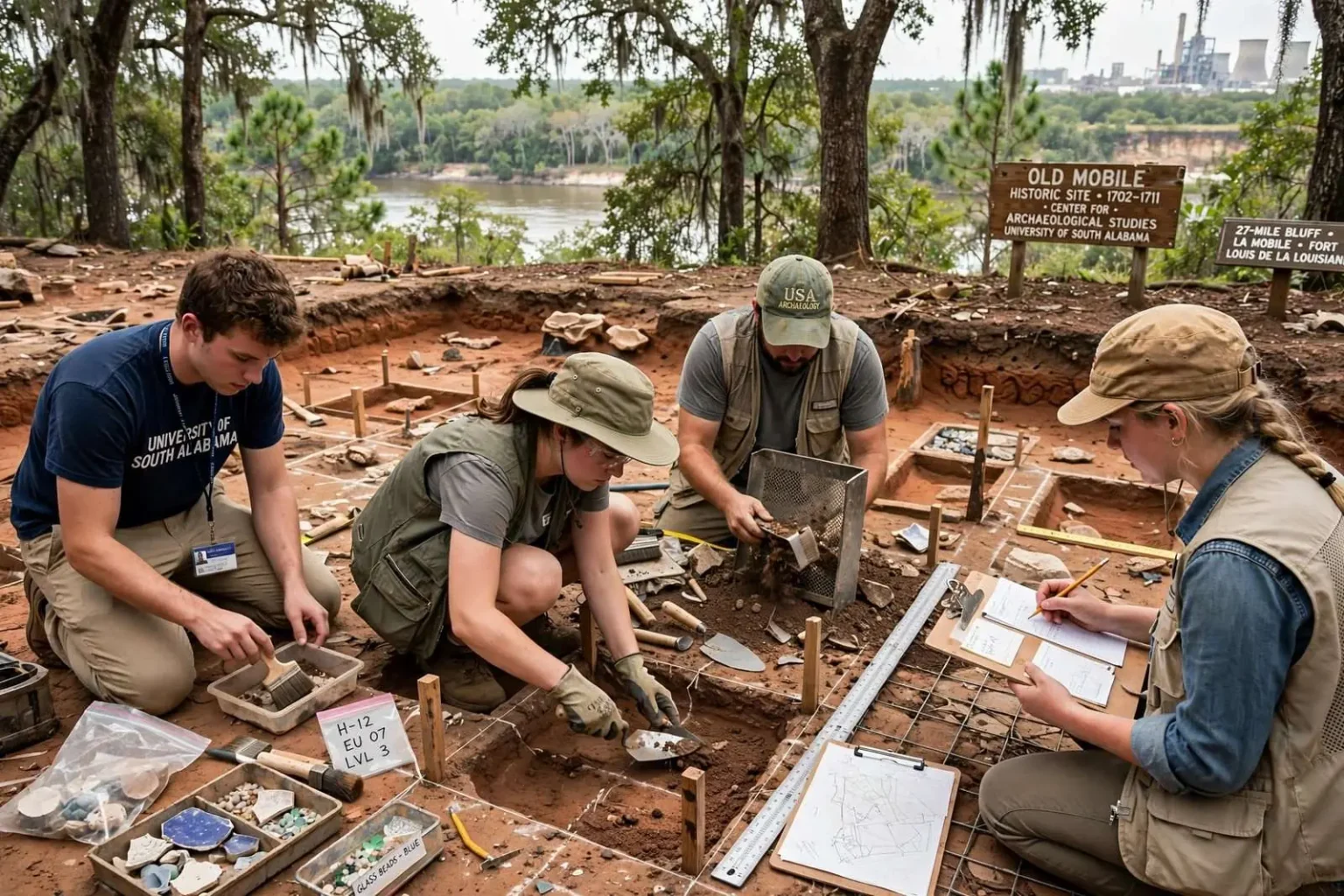
Students and volunteers from the University of South Alabama scrape away hard-packed dirt at house sites on the western bank of the Mobile River, part of the Old Mobile historic site overseen by the Center for Archaeological Studies. The excavation continues a project that has run for decades and turned a forgotten riverbank into one of the most important colonial-era archaeological sites in the American South.
Gregory Waselkov, the center’s director, leads the work at what was once known as La Mobile and protected by Fort Louis de La Louisiane. Under his direction, generations of students have learned field archaeology where France’s Gulf Coast colony began, uncovering the traces of a town that lasted less than a decade but shaped the region’s history permanently.
The site sits on property that is also home to a DuPont agricultural chemical plant, and access is limited. The industrial neighbor has, in an odd way, protected the archaeology, since the land was never plowed into subdivisions or paved over, leaving the colonial deposits intact beneath the surface. Occasionally a busload of visitors tours the site through Historic Blakeley State Park, one of the few ways the public can see the work up close.
The Founding of the French Colony
The colony was founded by Pierre Le Moyne d’Iberville and Jean-Baptiste Le Moyne de Bienville, the Canadian-born brothers who directed France’s early claims on the Gulf Coast. Bienville, who would go on to found New Orleans, established La Mobile as the seat of the young colony, a base for trade and diplomacy with the Native peoples of the region and a foothold in the contest among European powers for the mouth of the Mississippi.
The fort and town were built at 27-Mile Bluff, a spot that seemed safe but proved vulnerable to flooding. The choice reflected the strategic logic of the era — high ground near the river, defensible and positioned for contact with Native trading partners — but the low-lying Gulf landscape had its own ideas, and water repeatedly menaced the settlement.
The end came through a combination of catastrophe and calculation. In 1710 an English raider burned Port Dauphin, the colony’s outpost on Mobile Bay, and the following year a flood forced everyone into the trees. The decision was made to move downstream to present-day Mobile and burn the old fort, abandoning the bluff-top capital rather than rebuild it again.
That decision — and the deliberate burning that accompanied it — created the archaeological record researchers work with today. The town did not fade slowly or get built over; it ended abruptly, preserving a single frozen moment of colonial life.
What the Ground Has Given Up
Little of the fort survives — it was built shallowly of logs on thin topsoil, a quick construction suited to a frontier capital that its builders did not expect to occupy forever. Wooden posts rotted away centuries ago, leaving only the stains they left in the clay soil, which archaeologists map by color and texture.
But since the site was rediscovered and excavations began in 1989, USA researchers have identified at least 55 house sites spread over 80 acres. The pattern of those sites tells the story of a planned colonial town — streets, lots and structures arranged in the orderly fashion French colonial officials preferred, housing soldiers, colonists, traders and Native visitors who moved through the capital on diplomatic business.
The artifacts recovered from the house sites offer a portrait of daily life at the edge of the French empire: fragments of French and Spanish ceramics, trade goods, glass beads, gun parts, food remains and the humble objects of households three centuries gone. Each item helps archaeologists reconstruct what people ate, what they owned, what they traded and how French colonists and Native peoples interacted in the colony’s first capital.
“Because the town moved, we had this amazingly ideal situation where it’s all still here, essentially,” Waselkov said. The quote captures the site’s rarest quality — completeness — and explains why archaeologists have returned year after year despite the demanding conditions of the riverbank.
Why Old Mobile Survived
Unlike Mobile and New Orleans, where newer buildings were raised on top of the originals, Old Mobile was left undisturbed — making it a rare window into the earliest days of French colonial life in the region. The modern city of Mobile grew downstream, burying its own colonial past beneath three centuries of continuous development, while the first settlement slipped back into the woods.
Nature completed what abandonment began. Forest grew over the bluff, the river changed its edges, and by the twentieth century the location of the first Mobile was a matter of historical guesswork until archaeology confirmed it. The DuPont plant’s presence on the property kept development at bay, and the site passed into the controlled stewardship of researchers rather than the path of bulldozers.
The result is a colonial archaeological site of national significance sitting quietly on the Mobile River, studied carefully, visited rarely and preserved by the accident of having been forgotten.
For the University of South Alabama, the site has served as both a research treasure and a classroom. Field schools at Old Mobile have trained students in the fundamentals of excavation — careful layer-by-layer removal, mapping, cataloging — using one of the Southeast’s most significant colonial sites as the teaching ground.
The Bicentennial Perspective
The state’s bicentennial observance, marking two centuries since Alabama entered the Union, prompted reflection on the layers of history beneath that anniversary — and Old Mobile predates them all. Before statehood in 1819, before the American territorial period, before even the American Revolution, there was La Mobile on the bluff: a French town of several hundred colonists and soldiers, allied with Native nations, planting the seeds of the Gulf Coast’s European settlement.
Historians trace a direct line from that settlement to the region that exists today. The move downstream in 1711 established Mobile where it stands now; the trade relationships and alliances formed in the early colonial years shaped the politics of the Southeast for generations; and the colony’s archives — letters, manifests, maps — preserve the first written records of the places and peoples of the central Gulf Coast.
The archaeology fills in what the documents omit. Official records describe the decisions of governors and ministers; the ground at Old Mobile describes the meals, injuries, industries and daily negotiations of everyone else — soldiers’ wives, enslaved and free Native residents, traveling traders whose names never appeared in print.
Preserving a Fragile Resource
The site’s survival into the twenty-first century is a matter of careful management as much as luck. Access remains limited, coordinated through the Center for Archaeological Studies and occasionally through tours arranged by Historic Blakeley State Park, whose visitors reach the site by bus for guided looks at the ongoing work.
Researchers balance excavation with conservation. Only a fraction of the 55 identified house sites has been fully excavated, and modern practice favors leaving portions of a site untouched for future generations of archaeologists, whose techniques will be better than today’s. The ground itself preserves best when left alone, and each dig is planned with what remains buried firmly in mind.
The partnership with the property’s industrial owner has been essential to that stability. A working chemical plant and a colonial archaeological site make unusual neighbors, but the arrangement has kept the land intact — a compromise between the region’s economic present and its deepest past.
As Alabama celebrates two centuries of statehood, the work on the riverbank continues the way it has since 1989: slowly, season by season, in the humidity and the red clay. Each house site mapped and each artifact cataloged adds detail to the picture of the town that started it all — La Mobile, the first capital of French Louisiana, still here, essentially, exactly where its founders left it.
The Native Heart of the Story
The French colony at Old Mobile existed only within a web of Native relationships, and the archaeology reflects that reality throughout the site. Local tribes — the Tohome, the Mobile and other peoples of the region — were the colony’s trading partners, diplomats, neighbors and, at times, its residents, and their presence is visible in the artifact record alongside the French materials.
Trade goods moved in both directions. French cloth, beads, metal tools and weapons entered Native communities through the capital at 27-Mile Bluff, while deerskins, food and local knowledge sustained the small European settlement. The diplomatic ceremonies conducted at the fort — alliances sealed with gifts and speeches — set patterns the French would repeat across Louisiana for decades.
Archaeologists working the house sites pay close attention to the evidence of that exchange, since the ground holds a more honest record than the colonial documents, which recorded Native peoples largely through the eyes of French officials. Pottery made in Native traditions alongside French ceramics in the same deposits speaks to a community more intertwined than many histories acknowledge.
For modern tribal communities in Alabama and the surrounding states, the Old Mobile site represents part of their own heritage, and the university’s work has increasingly emphasized that the story of the first Mobile is a shared one — French and Native together, on a bluff above the river, nine years that shaped three centuries.
A Classroom on the Riverbank
The students and volunteers who scrape away the hard-packed dirt each season are learning a craft that has changed dramatically since excavations began in 1989. Modern field archaeology pairs trowels and screens with total stations, GPS mapping and careful digital record-keeping, and Old Mobile’s long history of annual work has produced an archive that spans those generations of technique.
The continuity matters scientifically. Because the site has been worked under a consistent institutional hand — the Center for Archaeological Studies, under Waselkov’s long tenure — findings accumulate coherently rather than as disconnected digs, and the 55 house sites and 80 acres of the settlement form a single, integrated research project.
That patient accumulation has made Old Mobile a reference point for French colonial archaeology across North America, cited by researchers studying sites from Canada to the Caribbean. The bluff above the Mobile River holds a place in that wider story, and Alabama’s bicentennial offered the state a moment to recognize the quiet, decades-long work that keeps it there.