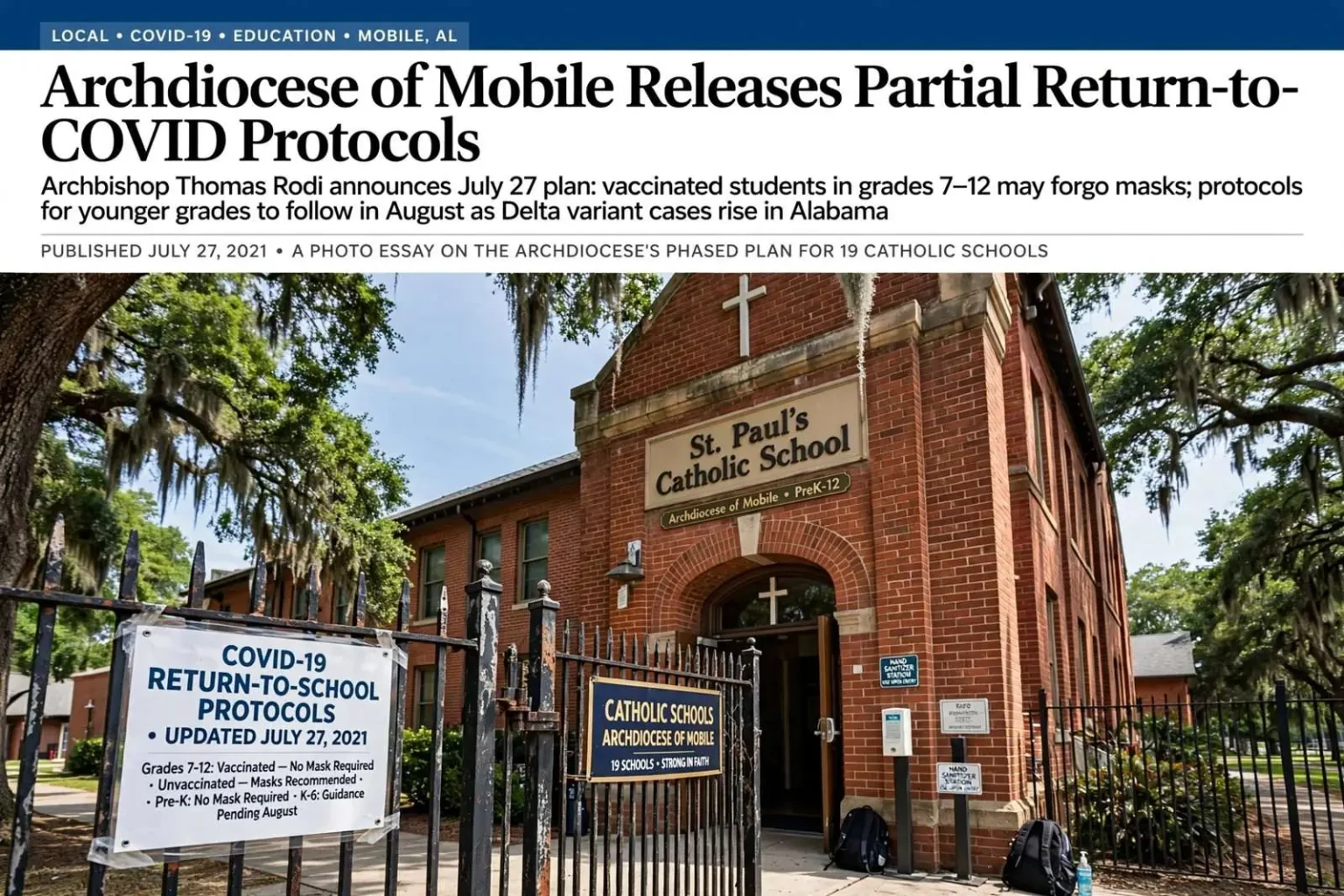
The Archdiocese of Mobile released part of its return-to-school protocols for the 2021-2022 academic year on July 27, outlining mask and vaccination guidelines for students across its Catholic school system as the delta variant pushed COVID-19 cases upward across Alabama. In a letter to parents, Archbishop Thomas Rodi announced that students in Grades 7 through 12 who are vaccinated will not be required to wear masks when school resumes in August. For unvaccinated students in those grades, masks are recommended but not mandated. Pre-school students are also not required to wear masks under the plan.
The announcement put the Archdiocese’s schools on a different footing from some public systems in the state, where mask debates were raging at school board meetings through the summer. By tying the mask requirement to vaccination status for older students, the archdiocese created a direct incentive for eligible students to get their shots — a vaccinated seventh through twelfth grader could expect a normal classroom experience, while an unvaccinated classmate faced a recommendation, but not an order, to cover up.
The guidance for older students followed the science as it stood in late July 2021. Vaccines had been authorized for children ages 12 and older by that point under the Pfizer-BioNTech emergency use authorization, meaning students in those grades could realistically arrive at school fully protected if they had started their doses in time. Students in kindergarten through sixth grade, however, had no vaccine available to them, a fact that shaped the decision to handle the younger grades separately.
The Archbishop said guidance for students in kindergarten through sixth grade would be released at the beginning of August, pending recommendations from the Alabama Department of Public Health. Students in those younger grades did not yet meet the age requirement to receive the COVID-19 vaccine at the time of the announcement. The delay acknowledged the awkward reality that the state’s guidance and the vaccine eligibility rules were both moving targets, and that a plan for unvaccinated children should wait on the public health officials whose recommendations the schools would be following all year.
Balancing In-Person Learning and the Delta Surge
The partial plan reflected the archdiocese’s effort to balance in-person learning with health precautions as the highly transmissible delta variant drove a surge in COVID-19 cases across Alabama during the summer of 2021. Delta changed the calculus that had governed the 2020-2021 school year. The variant was far more transmissible among younger people than the original strain, and by late July Alabama was experiencing one of the sharpest case increases in the country, with hospitalizations climbing across the Gulf Coast. School systems throughout the state were reopening in August into that deteriorating situation, and every system — public and private alike — had to decide how to balance a full return to classrooms against the protections the moment demanded.
For the archdiocese, the choice to allow vaccinated students to skip masks served multiple purposes at once. It rewarded families who had taken the vaccination step, it aligned the schools’ rules with the scientific reality that vaccinated individuals faced far lower risk of severe illness, and it sidestepped a certain amount of the political friction that had made masks the most contentious issue in American education that summer. A blanket mask mandate would have drawn criticism from parents opposed to mandates; no masks at all would have drawn criticism from parents worried about unvaccinated classmates. Tying the rule to vaccination status threaded between the two.
The recommendations-only approach for unvaccinated students was the more controversial half of the plan. Public health guidance from the CDC at the time urged universal masking in schools regardless of vaccination status, given delta’s transmissibility, and Alabama’s public health landscape in July 2021 was deteriorating fast. But the archdiocese operates independently of the state’s public school rules, and church officials evidently judged that a firm recommendation, combined with the vaccination incentive, struck the balance their school families would accept.
Parents receiving the letter also got a preview of how the year’s guidance would work procedurally: rather than a single comprehensive plan issued in July, the archdiocese planned a phased release, with older students’ rules set first and the elementary guidance following once the state health department weighed in. The approach treated the school year’s protocols as a living document, adjust-able as conditions changed — a stance shaped by eighteen months of pandemic planning in which guidance that seemed settled in June was repeatedly overtaken by events by August.
The System Behind the Plan
The Archdiocese of Mobile operates 19 Catholic schools across Mobile, Baldwin and surrounding counties, serving students from pre-kindergarten through 12th grade. The system includes elementary schools and high schools spread across south Alabama, from UMS-Wright Preparatory School and McGill-Toolen Catholic High School in Mobile to schools serving the Eastern Shore and beyond, and its enrollment draws families from across the religious spectrum in a region where Catholic education has deep roots going back more than a century and a half.
The scale of the operation is what made the announcement consequential. Mask and vaccine rules for 19 schools affect thousands of students and their families, hundreds of teachers and staff, and the parishes and parishes’ finances that support the system. Catholic schools in Mobile predate the public school system in parts of the archdiocese, and they hold a particular place in the city’s educational landscape — many Mobile families’ relationship with Catholic education spans generations, and the archdiocese’s decisions carry weight beyond its own enrollment, since surrounding districts often watch what neighbors do.
The August timeline for the elementary guidance also put a burden on families of younger children, who had to make back-to-school purchases and childcare arrangements without knowing what their children’s mask rules would be. Teachers in the younger grades, too, faced the practical question of how their classrooms would operate until the guidance arrived. But the archdiocese’s reasoning was that the elementary rules depended directly on the state’s recommendations, and that waiting for the Alabama Department of Public Health was more responsible than guessing.
The full return-to-school plan was expected to be finalized once state health officials issued their updated guidance for the coming school year. Until then, the archdiocese had given its oldest students — and their parents — the clearest picture of what August would look like, and held the rest of the system’s rules in reserve, ready to be adjusted as the delta surge and the state’s response continued to evolve. For a school system whose classrooms span pre-kindergarten through 12th grade, the summer’s partial release was an attempt to be as specific as the science allowed, and no more certain than the circumstances warranted.
The announcement also placed the archdiocese within a wider pattern among Alabama’s private schools that summer. Private systems across the state — Catholic, independent and evangelical — were writing their own pandemic rules, free from the state masking debates that dominated public school boards, but also without the centralized health infrastructure public districts relied on. Catholic school systems nationally leaned on guidance from their dioceses and state health departments, and the Mobile archdiocese’s decision to wait on the Alabama Department of Public Health for its youngest students followed that pattern: borrow the state’s expertise where it exists, and exercise local judgment where it does not.
The vaccination incentive embedded in the plan was its most distinctive feature. Families of middle and high school students who had been undecided about vaccinating their children now had a concrete, immediate reason to act before the school year began: a maskless classroom. Whether that incentive moved many families is hard to measure, but its design reflected the archdiocese’s reading of its community — a system where many parents were eager to put the disruptions of the previous year behind them, and where the fastest route back to normal was vaccinating every eligible member of the household.
It also reflected the moment’s particular uncertainty about children. In summer 2021, pediatric cases were rising in states with low vaccination rates, and Alabama’s vaccination rate lagged the national average by a wide margin. Pediatric hospitals in the state were beginning to report increases in young patients as delta spread, a development that shaped school decisions everywhere in the state. Against that backdrop, the archdiocese’s plan tried to thread a needle: reopen fully, in person, on schedule — the priority parents had made unmistakable after a year of remote and hybrid learning — while reserving the option to tighten rules once the state’s elementary guidance and the course of the delta wave were clearer.
The archdiocese’s letter also carried an implicit message about the year ahead: flexibility. Families in the 19 schools had lived through plans that changed with each surge, and the July 27 announcement set expectations that the 2021-2022 rules would likewise be adjusted as circumstances changed. The July release was, by design, a partial answer — the framework for the oldest students, a promise of details for the youngest, and a commitment to finalize everything when the state’s updated guidance arrived. For the parents of roughly the oldest half of the system’s students, the calculus was now concrete: a vaccinated student could expect an unmasked August; an unvaccinated one would be recommended, but not required, to mask. Everyone else would hear the rest of the plan within weeks.