Archdiocese to Close Historic St. Joseph Parish in Downtown Mobile
The Archdiocese of Mobile will close St. Joseph Catholic Church, a downtown parish dating to 1857, in January 2018, folding its members into the Cathedral-Basilica of the Immaculate Conception amid declining attendance and financial strain.
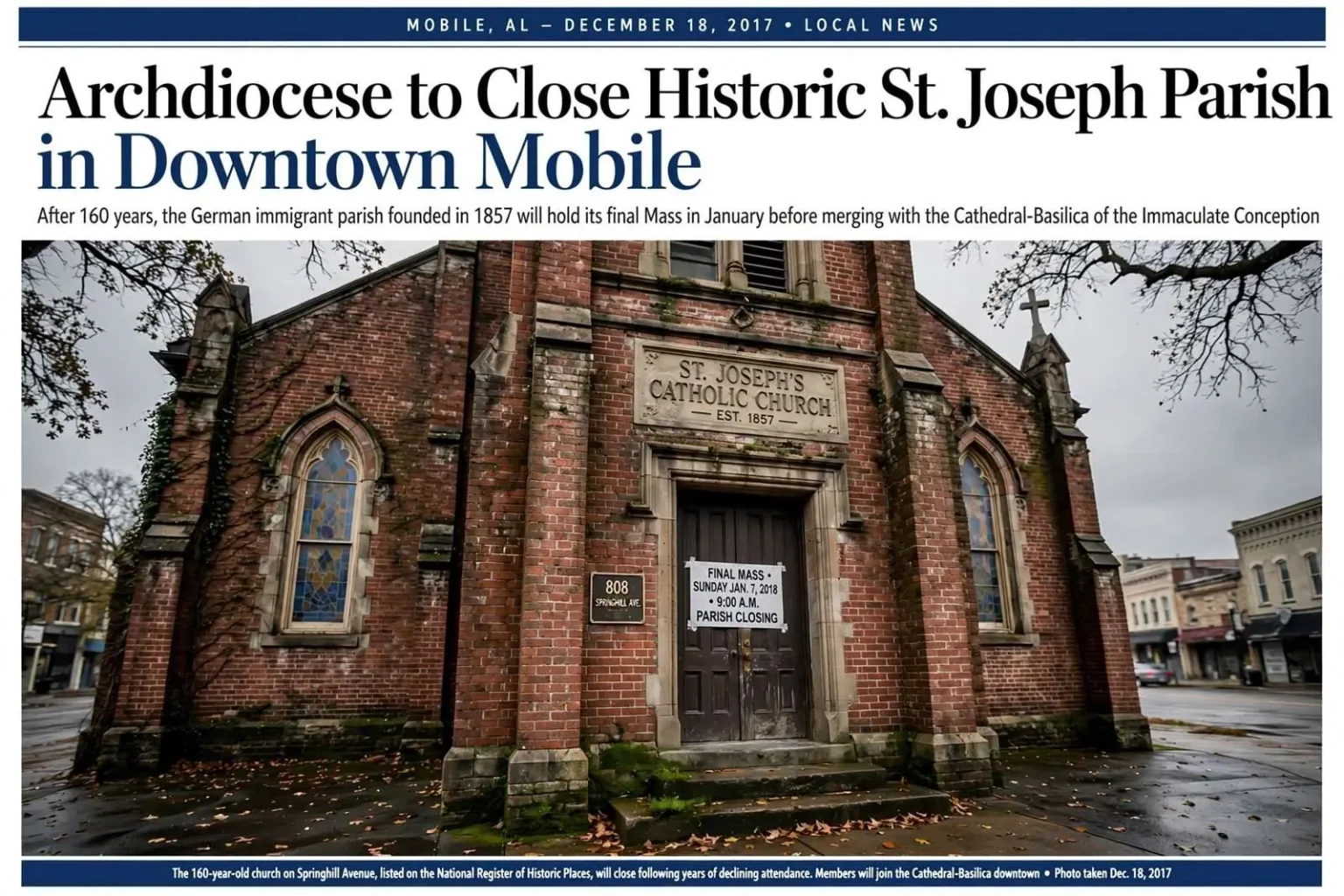
A downtown Mobile church with roots stretching back more than 160 years will close its doors for good in January 2018, the Archdiocese of Mobile has confirmed, ending regular worship at one of the city’s oldest Catholic parishes. The announcement closes a chapter in Mobile’s Catholic history that runs from the waves of German immigration that built the city’s nineteenth century neighborhoods to the demographic shifts that have hollowed out many of its older congregations.
St. Joseph Catholic Church, founded in 1857 to serve the city’s growing community of German immigrants, will be formally dissolved as a parish next year, with its members folded into the Cathedral-Basilica of the Immaculate Conception downtown. The merger means the survivors of a parish that predates the Civil War will worship in the mother church of the Archdiocese of Mobile, one of the oldest Catholic dioceses in the United States and the seat of the church in Alabama. Parish dissolutions of this kind follow a formal process under church law, in which a congregation’s members, records and assets are formally absorbed into a neighboring parish.
The Rev. Michael Farmer, who has served as pastor of St. Joseph since the Cathedral parish absorbed it from the Jesuit order in 2009, said the decision came after years of declining participation and a shrinking financial base. Farmer, who continues to lead the Cathedral parish, described the arithmetic that ultimately made the closure inevitable: a congregation too small to generate the activity that defines parish life, supporting a building too old and too large for the resources available.
A Single Mass and a Shrinking Congregation
The church, located at 808 Springhill Avenue and listed on the National Register of Historic Places, currently offers a single Sunday Mass at 9 a.m. That schedule is a marked contraction for a parish that once anchored a full liturgical calendar for a thriving immigrant community. Springhill Avenue was one of the main corridors of German Catholic settlement in Mobile, and St. Joseph grew up alongside the working families who built homes and businesses around it.
Farmer said attendance has hovered around 85 people for years, without the kind of broader parish activity — religious education, social gatherings, regular ministries — that typically sustains a congregation. In modern Catholic practice, a parish is expected to function as more than a Sunday worship site: catechism classes for children, outreach ministries, altar societies, and social organizations knit members together and draw new families in. Without those structures, a congregation tends to age in place and shrink.
“We came to the realization that what constitutes parish life was not there,” Farmer said. “No other activities were taking place.”
Money was also a factor. Farmer said collections at St. Joseph have been sufficient to cover little more than utility costs at the roughly 110-year-old building. Larger expenses, including insurance, have been paid out of an endowment established by the Jesuit priests who ran the parish before 2009. The Jesuits, the religious order formally known as the Society of Jesus, staffed St. Joseph for generations, and their decision more than a decade ago to withdraw from the parish marked the first step in the wind-down now reaching its conclusion.
The funding structure left the parish dependent on a finite inheritance rather than a living community of givers. Endowments can sustain a building’s routine costs for a time, but major maintenance on a century-old structure — roofing, mechanical systems, masonry — can run into sums that no small congregation could raise, and no prudent diocese commits to indefinitely.
The Building Will Stand — For Now
Despite worry among longtime members that the historic structure could be demolished, Farmer said that is not the plan. He said the Archdiocese has no immediate use in mind for the building once the parish closes, though officials would eventually like to sell it. That ambiguity — no demolition, but no defined future either — has done little to reassure parishioners who have watched other historic church properties in cities across the country end up sold, converted, or cleared.
Sacred items inside the church — altars, statuary and other fixtures — will be removed and are expected to be given to St. Ignatius parish, another former Jesuit congregation in Mobile that is planning a new church building. A fundraising campaign for that project is expected to begin soon.
“They’ll integrate the pieces into a new church with a traditional look,” Farmer said. “It will be a positive option in a very sad situation.”
The transfer of sacred art and furnishing is a solemn and carefully documented process in Catholic practice. Altars, which in Catholic theology hold a central place in a church, are treated with particular care, and historic statuary that a parish collected over generations is often dispersed to congregations that can continue to use it. For St. Joseph’s members, the image of their sanctuary’s fixtures reborn inside a new church a few miles west is a small consolation within a larger loss.
Parishioners Caught Off Guard
The announcement has left longtime parishioners like Patricia Fellis searching for answers. Fellis, whose family ties to St. Joseph go back generations, said she was married in the church and raised there, and has no idea yet where she will attend Mass once it closes.
“I’m obviously going to find somewhere else to go,” Fellis said. “I’m not going to give up the faith.”
For families whose identity is bound to a single church building — baptisms, first communions, weddings and funerals all in the same sanctuary — a dissolution is experienced as a personal rupture rather than an administrative reorganization. The Cathedral-Basilica will absorb the former members, but its downtown location and much larger scale will be unfamiliar ground for people accustomed to a small, intimate congregation.
Fellis said the closure caught many in the small congregation off guard, even though speculation about the parish’s future had circulated for years.
“It took us by surprise,” she said. “We had heard the rumors for years, but it sounded ludicrous. We’re trying to find out more information.”
She acknowledged the parish is small and skews older but argued attendance had been slowly recovering. Fellis attributes years of decline to the earlier closure of the parish’s school, which was later replaced by the Wings of Life program, along with what she described as an unpopular former pastor. The loss of a parish school is a recurring theme in congregation collapses across the country: schools anchor young families to a parish and give it a mission, and when a school closes, the families that depended on it frequently scatter to other parishes that still have one.
She had warmer words for Farmer himself.
“We’re thankful we have him,” she said.
Fellis said a handful of young families had recently begun attending and were welcomed warmly, but ultimately drifted away. Farmer said that is not unusual for a parish without a school, since families with children often look for a congregation that offers religious education alongside worship. The pattern creates a circular problem for an aging parish: without young families there is no energy or revenue, and without the infrastructure young families expect, they do not stay.
“We don’t have a school,” Fellis said. “Are we going to be punished and torn apart because we don’t have a school?”
Fellis also pushed back on the idea that St. Joseph is in financial distress, noting the parish’s endowment remains intact even after covering building expenses.
“However, it’s not going to run out,” she said.
Her argument gets at the tension at the heart of many diocesan consolidation decisions. From the parish’s side, an endowment that covers the bills looks like solvency. From the archdiocese’s side, a congregation of 85 with no programming and no growth trajectory is not a parish in any operational sense — it is a building with a Mass schedule, sustained by an inheritance that exists to serve a community that has largely moved on. Bishops who must plan for entire dioceses typically weigh vitality, not just solvency, when deciding which congregations to keep going.
A Congregation Prepares to Scatter
With the closure now set for January, Fellis said she is trying to gather more details for fellow parishioners before the congregation disperses.
“I’m trying to call people and find out so we can at least get some answers before we’re torn apart,” she said. “The church is way too beautiful to disappear. It’s just too beautiful.”
The weeks between the announcement and the final Mass will mark the last chapter in a 160-year history. When St. Joseph was founded in 1857, Mobile was a booming port city whose cotton trade drew immigrants from across Europe, and German Catholics established their own congregation because they wanted preaching, education and community in their native language. The parish they built survived the Civil War, the yellow fever epidemics of the late nineteenth century, two world wars, and the long suburban migration that emptied so many downtown congregations after mid-century.
Its National Register of Historic Places listing recognizes what generations of Mobilians have seen in the building: a landmark that tells the story of the city’s immigrant past as plainly as any museum could. The families who remain say they will carry the parish with them, even if the building’s future now belongs to the archdiocese and whatever buyer eventually acquires it.
For the Archdiocese of Mobile, the dissolution is part of a broader reckoning facing Catholic dioceses across the Gulf South. Congregations founded in the nineteenth century to serve ethnic communities that have long since assimilated and dispersed now face the arithmetic of declining Mass attendance, aging facilities and rising maintenance costs. The mergers and closures that result are rarely contested on the finances — nearly everyone concedes the numbers — but they are almost always contested on the meaning.
St. Joseph’s last months will follow the pattern seen at dissolving parishes everywhere: a final Christmas season in a familiar sanctuary, longtime members photographing stained glass and statuary, and conversations about where to worship next. The altars and figures that filled the church will move on to St. Ignatius’s new building; the parish register will move to the Cathedral; and at 808 Springhill Avenue, the doors of a church that has stood for more than a century will simply close, with no one yet able to say what comes next.