Arrest Made in Dauphin Island Parkway Homicide That Killed Michael Cannon
Mobile police charged Cyrus King, 35, with murder in the shooting death of 50-year-old Michael Cannon on Dauphin Island Parkway.
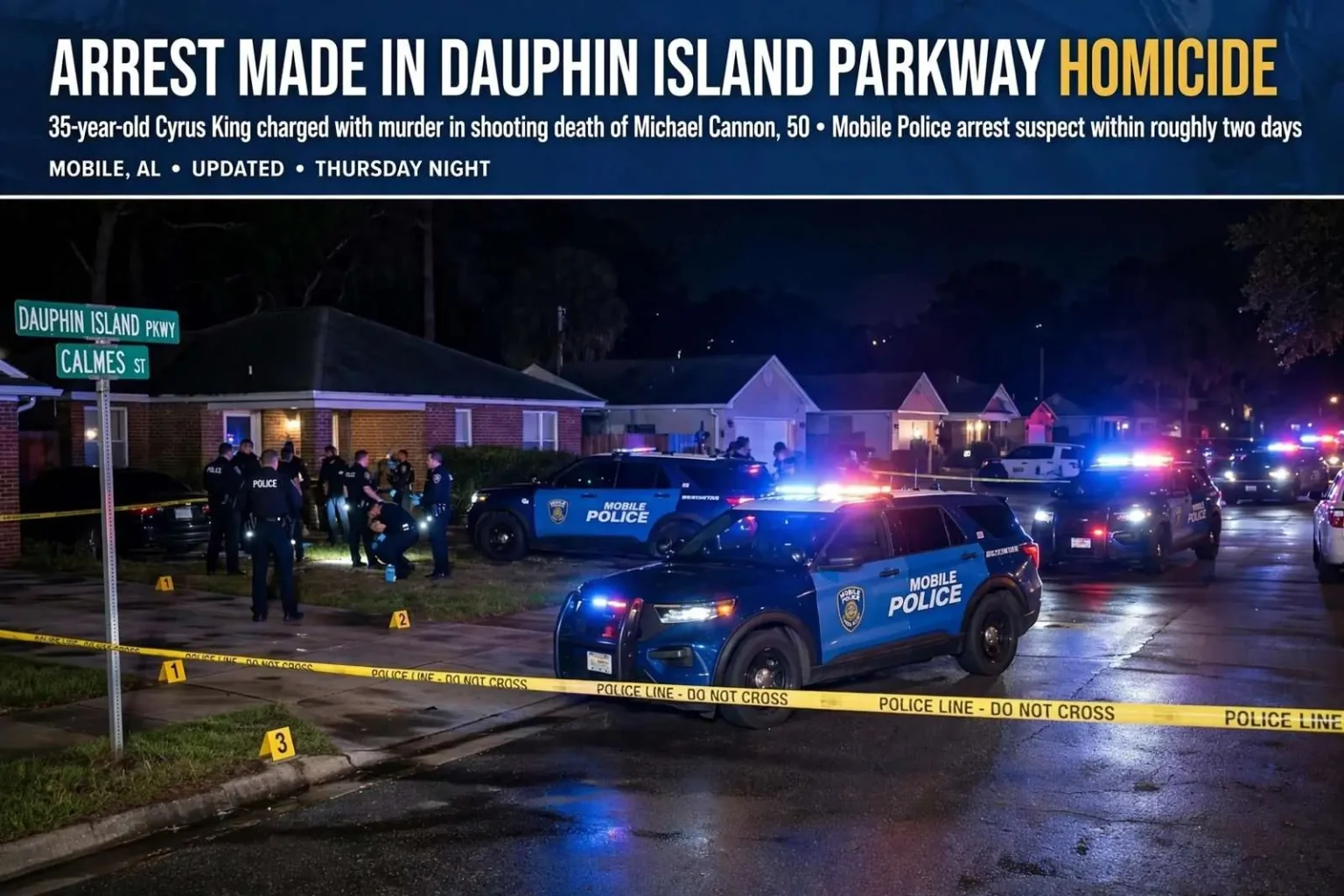
Mobile police have charged 35-year-old Cyrus King with murder in the shooting death of 50-year-old Michael Cannon, moving from a report of a single shot on Dauphin Island Parkway to an arrest in custody within roughly two days. The homicide unfolded in the 500 block of Dauphin Island Parkway near Calmes Street, a residential stretch of the long corridor that runs south from the city’s industrial riverfront toward Dauphin Island. Cannon was found suffering from apparent gunshot wounds in the driveway of a home and was pronounced dead at the scene.
Officers were called to the location around 9 p.m. on a Thursday after a report of a single shot. First-arriving units located Cannon in the driveway of the home, where evidence markers dotted the pavement as investigators began documenting shell casings and other physical evidence left behind in the overnight hours. Emergency medical crews responded alongside patrol officers, but the injuries proved fatal, and Cannon was pronounced dead where he fell.
The initial response followed the pattern of any Mobile homicide investigation. Patrol officers secured a perimeter around the block, keeping residents and passersby away from the driveway and the street in front of the home while detectives were summoned to take over. The scene was held through the night as investigators photographed the area, collected evidence, and began canvassing nearby homes for witnesses and security-camera footage that might show who was present when the shot was fired.
How the case unfolded
Within two days of the shooting, investigators had identified both the victim and the shooter, and King was in custody facing a murder charge. The speed of the identification reflected the combination of evidence gathered at the scene, interviews conducted in the hours and days after the killing, and information that reached investigators as word of the death spread through the neighborhood and through local news coverage of the case.
Police did not detail publicly what led them to King, and the affidavits supporting a charge like this typically become part of the court record as the case moves forward. What the department made clear is that the identification of a suspect in roughly 48 hours represented the product of detectives working the case continuously, and that assistance from residents who came forward played a part in moving the investigation along.
Under Alabama law, murder is a Class A felony, the most serious classification short of capital murder, and a conviction carries a punishment range that runs from a decade in prison to life. Prosecutors with the Mobile County District Attorney’s Office review the evidence detectives assemble before presenting the case to a grand jury, which decides whether an indictment will move the charge toward trial in Mobile County Circuit Court.
The scene on the parkway
The 500 block of Dauphin Island Parkway sits near Calmes Street in a part of the city where residential streets branch off the main thoroughfare, and where the parkway itself carries steady traffic between downtown and the communities to the south. A shooting on the corridor draws attention quickly because the road is a daily route for thousands of commuters, school buses, and freight heading toward the island communities and the port infrastructure at the mouth of Mobile Bay.
Residents of the blocks around Calmes Street woke the next morning to a street that remained partly closed and a driveway still marked with evidence. Homicide scenes in residential neighborhoods are processed methodically, and it is common for investigators to remain on site for many hours after the initial response, returning in daylight to photograph conditions that were not visible at night and to speak with neighbors who were asleep when the first units arrived.
The Medical Examiner’s Office takes custody of the deceased in every Mobile homicide, and an autopsy is performed to confirm the cause and manner of death. Those findings, along with the physical evidence and witness statements, form the core of the file that detectives forward to prosecutors. In this case, the department said Cannon was pronounced dead at the scene, sparing his family the uncertainty of a hospital vigil.
Tips still welcome
Police thanked the public for its assistance in the case and asked anyone with additional information about the shooting to call the Mobile Police Department at 251-208-7211. Even after an arrest, investigators continue to accept information, because details that surface later can strengthen the prosecution’s case, rule out alternative theories, or connect the incident to other unsolved work.
Residents who prefer not to give their names can pass tips anonymously through CrimeStoppers of Mobile, which takes information on felony crimes across the area and forwards it to the appropriate investigative unit without revealing the caller’s identity. Anonymous tips have long been a staple of homicide investigations in the city, particularly in neighborhoods where witnesses may be reluctant to speak openly with officers.
For the family of the victim, the arrest marks the beginning of a different kind of wait. Criminal cases in Alabama can take many months to move from arrest to resolution, with grand jury review, arraignment, motion practice, and potential trial proceedings all ahead. Victim services coordinators work with surviving family members through that process, keeping them informed of court dates and of the decisions that prosecutors make along the way.
What the charge means
A murder charge in Alabama does not require proof of premeditation in the way popular accounts often suggest. The statute covers conduct in which a person intentionally causes the death of another, among other circumstances, and prosecutors weigh the evidence gathered at the scene, statements from witnesses, and forensic results when deciding how to proceed. If the grand jury returns an indictment, the defendant is arraigned in circuit court and the case is assigned to a trial judge.
Defendants facing Class A felony charges are typically held without an easy path to release while the case pends, and initial court appearances happen quickly after an arrest. The early weeks of such a case involve defense attorneys reviewing the state’s evidence through the discovery process, and it is not unusual for months to pass before any substantive hearings are held.
For the neighborhood where the shooting occurred, the arrest offers a measure of reassurance that the person police believe responsible is no longer at large. Detectives, for their part, emphasize that the case file remains open in a practical sense until the prosecution is complete, and that they welcome any further information from the public about the events of that Thursday night on the parkway.
Gun violence and the community response
Every homicide in Mobile leaves a footprint beyond the immediate family. Schools near a scene may adjust morning routines, churches and neighborhood associations often organize vigils, and community groups that work on violence prevention add the incident to the tally that shapes their outreach. On the Dauphin Island Parkway corridor, as in other parts of the city, residents have repeatedly been asked to treat tips as a civic responsibility, since investigations move only as fast as the information available to detectives.
The Mobile Police Department’s investigative approach to cases like this one is built around rapid response in the first 72 hours, when witnesses’ memories are freshest and surveillance footage has not yet been overwritten. The two-day identification of a suspect in this case fits within that window, and commanders regularly point to the cooperation between patrol officers who secure a scene and the detectives who carry the case forward as the decisive factor in early arrests.
Anyone with information about the shooting death of Michael Cannon can still reach the Mobile Police Department at 251-208-7211. Callers who wish to remain anonymous can contact CrimeStoppers, and information provided after an arrest remains valuable to prosecutors as the case moves through the Mobile County court system.
Remembering the victim
Michael Cannon was 50 years old, an age at which most Mobile families are counting grandchildren and planning retirements rather than funeral services. Homicide victims in the city are remembered by neighbors and relatives in the days after a death, and it is common for those who knew the person to gather near the scene, leave flowers or balloons at the edge of the property, and share memories with the reporters who come to the block seeking a fuller picture of who was lost.
For residents of the 500 block, the loss is also personal in a practical way. A death in a driveway that people pass every day changes how a street feels, and community leaders in neighborhoods along the parkway have long argued that the fastest route back to normalcy is a complete investigation followed by an open and timely prosecution.
The department’s decision to publicly thank the community for its assistance underscores how much these cases depend on ordinary residents. Detectives can collect shell casings, pull camera footage, and run records checks, but the detail that breaks a case open is frequently a phone call from someone who saw a vehicle, heard an argument, or recognized a face in a photograph. In this investigation, that cooperation helped produce an identification within two days.
What happens next in the case
With King in custody and charged, the case now moves to the courts. The next milestones are typically a formal appearance before a judge, the assignment of defense counsel, and presentation of the evidence to a Mobile County grand jury. If the grand jury indicts, the case is set for further proceedings in Mobile County Circuit Court, where both sides will continue to develop their positions through discovery and pretrial motions.
Prosecutors do not comment in detail on open cases, and defense attorneys have not yet filed public responses describing their client’s position. The public record in the case will grow slowly, with the most meaningful developments coming at hearings rather than in daily statements, which is typical for felony prosecutions in Alabama.
Residents of the area around Calmes Street and the rest of the Dauphin Island Parkway corridor who remember anything about the Thursday night in question are still encouraged to call 251-208-7211. The investigation formally continues, and detectives reviewing the file can follow up on any new detail, no matter how small it may seem to the person providing it.