
Arrest Made in Double Homicide on Dr. MLK Jr. Avenue That Killed Camdon Jackson and Van Kennedy
Mobile police arrested James Wilson IV in the MLK Jr. Avenue double homicide that killed Camdon Jackson and Van Kennedy.
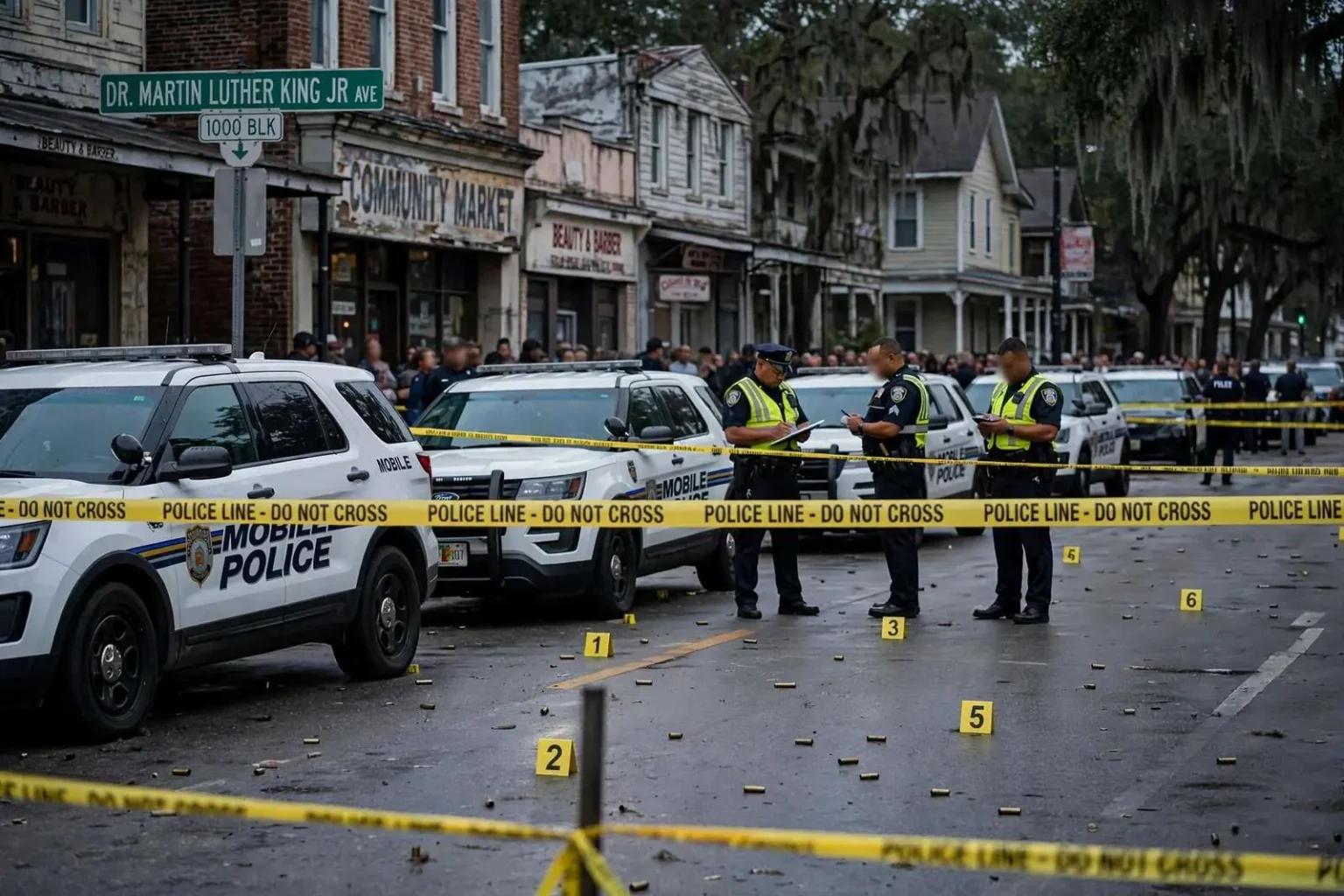
MOBILE, Ala. — Mobile police have arrested a suspect in the double homicide on Dr. Martin Luther King Jr. Avenue that left two men dead earlier this month, closing in on the case behind one of the city’s most intense bursts of gunfire this year.
The violence unfolded on a Wednesday along the avenue in the heart of Mobile’s Africatown-adjacent northside, where investigators later documented more than two dozen bullet casings scattered across the pavement. Two men — identified by police as 25-year-old Camdon Jackson and 26-year-old Van Kennedy — were killed in the exchange.
At least two cars were involved in the exchange of gunfire, and police said a third vehicle may have been as well. The scene, with dozens of casings and multiple vehicles in motion, told investigators they were dealing with a rolling shootout rather than a single ambush.
The scene on the avenue
Dozens of residents crowded the scene as officers investigated, drawn out of their homes by the sound of sustained gunfire on a weekday evening. Dr. Martin Luther King Jr. Avenue is the main commercial spine of Mobile’s northside, lined with churches, businesses and row after row of historic homes, and violence of this scale on the avenue lands hard on the people who live along it.
Homicide detectives spent hours processing the pavement — marking casings, photographing vehicles and canvassing for cameras — while patrol units held the perimeter. The density of shell casings suggested the exchange involved multiple shooters firing multiple rounds, though police did not say how many weapons were involved or who fired from which vehicle.
Police appealed for witness video and tips from anyone who saw the gunfire, asking residents and business owners along the avenue to check doorbell and security cameras for footage of the moments before and after the shooting. In cases with multiple vehicles and moving shooters, video evidence is often the difference between a hypothesis and a case prosecutors can take to a jury.
The arrest
Days later, detectives located and arrested 38-year-old James Wilson IV, charging him with two counts of murder and two counts of shooting into an occupied vehicle. The charges track the two men killed and the vehicles involved in the exchange, and they represent the first formal accounting of criminal responsibility for the Wednesday shootout.
Shooting into an occupied vehicle is a distinct felony under Alabama law, aimed precisely at the kind of mobile gunfire that marked this case — shots fired at or into cars carrying people, regardless of whether the bullets find their targets. Combined with two murder counts, the charges expose Wilson to decades in prison if convicted.
Detectives have not said how they identified Wilson or whether additional arrests are expected. With at least two vehicles confirmed involved and possibly three, the investigation continues into whether others who fired or were present will face charges as well.
The first court appearance
At Wilson’s initial court appearance, a judge held off on ruling on bond because the defendant did not yet have a lawyer. Bond decisions in homicide cases are consequential — setting bail too low raises public safety concerns, while judges generally want defense counsel heard before locking in terms on a capital-range charge.
A status hearing was set for January 14, when bond was to be addressed. By that date, Wilson is expected to have counsel on record, either privately retained or appointed, and the court will take up the conditions, if any, under which he could be released while awaiting trial.
The initial appearance is the first step in a process that will move through Mobile County’s district and circuit courts. The District Attorney’s Office will present the case to a grand jury for indictment, and the defense will receive discovery — including the casings analysis, any video recovered from the avenue and witness statements gathered in the days after the shooting.
The avenue and its context
Dr. Martin Luther King Jr. Avenue carries the name of the civil rights leader through a section of Mobile with deep historical roots. The avenue runs through the community near Africatown, the historic settlement founded by the descendants of the Clotilda, the last known slave ship to bring captive Africans to the United States, and its neighborhoods have been the focus of renewed preservation and redevelopment attention in recent years.
Like main streets in many American cities, the avenue has contended with gun violence that flares in bursts, and each incident renews the community’s calls for intervention. Residents who came out of their homes after the Wednesday shooting did so in a neighborhood where people know one another, and where dozens of witnesses to gunfire creates both an opportunity for investigators and a burden on the people who must carry it.
Mobile police have consistently emphasized the importance of witness cooperation in shooting cases, and the department’s homicide clearance efforts depend heavily on video and tips. The two dozen casings documented on the avenue will be matched against weapons if any are recovered, and ballistics results will become part of the case file that the grand jury reviews.
The charges under Alabama law
Murder in Alabama is a Class A felony carrying a sentence of twenty years to life, and two counts arising from the same incident are prosecuted as separate crimes with separate potential sentences. Judges structure those sentences concurrently or consecutively depending on the circumstances, and prosecutors weigh the strength of the evidence on each count when negotiating or trying a case.
Shooting into an occupied vehicle, codified in Alabama’s criminal code, carries its own prison exposure and exists because of exactly the dynamics seen on the avenue: when shots are fired into cars, the people inside are trapped targets, and the law treats the act itself as a serious felony even when no one in the vehicle is struck. Two counts of that charge, paired with two murder counts, reflect the multi-vehicle nature of the Wednesday exchange.
The grand jury process will come next. A Mobile County grand jury hears the evidence and votes on an indictment, and only then does the case proceed to arraignment in circuit court. Homicide cases in the county routinely take a year or more from arrest to trial, with the bulk of that time consumed by discovery, lab work and motion practice.
The work of identifying a shooter
The path from two dozen casings to an arrest in days required detectives to move quickly on several fronts at once. Investigators matched vehicles to owners through witness descriptions and camera footage, pulled video from businesses and homes along the avenue, and interviewed the dozens of people who gathered at the scene. Tips called into the department and its tip lines feed the same investigation.
Ballistics adds another layer. Each casing recovered from the pavement can be test-fired against a weapon if one is recovered, linking a specific gun to the scene. With multiple shooters suspected, the casings analysis helps detectives sort how many weapons were fired and which positions they fired from — the physical map of the shootout that witness accounts alone cannot provide.
The arrest of a 38-year-old suspect in a case involving victims of 25 and 26 also raises the questions detectives continue to pursue: the relationships among the people in the vehicles, what preceded the exchange, and whether the gunfire was a continuation of an earlier dispute. Police have not released those details, and the affidavit supporting the arrest warrant remains sealed pending the court process.
Detectives also face the ongoing question of additional suspects. With two vehicles confirmed involved and a third possible, investigators are working to account for everyone who was in those cars, everyone who fired, and everyone who fled the scene. Each additional identification would bring additional charges or additional witnesses, and the department has said the case remains under active investigation as the January hearing approaches.
What the community can expect
For the families of Camdon Jackson and Van Kennedy, the arrest begins the long legal accounting of their sons’ deaths. Murder prosecutions move through anniversaries — the status hearing in January, the grand jury, the trial — and victim family members in Mobile County are accompanied through that process by the District Attorney’s victim services officers.
For the avenue itself, the arrest is one measure of resolution in a case that shook a neighborhood used to grief. The department’s request for witness video remains open, and detectives continue to ask anyone with footage of the Wednesday night shootout to come forward, particularly anyone whose camera captured the vehicles involved before they reached the avenue.
The January 14 hearing will address bond, and the case will unfold from there in the courts. What is already clear from the charges is the police account of the night: an exchange of gunfire across multiple vehicles, two men killed, and a suspect now in custody facing the full weight of Alabama’s homicide statutes.


