Artificial Reef Honoring Charlie Kirk Set to Be Sunk Off Destin This Week
An artificial reef built at Walter Marine in Orange Beach to honor Charlie Kirk is set to be sunk off the coast of Destin, Florida, on Wednesday, roughly ten months after supporters helped decorate it.
An artificial reef created as a memorial to conservative activist Charlie Kirk is scheduled to be sunk into the Gulf of Mexico off the coast of Destin, Florida, this week, roughly ten months after supporters gathered in Orange Beach to help build it. The deployment closes out a project that began as an idea among a small circle of Kirk admirers on the Emerald Coast and grew into a concrete monument now destined for the sea floor, where organizers hope it will serve both as a tribute and as productive habitat for Gulf fish.
Kirk, a polarizing right-wing activist and founder of Turning Point USA, was assassinated at a speaking event on Sept. 10, 2025. The shooting sent shockwaves through conservative organizations across the country, and in the weeks that followed, communities loyal to Kirk sought ways to memorialize him in ways that reflected their own local character. According to reports published the following month, a group based in Destin decided that an artificial reef would serve as a fitting tribute — a permanent, physical marker that would sit beneath the waters where local anglers, divers, and charter crews work every day.
Artificial reefs are a common sight in the waters off the Florida Panhandle and the Alabama coast, placed by public agencies and private groups alike. The northern Gulf Coast has one of the most active artificial reef programs in the United States. Alabama maintains an extensive permitted reef zone off its coast, and Okaloosa County, which includes Destin, has spent decades deploying vessels, concrete modules, and other structures offshore. Over time, the structures attract fish — including species prized by anglers — as marine life colonizes their surfaces and interior spaces. Sponges, corals, algae, and barnacles attach to the hard substrate, baitfish gather in the shelter, and larger predators follow. Within a matter of months, a bare concrete pyramid can become a functioning piece of reef ecosystem.
For communities like Destin, which calls itself the world’s luckiest fishing village, the appeal of a memorial that doubles as fish habitat is practical as well as sentimental. A reef sunk offshore becomes a waypoint for charter boats and private anglers, entered into GPS units and visited season after season. Unlike a plaque on a wall, the tribute is something people interact with, and its value to the fishery can grow year after year as the structure matures.
Built and Decorated in Orange Beach
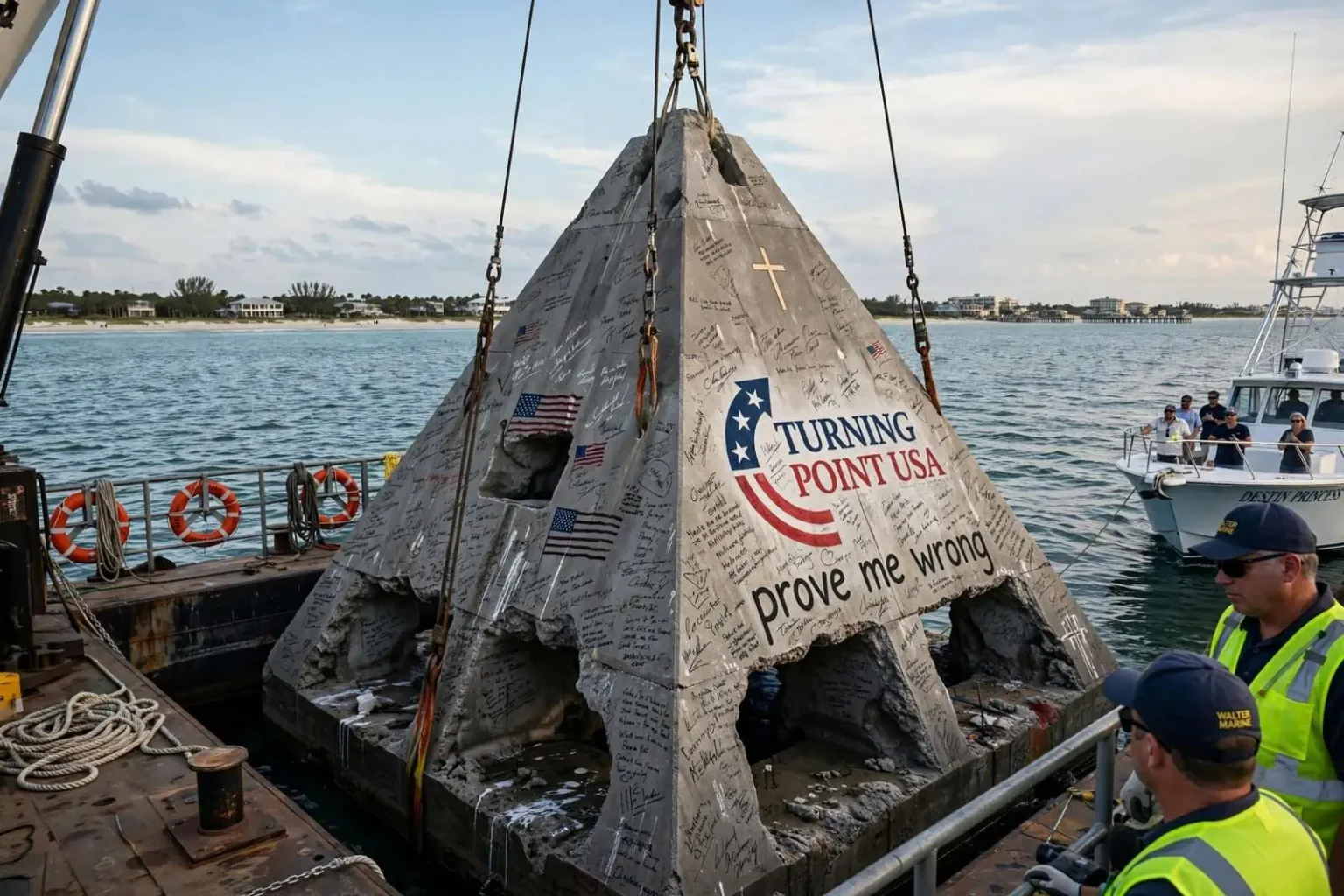
On Oct. 14, 2025 — Kirk’s birthday — supporters gathered at Walter Marine in Orange Beach to help decorate the freshly poured concrete that would form the sides of the reef. The build day drew participants who signed and inscribed the wet concrete before it hardened, making the finished structure something closer to a collective monument than an off-the-shelf reef module. The decorations include religious references, the logo of Turning Point USA, and the organization’s motto, “prove me wrong.”
“To me it’s our way of expressing from Destin, our respect for the man, honoring the man, and the person he was,” said Capt. Mike Parker, who led the memorial effort.
Parker said the project was expected to cost about $17,000, a sum raised to cover the concrete, the fabrication, the rigging, and the eventual offshore deployment. Artificial reef projects of this scale are not trivial undertakings: the structure must be built heavy enough to stay put on the bottom, stable enough not to shift in storms, and shaped to provide the kind of vertical relief and interior cover that Gulf fish prefer.
Stewart Walter of Walter Marine said the finished reef stands about 15 feet tall and weighs more than 17 tons. It is roughly pyramidal in shape, with openings and internal structures designed to give smaller fish places to shelter. That design reflects decades of hard-won knowledge among Gulf Coast reef builders: fish respond to complexity. A solid block offers little, while a structure with passages, ledges, and interior chambers can hold everything from baitfish to grouper and snapper.
Walter Marine has built and deployed artificial reefs across the Gulf for years, work that was featured in a 2013 reality show called “Reef Wranglers.” The Orange Beach company has long been a fixture of the regional reef-building world, and its involvement gave the Kirk memorial access to the specialized equipment and experience required to take a 17-ton concrete pyramid from a waterfront yard to the open Gulf.
Sinking Set for Wednesday
Plans call for the reef to be sunk off the coast of Destin on Wednesday, Aug. 19. The timing of the deployment depends in part on sea conditions, as barges carrying reef material need relatively calm weather to position the structure accurately on its permitted site. Once lowered to the bottom, the reef will begin its transformation immediately, with colonizing organisms arriving within weeks and the structure functioning as fish habitat well before its concrete surfaces fully mature.
At least one Destin-based charter company, Destin Princess and Destiny Party Boat Fishing, is offering rides for people who want to witness the sinking firsthand. The company operates party boat trips out of the Destin East Pass, and organizers of the memorial expected interest from anglers and supporters who wanted to be on the water for the moment the reef reached the bottom. Charter operators along the Panhandle often participate in reef deployments, both because the events draw customers and because the reefs themselves become long-term assets to the fishing fleet.
The distance between the reef’s construction and its final resting place is only a few dozen miles — Orange Beach to Destin runs along a stretch of coastline that shares the same Gulf waters and the same fishing community. But the project has spanned nearly a year, moving through design, fundraising, construction, curing, and finally the logistics of offshore placement. Deployments of this kind require coordination with regulatory agencies that permit artificial reefs, which set requirements for materials, marking, and location.
For the Destin group behind the effort, the deployment day is expected to carry both celebration and reflection. The project began in grief following Kirk’s September 2025 assassination, and those involved have described it as a way of turning loss into something lasting. The inscription-filled concrete, once underwater, will no longer be readable up close by most visitors, but the people who wrote on it a year ago will know where their words sit.
What Happens on the Sea Floor
Marine scientists who study artificial reefs describe a fairly predictable succession once a structure reaches the bottom. Within days, bacterial films begin forming on the concrete. Within weeks, algae and encrusting invertebrates such as barnacles and tunicates cover accessible surfaces. Small baitfish — pinfish, glass minnows, cigar minnows — arrive quickly, drawn to vertical relief in otherwise open sand bottom. As the community develops, reef fish species move in, and a structure like the Kirk memorial can hold red snapper, gray triggerfish, amberjack, and gag grouper, all species central to the recreational charter industry that drives Destin’s economy.
The pyramidal shape chosen for the reef is intentional. Vertically oriented structures with openings mimic natural ledge habitat, and the internal chambers give juvenile fish refuge from predators. At more than 17 tons, the Kirk reef has substantial mass, and its footprint on the bottom should be stable through storm seasons.
Concrete is a preferred reef material because its chemistry is compatible with seawater and its rough, porous surface gives settling larvae plenty of nooks to attach. Reef programs across the Gulf have deployed everything from decommissioned ships to bridge rubble to purpose-poured modules, and researchers generally find that structure — not the specific material — is what matters most to fish. A 15-foot-tall pyramid on open sand bottom changes the character of the neighborhood immediately.
The reef also joins a broader network. Anglers fishing off Destin already work a patchwork of public reef sites, and each new deployment adds a piece of habitat that will be visited, fished, and monitored for decades. State and county reef programs log deployments in public coordinates, and the Kirk memorial will take its place among them — a monument measured not in brass and stone, but in tons of concrete and the fish it holds.
Supporters say that is exactly what Kirk’s admirers in Destin wanted: something the community can return to, that grows more valuable with time, and that reflects the outdoor, saltwater character of the place they call home. Ten months after the wet concrete was signed in Orange Beach, the inscription-covered pyramid is finally going where it was always meant to go.
A Regional Tradition of Building Reefs
The Kirk memorial is the newest entry in a long regional tradition. Alabama’s artificial reef program, administered through the state marine resources division with federal partners, dates back decades and covers one of the largest permitted artificial reef areas in the country. The program’s success helped make Orange Beach and the surrounding area a destination for reef fishing, and private companies like Walter Marine grew alongside it, deploying everything from small concrete pyramids for private anglers to large vessel sinkings for public sites.
Across the state line, Okaloosa County and the city of Destin have their own deep history with artificial reefs. The waters off the Panhandle hold sunken ships, bridge spans, and thousands of concrete modules. Local reef associations and fishing clubs have long raised money and volunteered labor to put habitat on the bottom, and the partnership between public agencies, charter fleets, and private builders is a defining feature of how the Panhandle manages its nearshore and offshore fisheries.
That infrastructure is part of what made the memorial feasible. A group without prior reef-building experience would struggle to navigate permitting, fabrication, and deployment on its own. The Destin organizers instead tapped into an existing ecosystem of builders, fabricators, and charter operators — and Walter Marine, sitting just down the coast in Orange Beach, was a natural partner. The Oct. 14 build day turned what is normally an industrial process into a community event, with supporters doing the decorating work that made the reef unique.
The Days Ahead
With the sinking set for Wednesday, Aug. 19, the remaining work is logistical: loading, transport to the permitted site, positioning, and release. Deployment crews watch forecasts closely in late August, when summer thunderstorms and afternoon squalls can complicate operations on the water. If conditions hold, the reef should be on the bottom by the end of the day, and the charter boats carrying observers will likely linger to see the first fish arrive.
Anglers who book rides to watch the sinking will get a close look at how the process works — the barge, the crane or lifting gear, the slow descent as the structure floods and settles. For many, it will also be a chance to mark a spot they plan to fish for years. Reefs of this size often produce quickly, and the first trips to the new site will begin the process of learning what it holds.
The project’s cost — about $17,000 from start to finish — reflects the reality that even a single reef module involves real money and real coordination. Community fundraising covered the bill, and organizers have framed the expense as money well spent: a permanent tribute that costs nothing to maintain and gives back to the fishery with every passing season.
Kirk’s death in September 2025 remains a defining event for the organizations he built, and memorials to him have taken many forms across the country — campus chapters, scholarship funds, statues, and signage. The Destin reef stands out for its distinctly Gulf Coast character. It could only have come from a community where the sea is central to daily life, and where a fitting memorial is one that sits beneath the waves and holds fish.
By Wednesday evening, if weather permits, the decorated pyramid will rest on the sandy bottom off Destin, its “prove me wrong” motto and Turning Point USA logo facing out into the dark Gulf water. Marine growth will soften the inscriptions over the years, and the structure will become, in the fullest sense, a reef. For the people who built it, that transformation is the point — a memorial that lives, grows, and serves the community that created it.