Artur Davis Is Losing Democrats on Purpose, and Sam Jones Is Staying Anyway
The congressman's health care vote and his snub of black political organizations have infuriated Democrats. Mobile's mayor disagrees with both moves and says he is voting for him regardless.
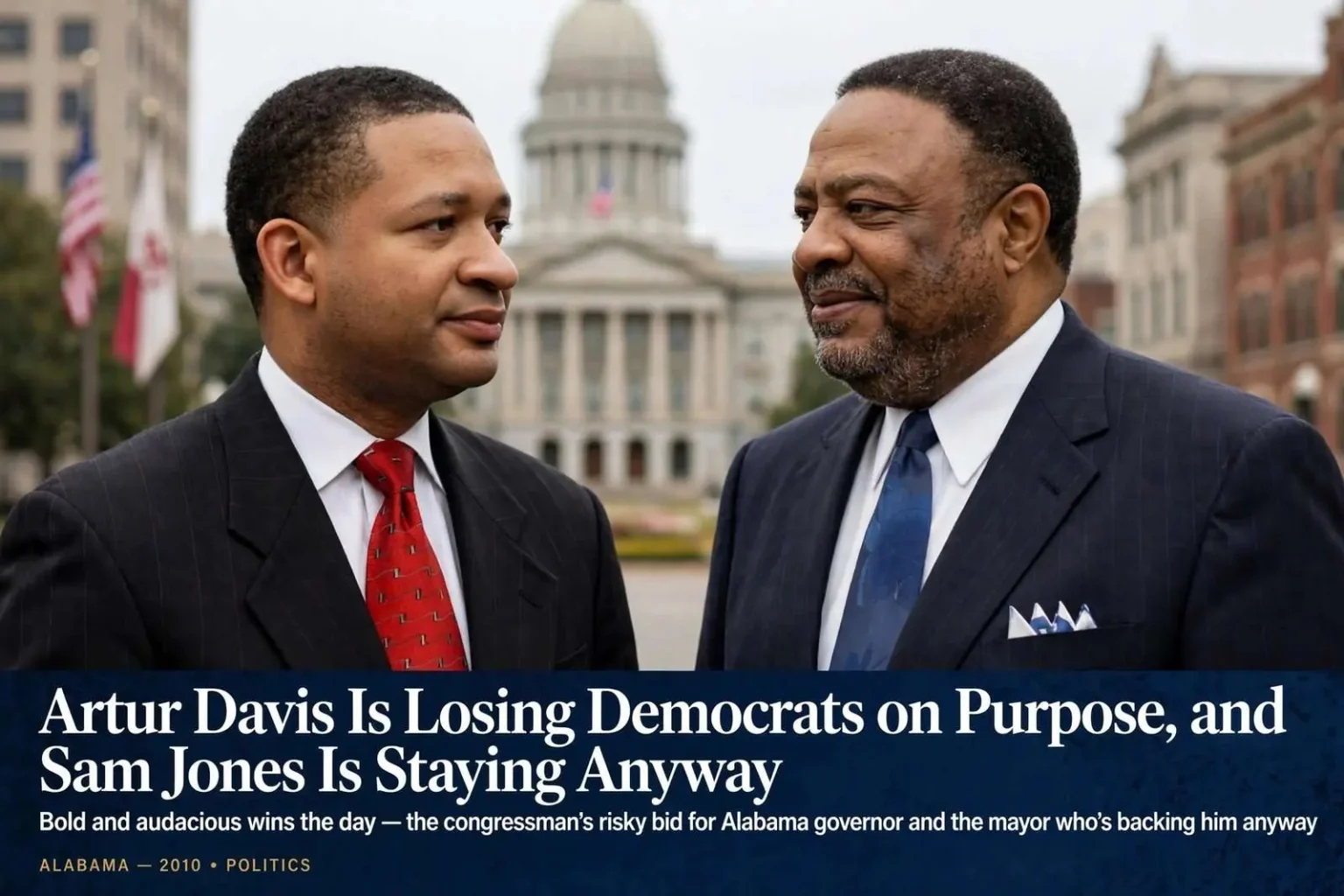
Bold and audacious wins the day. That, one suspects, is the calculation behind Artur Davis’ campaign to become Alabama’s first black governor — a bid that a traditional approach was never going to deliver. That scores of Democrats are angry with Davis appears to be part of the plan. It is an odd sort of plan, given that he is asking those same Democrats to make him their nominee. But it is not an accident.
Davis, the four-term congressman who represents Alabama’s 7th District — a swath of the Black Belt that stretches from Birmingham through Selma and down into portions of Mobile and Tuscaloosa — has spent two years building a campaign designed less to please the Democratic establishment than to leap over it. In a state where the party’s nomination has historically been settled inside a network of county committees, black civic organizations and courthouse regulars, Davis has chosen to run around that network rather than through it, on the theory that the general election in November will not be decided by the people who dominate the June primary.
The votes that made them angry
The congressman signaled early that he was not the Alabama Democrat his party was used to. He unseated his predecessor Earl Hilliard in 2002, toppling an incumbent whose ties to the old guard of black Alabama politics ran deep and whose defeat marked a generational changing of the guard in the 7th District. He served as state chairman of Barack Obama’s campaign in 2008 while the state Democratic establishment lined up behind Hillary Clinton. That one worked out: Obama carried Alabama’s Democratic primary decisively, and the outcome demonstrated that an insurgent organization could beat the traditional apparatus on its own turf.
The break that exposed the depth of the backlash was his vote against the Obama administration’s health care reform bill — a vote his critics regard as a betrayal of the principles and the people who gave him his platform. For a black congressman from Alabama to oppose the signature legislative achievement of the nation’s first black president struck many Democrats as more than a policy disagreement; it read as a declaration of independence from the coalition that produced him.
The defense is arithmetic. The bill passed. Davis’ vote was not needed in Washington, which left him free to cast it wherever it did him the most good in Alabama. House leaders had votes to spare on the final tally, and a southern Democrat facing a statewide electorate that remained deeply skeptical of the new federal health care law could plausibly argue that his constituents’ broader interests were better served by distance from it. He saw an opportunity and took it: the chance to present himself as a fiscally responsible, independent-minded centrist. Whether he is one is a question that will be settled over years, not months. For now, he can advance the appearance, and in a general election against a Republican, the appearance may be worth more than the record.
The snub that made them angrier
Davis has also refused to appear before the New South Coalition and the Alabama Democratic Conference to seek their endorsements — the two organizations that have historically shaped black turnout in Alabama Democratic primaries. The ADC, the umbrella group of black Democratic clubs founded decades ago to organize black voters across the state, and the New South Coalition, its close ally in candidate screening and endorsement, have functioned for a generation as the gatekeepers through which statewide Democratic hopefuls must pass. Their endorsement interviews are a ritual of every primary cycle; their sample ballots are distributed in churches and neighborhoods on the Sunday before every election, and in a low-turnout primary their imprimatur can be worth thousands of votes.
To Davis, not having their blessing is worth more than having it. A candidacy openly identified with the old organizations would confirm the Republican argument that a Davis governorship would be a return to the politics of the past. Skipping the interviews, by contrast, lets him run as something new — even if it means absorbing the organizations’ opposition.
His opponents in the primary, led by Agriculture Commissioner Ron Sparks, are hammering him for betrayal, cowardice and political expediency. Sparks, the Southeast Alabama Democrat who has won statewide office twice, has positioned himself as the candidate of the traditional coalition, courting the ADC and New South votes that Davis is spurning and attacking the congressman for spending his career looking past the party that elected him. His campaign appears content to absorb the blows in the hope that voters otherwise drawn to Republicans Bradley Byrne or Robert Bentley will look again and reconsider their assumptions.
The strategy boils down to a trade: Davis would rather beat Sparks 54-46 in June and have a real chance in November than beat him 61-39 in June and lose badly in the fall. A landslide nomination powered by the party’s liberal base, the thinking goes, would hand the Republican nominee a ready-made attack ad. A narrow win built on crossover appeal would at least leave him standing on terrain where a general election campaign is possible — a real consideration in a state where no Democrat has won the governor’s office since 1998 and where the Republican nominee, whether Byrne or Bentley, will start with structural advantages in the suburban counties that have drifted rightward for two decades.
Which brings us to the mayor
Mobile Mayor Sam Jones endorsed Davis months ago with considerable ceremony at the Battle House, the restored downtown hotel that has become the setting for the city’s most prominent announcements. Davis had been a valuable ally in Mobile’s campaign to win the U.S. Air Force refueling tanker contract for Brookley Field — a fight the region ultimately lost, but one in which Davis used his seat in Congress and his standing with the Obama White House to lobby on the city’s behalf. Jones supported the health care bill. He disagrees with the snub of the ADC and New South. He is voting for Davis anyway.
“I endorsed Artur and I think when you endorse somebody you have given your word and that’s it as far as I’m concerned,” said Jones.
“I certainly don’t agree with his position on (snubbing of) New South and ADC,” the mayor said. “They are very viable organizations in this state and serve a very viable purpose. I don’t quite understand his position with them, but I guess he has the right to run his campaign the way he sees fit. In my judgment it is a political error. But he is running his own campaign and I don’t have any say in that. I would think anyone in the state of Alabama would understand how vital these organizations have been for voter registration, voter education and voter turnout.”
“Let me put it this way,” Jones added. “I’m going to vote for Artur. As I look at it, in the political arena, once you give your word, that’s it.”
The mayor’s position is a studied middle course. He will not defend the strategy, and he says so in terms that leave no ambiguity about where his own sympathies lie — with the civic organizations that registered and mobilized the voters who elected him. But neither will he withdraw the endorsement that he says he treats as a matter of his own word and honor. In a campaign season full of Democrats renouncing Davis, Jones has chosen to criticize him and stand by him at the same time.
The bet
Jones is a political veteran who understands that a campaign and a governorship are two different games. You have to win the first one to play the second. Davis is betting that the price of alienating his base in June is worth the credibility it buys him in November. Whether Alabama Democrats will let him make that trade is the question on the June 1 ballot.
The gamble’s logic rests on some uncomfortable arithmetic for the party. Alabama’s Democratic primary electorate has been shrinking for years as conservative and even moderate whites have drifted to Republican ballots, leaving a base that is overwhelmingly black and heavily concentrated in a handful of urban and Black Belt counties. A nominee chosen by that electorate must then introduce himself to a general election audience that looks very different. Davis’ answer is to blur that introduction by running against his own coalition now, in front of the general audience, rather than waiting until June is over.
Whether Alabama Democrats will let him make that trade is the question on the June 1 ballot. Unlike ADC Chairman Joe Reed and New South’s Hank Sanders, who have held back, Mobile’s mayor climbed aboard early — and, whatever his private misgivings, he has not climbed off. Reed and Sanders, whose organizations could still make an endorsement in the race or stay out of it entirely, have so far declined to commit to Sparks, a restraint that leaves open the possibility that Davis can win without converting his critics.
For Mobile, the episode carries a practical weight beyond the intrigue. The city has spent years cultivating relationships in Washington on matters — the tanker contract chief among them — that no single election can be allowed to jeopardize. Jones’ decision to keep his endorsement intact preserves the mayor’s line to the one Democrat most likely to hold federal office in the field, whatever happens on June 1 and whatever either man’s party thinks of it.
The June 1 primary will settle the question the old organizations thought was theirs to decide. If Davis wins, he will have demonstrated that an Alabama Democrat can reach a statewide nomination by walking past the gatekeepers — and the anger that scores of Democrats feel toward him will have been, precisely as designed, the cost of doing business rather than the price of defeat. If he loses, the establishment will read the result as proof that the network still decides, and the first black governor’s race in Alabama history will have ended as a case study in how much the state’s politics can and cannot change at once.