
ArtWalk 11/11/11: A Dozen Gallery Openings and a Day of Poetry Across Downtown Mobile
The 11/11/11 LoDa ArtWalk packed downtown Mobile with gallery openings, the Nudes in November show, a photo contest and all-day poetry readings.
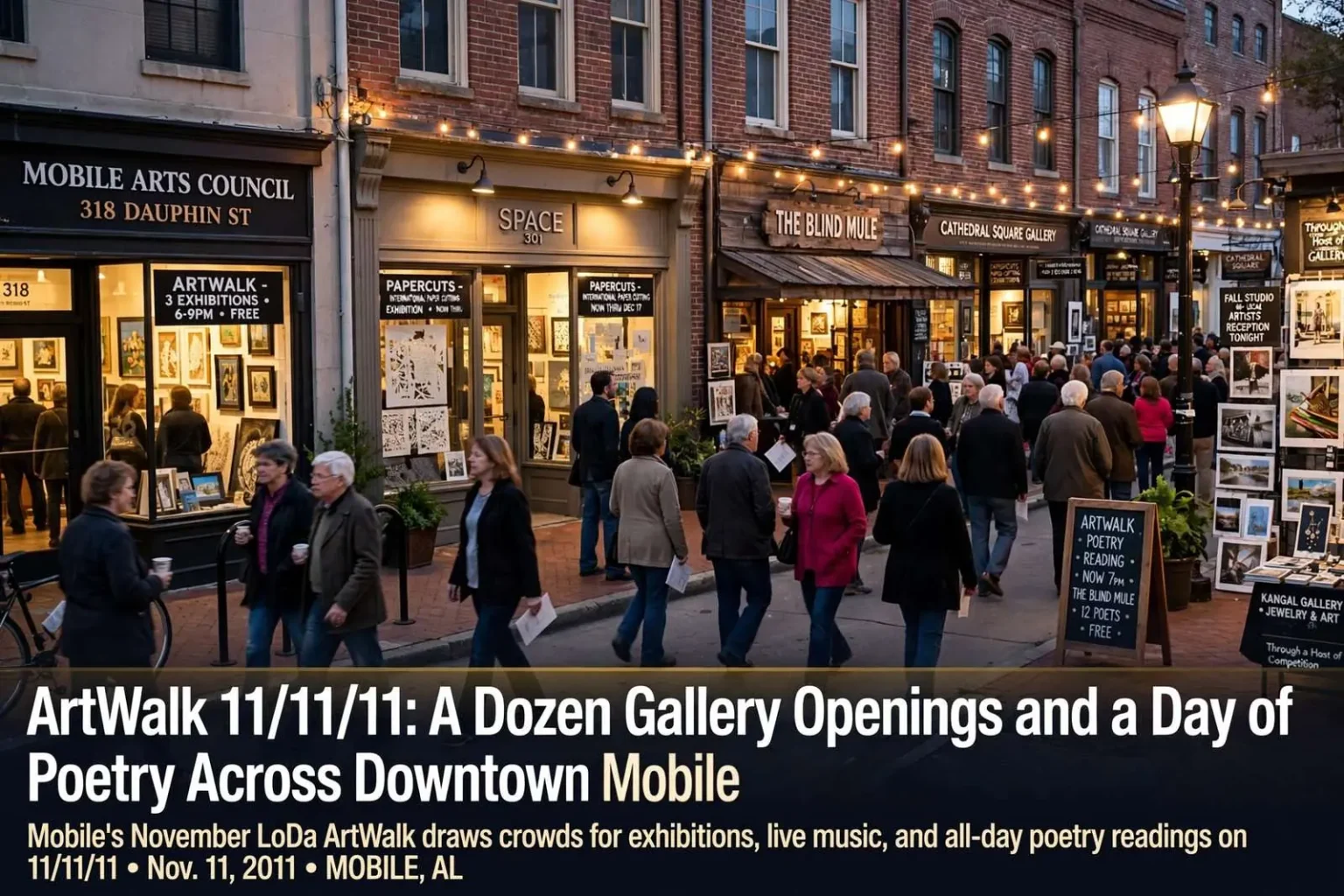
Mobile’s November LoDa ArtWalk, held Friday, 11/11/11 from 6 to 9 p.m., was one of the year’s fullest, with more than a dozen exhibitions and receptions along Dauphin and Conti streets plus an all-day poetry reading series organized by Rob Gray. The date itself — a once-a-century run of ones — gave the evening a promotional hook, but the sheer density of openings did the real work of pulling crowds downtown. Gallery owners and organizers had stacked the calendar deliberately, and visitors moving up and down the two blocks of Lower Dauphin that anchor the district could find photography, painting, installation, paper art, jewelry and live music within a few minutes’ walk of one another.
LoDa ArtWalk is the Mobile Arts Council’s signature monthly event, and evenings like this one explain its endurance. The format is simple: galleries, studios and businesses open their doors on the same evening, artists are present, and the street itself becomes the exhibition. What distinguished the 11/11/11 edition was scale. A dozen openings scattered across a walkable district meant that no single venue captured the whole crowd, and the energy shifted from a handful of anchor galleries to the street as a whole.
The Gallery Lineup
The Mobile Arts Council at 318 Dauphin Street paired Emily McMillan’s installation on the 1960s with works by Bertice, Heather and Joey McPherson and paintings and prints by Amanda Youngblood in a three-show reception running through December. The combination gave the council’s galleries both a thematic anchor and a survey of several local artists at once, encouraging visitors to move between rooms and compare approaches.
Space 301 kept “Papercuts,” the international paper-cutting survey curated by Reni Gower, on view through December 17. The exhibition brought cut-paper traditions from around the world to Mobile, demonstrating how a humble material and a blade could produce work of considerable intricacy, while the nearby Crescent Theater opened the Emile Hirsch film “The Way” for nightly screenings, extending the evening’s cultural offerings beyond the visual arts.
Cathedral Square Gallery’s “Fall Studio” reception showed acrylics and oils from more than 60 local artists, spotlighting Lynn Luna, Benita McNider, Roy Waters and Tutta Greer Cone. The gallery, situated near Cathedral Square in the historic district, functions as a cooperative outlet for area painters, and its fall reception is one of the largest group shows of the season — a single room where visitors can take the measure of the city’s whole painting community.
The Host Gallery staged its first annual fine-art photography competition, “Through a Host of Lenses,” announcing the winner at 7:15 p.m. to a packed house. Competition shows give emerging photographers a rare chance at wall space and a jury’s imprimatur, and scheduling the announcement mid-ArtWalk guaranteed an audience for the reveal. Artology marked its one-year anniversary with watercolor Mobile landmarks, coastal maps and guest artist Kathy Friedline — a milestone for a young gallery and a reminder of how quickly new venues had multiplied downtown.
Optera Creative debuted Christopher R. Murray’s “Graven Images” paintings, while KANGAL Gallery featured jewelry artist Helen Huppertz and painter B’Beth Weldon with live music from Jude Mansur. Lucy Gafford’s “Vacant” opened its doors to ArtWalk visitors as well, and Walter Beckham’s photographs from France and Italy hung at Edward Jones Investments. Josh Holland and Jordan Bramlett showed at The Blind Mule, Eileen Morrison decorated glasses outside the OK Bicycle Shop, and Blue Velvet Studio’s third annual “Nudes in November” figure-art show drew steady traffic at 709 Dauphin — by now a fixture of the November calendar and a reliable crowd-drawer for the studio.
Poetry From Morning to Night
The day’s poetry program made 11/11/11 unusual even by ArtWalk standards. Running from late morning until late evening across five locations, the series was organized by Rob Gray and gave the date a literary dimension that stretched far beyond the usual three-hour gallery evening. The readings began with students: poets from the University of South Alabama, University of Mobile, Spring Hill College and other schools read at Moulton Tower Amphitheater at 11 a.m., putting emerging writers on a public stage in one of the university’s most recognizable outdoor settings.
In the afternoon, Satori Coffee House hosted eleven poets at 3 p.m., including Sue Walker, Susan Martinello and Sonya Bennett. Walker, a longtime figure in Mobile’s literary community and a former poet laureate of Alabama, anchored a lineup that mixed established voices with newer ones — exactly the blend that keeps a reading series alive. Coffeehouse readings carry a different texture than gallery openings: shorter attention distances, quieter rooms, and an audience that came specifically to listen rather than wandering in off the street.
The Blind Mule closed the day with a dozen readers at 5 p.m., repeating the program at 7 and 9 p.m., featuring Jeff Goodman, Bruce Alford and Carol Case among others. The repetition was a practical accommodation to ArtWalk traffic — visitors who wanted both the galleries and the poetry could catch a second or third sitting — and it kept the restaurant’s back room busy through the evening, with each session drawing its own mix of regulars and walk-ins.
Why the Night Mattered
Nights like 11/11/11 are how a mid-sized city’s arts district builds an identity. The combination of a dozen visual arts venues, a film opening, live music and a full day of poetry created a case for downtown Mobile as a cultural destination rather than a scattered collection of shops. The concentration also matters economically: visitors who come for one reception stay for dinner, drinks and a second gallery, and the regular rhythm of ArtWalk Fridays gives restaurants and bars a dependable monthly surge.
For the artists, the value is different. A single evening can put a painter’s work in front of more people than a month of ordinary gallery hours, and the variety of venues — from the institutional Mobile Arts Council to a bicycle shop’s front window — means there are entry points for artists at every stage. The 11/11/11 edition demonstrated the format at close to full capacity: more than a dozen exhibitions, five reading locations, and crowds that moved between them all evening.
By 9 p.m., when the official ArtWalk hours ended, the last poetry session at The Blind Mule was still underway and gallery lights along Dauphin and Conti were clicking off one by one. The date’s novelty would not repeat for a century, but the template it showcased — a dense, walkable, multi-arts evening organized around a single street corridor — had become a monthly fact of life in Mobile, and November’s edition stood as one of the strongest arguments yet for the district’s momentum.
The District Behind the Night
The stretch of downtown that hosted all of this activity is the product of two decades of deliberate rebuilding. Lower Dauphin — shortened by locals to LoDa — takes its name from the lower section of Dauphin Street, the axial thoroughfare of Mobile’s historic grid, and by 2011 it had become the de facto arts and entertainment corridor of the city. A scattering of galleries, artist studios, the Crescent Theater’s independent film screens, restaurants and bars occupy buildings that were, a generation earlier, largely vacant storefronts. The Mobile Arts Council’s presence at 318 Dauphin gave the corridor an institutional anchor, while newer spaces like Artology and Optera Creative showed how quickly a healthy district could absorb experimental ventures.
That mix of old and new is part of what made the November 2011 ArtWalk representative of the district’s character. Cathedral Square Gallery represented the older cooperative tradition — dozens of member artists sharing sales space and staffing receptions. Space 301, operating in a converted printing building, represented the larger-scale exhibition model able to host a curated international survey like “Papercuts.” The Host Gallery’s juried photography competition and Blue Velvet Studio’s annual figure show represented the entrepreneurial tier, venues that build their own audiences through recurring signature events. A visitor could walk the corridor in an hour and see three distinct models of how local art gets made and sold.
Poetry’s Place in the Festival
The all-day poetry series organized by Rob Gray deserves particular attention because it connected Mobile’s literary community to the visual arts crowd in a way few ArtWalks had managed. The program’s architecture — student readers at Moulton Tower in the late morning, a mid-afternoon session at Satori Coffee House, and evening sessions at The Blind Mule — traced a line through the day that mirrored the city’s geography of writing and study. The University of South Alabama, University of Mobile and Spring Hill College all maintain active writing programs and student literary communities, and their readers rarely appear in front of a general downtown audience. An amphitheater reading at 11 a.m. put them there.
The afternoon and evening sessions flipped the balance toward established poets. Sue Walker, Susan Martinello and Sonya Bennett at Satori, then Jeff Goodman, Bruce Alford and Carol Case leading the repeated programs at The Blind Mule, gave the series professional weight, while the twelve-reader format of the Blind Mule sessions kept individual sets short and the program moving. Repeat seatings at 5, 7 and 9 p.m. acknowledged the practical rhythm of an ArtWalk night — audiences arrive in waves, dine in between, and return.
A Calendar Worth Copying
For organizers in other cities, the lesson of Mobile’s 11/11/11 was less about the novelty date than about density and layering. A dozen visual arts venues open simultaneously will outdraw any single gallery’s opening night, and adding a parallel program in another discipline — in this case poetry running from morning to night — extends the event’s footprint without competing for the same wall space. The five-location poetry circuit used venues that were, in some cases, also showing art, so the audiences braided together rather than splitting.
The November date also benefited from its position in the seasonal calendar. It fell after the summer lull and ahead of the holidays, when galleries do a meaningful share of their annual sales and residents are looking for outings that include gift browsing — jewelry at KANGAL Gallery, decorated glassware, prints and photography all fit that impulse. Exhibitions opened that night, including the three-show reception at the Mobile Arts Council and “Papercuts” at Space 301, were scheduled to run through December precisely to catch that traffic. As the crowds thinned near 9 p.m. and the final poetry session wrapped at The Blind Mule, the evening had made its case: downtown Mobile, on the right Friday, could stage a cultural night equal to anything in the region.


