Ascension Health Mandates COVID-19 Vaccine for All Employees by November
Ascension Health, including Providence Hospital in Mobile and Sacred Heart in Pensacola, will require all employees to get the COVID-19 vaccine by November.
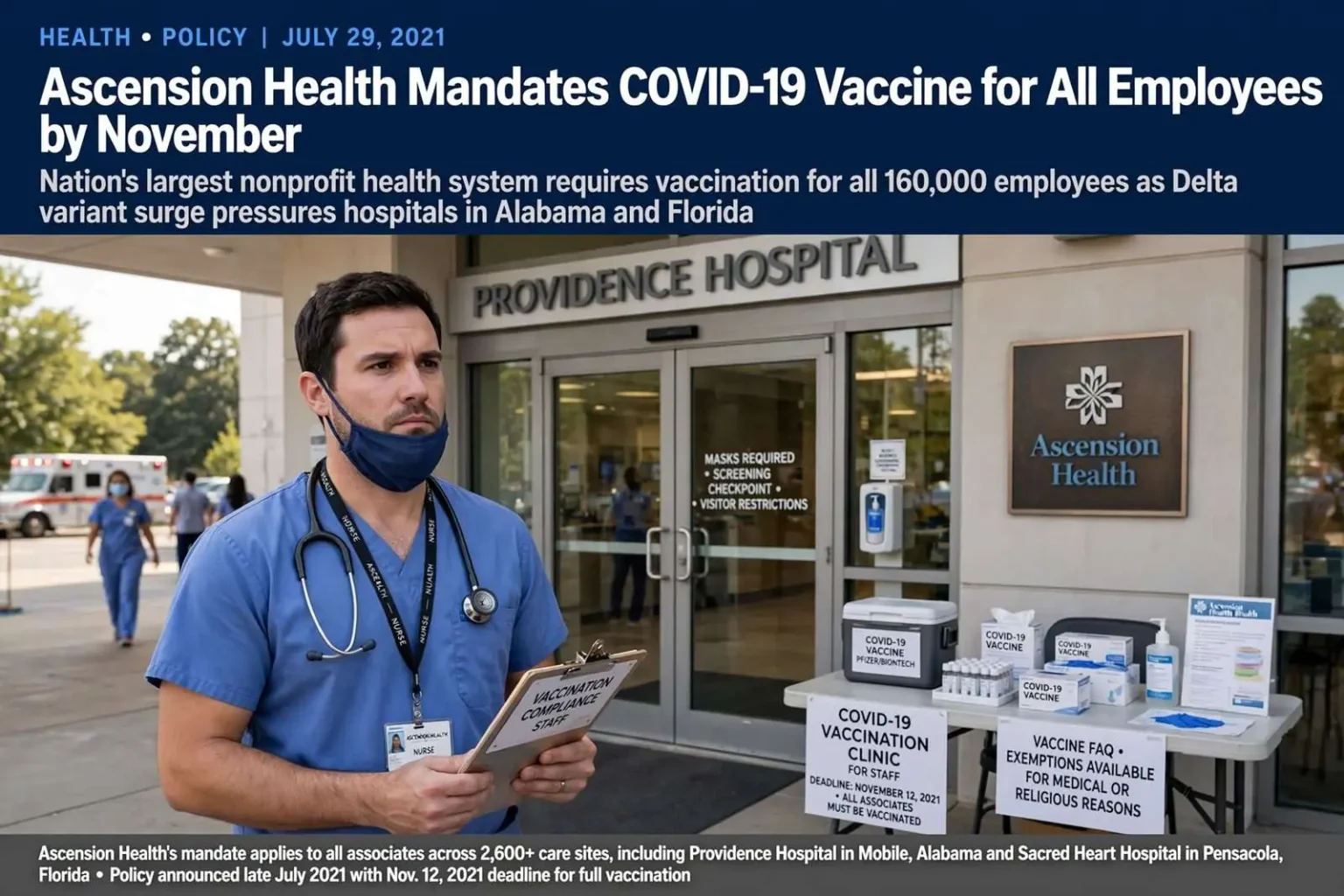
Ascension Health, the national hospital system that includes Providence Hospital in Mobile and Sacred Heart Hospital in Pensacola, announced in late July 2021 that all associates would be required to receive the COVID-19 vaccine, making it one of the first major health systems in the country to impose a blanket mandate on its workforce during the summer’s Delta surge.
The mandate, announced via a statement on the company’s website, applies to all associates regardless of whether they provide direct patient care or work onsite or remotely. The company set a deadline of November 12, 2021, for all employees to have completed the vaccine series, giving workers across the system’s hospitals and clinics roughly three and a half months to comply.
Ascension Health is one of the largest nonprofit health systems in the United States, operating more than 2,600 sites of care across the country. Its decision rippled far beyond its own payroll: when an employer of that size mandates vaccination, competitors, partner hospitals and rural facilities that share staff with Ascension facilities all face a changed landscape on what had been, for much of the pandemic, a voluntary matter.
A decision shaped by the Delta variant
The move placed Ascension among a growing number of major health systems and hospital networks requiring employee vaccinations during a period when the highly contagious Delta variant was driving a new wave of infections nationwide. By late July 2021, the variant accounted for the overwhelming majority of new cases in the United States, and hospitalizations were climbing fastest in states with low vaccination rates — a list that included both Alabama and Florida, the two states where Ascension’s Gulf Coast facilities operate.
Earlier in the pandemic, many hospital leaders had hesitated to mandate the vaccine, citing its authorization status and uncertainty about workforce response. The Delta variant changed that calculus. With vaccinated healthcare workers nonetheless capable of transmitting the virus to vulnerable patients, and with beds filling in communities where spread was rampant, systems that had spent months encouraging vaccination began requiring it, framing the mandate as the latest step in infection control rather than a policy revolution.
In Mobile, where Providence Hospital serves as one of the city’s primary medical centers, the announcement came as Alabama was experiencing a sharp rise in COVID-19 cases. The state had one of the lowest vaccination rates in the country at that time, making the employer mandate a notable development for healthcare workers in the region. Hospitals in Mobile were admitting new COVID patients daily, and the strain on staffing was becoming a story of its own as nurses and respiratory therapists moved between systems or left bedside care altogether.
What the mandate required
Under the policy, associates were to complete the vaccine series by the November deadline, with the system indicating that limited exemptions for medical reasons or sincerely held religious beliefs would be considered through its usual accommodation process. The requirement covered employees at every level and in every setting — clinicians, support staff, administrative workers and those working from home — a scope that distinguished Ascension’s policy from systems that mandated vaccination only for patient-facing staff.
The company said the policy was grounded in its commitment to the health and safety of patients and staff, noting that the vaccines had been shown to be safe and effective at preventing severe illness and hospitalization. That framing mirrored the position of national medical organizations, which by mid-2021 were calling on healthcare employers to require vaccination for the workforce most likely to be exposed to the virus.
Why healthcare workers were the focus
The logic of mandating vaccination in hospitals was different from the logic in offices or factories. Healthcare workers face constant exposure to infected patients, which makes them both more likely to catch the virus and more likely to spread it to the people least able to survive it — the elderly, the immunocompromised, the newborns and the chronically ill who fill hospital beds. A vaccinated workforce lowers the chance that the hospital itself becomes a site of transmission, a failure mode that haunted institutions early in the pandemic when infected staff unknowingly carried the virus onto units.
There was also the practical matter of keeping the doors open. The Delta wave hit hospitals precisely when their staffing was thinnest, and unvaccinated employees who fell ill took themselves out of the schedule at the worst possible moment. A mandate, on this reasoning, was not only an infection-control measure but a workforce-protection measure: every employee vaccinated before the fall surge was one less clinician likely to be out sick during it. Hospital administrators who made the case for mandates in the summer of 2021 leaned heavily on that point, describing vaccination as seasonal readiness rather than politics.
The mandate also aligned the system with the direction of federal policy, which was moving toward requirements for healthcare settings as the year progressed. For an organization with facilities across multiple states, getting ahead of a patchwork of state and federal rules carried its own appeal, and the November deadline gave Ascension time to complete compliance before winter, when respiratory season would stack influenza on top of whatever the coronavirus did next.
What it meant for the Gulf Coast workforce
For the thousands of people who work at Providence in Mobile and Sacred Heart in Pensacola, the mandate turned an individual decision into an employment condition. Some welcomed it: healthcare workers had spent more than a year at elevated risk, and many saw the vaccine as overdue protection for themselves, their colleagues and their patients. Others pushed back, and healthcare systems across the country fielded questions about exemptions, timelines and whether employees who declined would lose their jobs.
The region’s timing made the stakes concrete. Alabama’s vaccination rate lingered near the bottom of national rankings through the summer of 2021 even as the Delta wave pushed hospitals toward capacity, and Pensacola’s Escambia County faced a similar surge on the Florida side. Ascension’s Gulf Coast facilities were part of the safety net absorbing that wave, which meant the mandate applied to the very workers most likely to encounter the virus — and most needed at the bedside if cases kept climbing.
Hospital leaders also weighed the risk of losing staff to the policy. Systems that mandated early generally reported that only small percentages of employees ultimately declined, with a wave of last-minute vaccinations ahead of each deadline. Whether the same pattern held at Ascension’s Alabama and Florida hospitals would only become clear as the November 12 deadline approached, but the math facing the organization was straightforward: a workforce outbreak or a staffing shortfall were both worse outcomes than a hard policy conversation.
The broader shift in healthcare
Ascension’s announcement landed in the middle of a summer that transformed vaccine requirements across American healthcare. Throughout July 2021, one system after another moved from encouragement to requirement — first for medical staffs, then for all employees — as the Delta variant erased the hope that voluntary uptake would end the pandemic. Houston Methodist had become the first major system to mandate in the spring and weathered legal challenges to it; others followed as the fall approached.
For workers weighing the decision, the employer mandate changed the practical question. Surveys through the period showed that a share of unvaccinated employees who said they would refuse on their own nonetheless got the shot when a deadline made vaccination a condition of continued employment. That dynamic — the mandate as tiebreaker — was precisely what public health officials pointed to when they urged large employers to act.
What came after the announcement
The months between the late-July announcement and the November deadline became a period of education and accommodation across the system. Hospitals scheduled vaccination clinics for staff, human resources offices processed exemption requests, and managers worked through the questions of employees who had hesitated — questions about fertility rumors, side effects, and the speed of the vaccines’ development. By the time the deadline arrived, the policy had become part of ordinary operations: one more credential, like a flu shot or a tuberculosis test, required before an associate could work.
For Mobile and Pensacola, the significance of the announcement outlasted the deadline. The region’s hospitals had spent the Delta summer making triage decisions and staffing emergency rooms around a preventable wave of illness, and the largest employer on the local healthcare scene had decided that its response would be mandatory rather than voluntary. Whatever individual associates thought of the policy, Ascension’s Gulf Coast facilities entered the fall of 2021 with one of the clearest answers in the region to the question of whether healthcare workers would be vaccinated — and with a November 12 date by which the answer would be settled.