Atmore man struck, killed by 18-wheeler on South Main Street
A 31-year-old Georgia man was struck and killed by a commercial truck on South Main Street in Atmore, police said.
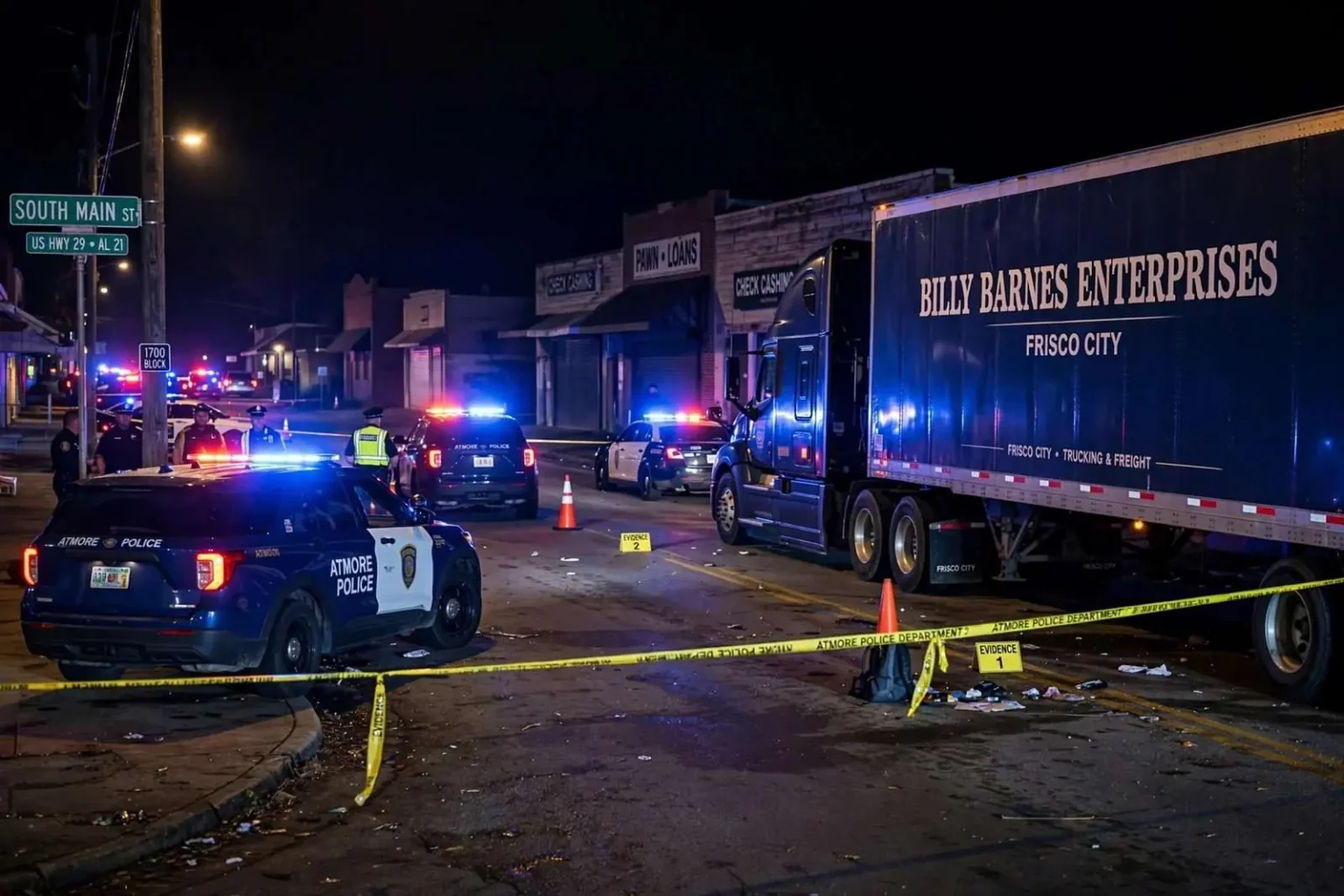
A pedestrian was struck and killed by a commercial tractor-trailer in Atmore early Friday, police said. The Atmore Police Department reported that officers responded around 1:19 a.m. to the 1700 block of South Main Street — a stretch of the roadway that carries U.S. Highway 29 and Alabama 21 through the heart of the city — after a report of a pedestrian hit by a truck owned by Billy Barnes Enterprises of Frisco City. The pre-dawn timing and the location along one of Atmore’s busiest corridors combined to make the scene a difficult one for responders working in darkness.
When officers arrived, they found a man’s body beneath the trailer and pronounced him dead at the scene. There was nothing medics could do for the victim by the time units reached the location, and the investigation shifted immediately from a rescue to a reconstruction. Police Chief Chuck Brooks identified the victim as 31-year-old Clemente Terrance G. Sims of Iron City, Georgia. The crash remains under investigation, and authorities have not yet said what factors — speed, visibility, lighting, or the movements of the pedestrian and the driver — may have led to the collision.
South Main Street is one of Atmore’s primary commercial arteries, lined with businesses and crossed daily by a mix of local traffic and long-haul trucks moving between Interstate 65 and the Florida line. Roads of that character pose familiar hazards for pedestrians, especially overnight, when lighting is limited, traffic volumes are lower and vehicle speeds tend to rise. Commercial trucks, which need far more distance to stop than passenger cars, make those same stretches more dangerous still when a person is on or near the roadway.
The death adds Atmore to a grim statewide pattern. Alabama consistently ranks among the states with the highest per-capita pedestrian fatality rates, and small cities along highway corridors see a disproportionate share of those deaths. State and local officials have repeatedly urged both drivers and pedestrians to treat multi-lane corridors with particular care after dark — drivers by slowing down and scanning the shoulders, and pedestrians by using sidewalks and crosswalks where they exist, wearing visible or reflective clothing, and walking facing traffic when no sidewalk is available.
For the Atmore Police Department, cases like this one involve a methodical process. Investigators typically document the scene, measure the vehicles’ final resting positions, examine skid marks and debris fields, and canvass for witnesses or nearby surveillance video. Commercial vehicles involved in fatal crashes are also subject to inspection, with investigators reviewing the driver’s hours, the truck’s mechanical condition and the company’s records as part of the effort to determine exactly what happened in the moments before the impact.
Commercial trucking on the corridor
Billy Barnes Enterprises, the Frisco City company whose truck was involved, is among the logging and freight operations that run regularly through south Alabama’s highway network. Trucks of that type move tons of freight along routes like South Main Street every night, and the drivers who operate them share the road with pedestrians, cyclists and local traffic in communities that grew up around these highways long before modern safety standards. Fatal crashes involving commercial vehicles trigger scrutiny that goes beyond an ordinary wreck, with both police investigators and federal safety rules coming into play.
Commercial drivers involved in fatal collisions can face drug and alcohol testing under federal transportation regulations, and the truck involved is typically examined for mechanical faults — brakes, lights and tires chief among them. Investigators also work to establish the sequence of events: where the pedestrian entered the roadway, whether the driver had any opportunity to avoid the impact, and whether darkness or visibility played a role. The results of that work determine whether any charges are appropriate, though many such crashes end without citations when the evidence shows the driver could not have prevented what happened.
A life cut short, a family notified
Behind the investigation is a 31-year-old man whose family is now coping with a loss that arrived in the middle of the night. Sims was from Iron City, Georgia, a small community in the southwestern corner of that state, and how he came to be on South Main Street in the early hours of Friday has not been publicly detailed. Identifying a victim and notifying next of kin is among the most somber duties a police chief carries out, and Brooks did so publicly once the family had been reached.
Pedestrian deaths ripple outward in small communities in ways that statistics do not capture. Neighbors along the corridor wake to police lights, local drivers reroute around a closed roadway, and residents are reminded how quickly a routine night can turn fatal on a highway that doubles as a hometown street. In Atmore, where many residents live within walking distance of the businesses along South Main, the crash is a hard local lesson about the risks of being on foot near truck routes after dark.
Atmore and its highways
Atmore sits in Escambia County near the Florida state line, and its road network reflects its position as a crossroads of south Alabama. Highways 21 and 29 run through the city, connecting it to Pensacola to the south and the interior counties to the north, while Interstate 65 passes just to the west. That geography brings steady commercial traffic through town — logging trucks, freight haulers and passenger vehicles alike — and it makes corridors like South Main Street a constant balancing act between through-traffic and local life.
Cities in that position have long wrestled with pedestrian safety on their main roads. Many of Alabama’s smaller communities were laid out in an era when walking to town was the norm, and businesses, churches and homes still front directly on state highways. Adding sidewalks, lighting and crosswalks is an ongoing challenge for towns with limited budgets, and the consequences of falling short are measured in crashes like the one police are now investigating.
The Escambia County coroner’s office handles death notifications and records in cases like this, and the formal determination of the cause and manner of death will become part of the public record as the investigation proceeds. Police have not indicated whether any charges are expected, and investigators generally decline to discuss potential fault while the evidence is still being gathered. Findings in commercial-vehicle fatalities can take days or weeks, particularly when vehicle inspections and record reviews are involved.
What investigators will examine
In the coming days, the work on the 1700 block of South Main Street will move from the roadway to the report file. Investigators will reconcile witness statements with the physical evidence, review any camera footage from nearby businesses, and complete the inspections that federal rules require for the truck involved. The Atmore Police Department has said only that the crash remains under investigation, and any additional detail — including whether the driver will face charges — will come from the department as that work concludes.
For now, the facts established by police are stark. Around 1:19 a.m. Friday, a pedestrian was struck by a tractor-trailer on South Main Street; the victim, 31-year-old Clemente Terrance G. Sims of Iron City, Georgia, was pronounced dead at the scene beneath the trailer. A family in two states is grieving, a trucking company’s operations are part of an active investigation, and a community that shares its main highway with heavy traffic is once again confronting the cost when the two collide.
A recurring danger on rural main streets
Safety advocates have pressed for years for more attention to pedestrian deaths in the South, where warmer weather extends walking seasons, sprawling road designs encourage higher speeds, and many communities lack the sidewalk networks that protect pedestrians in larger cities. The National Highway Traffic Safety Administration’s figures have shown pedestrian fatalities climbing nationally over the past decade, and Alabama’s numbers have stood out even against that trend. Rural main streets that double as state highways are among the most common settings for those crashes.
Engineering fixes exist, but they cost money small cities do not always have. Improved street lighting, marked crosswalks with flashing beacons, reduced speed limits through commercial districts and dedicated pedestrian paths all make corridors like South Main Street safer, and grant programs through the state and federal governments periodically fund such projects. Until those improvements arrive, the burden falls on drivers and pedestrians alike to treat dark, high-speed corridors with the caution the environment demands.
Anyone with information about Friday night’s crash is asked to contact the Atmore Police Department, as investigators continue to piece together the sequence of events that claimed the life of a 31-year-old visitor to the city. The department has not announced a timeline for completing the investigation.